
How Plastic Pollution Actually Reaches Marine Life
From a bottle on a beach to the fish swimming past your mask: how plastic enters the ocean food web, what it may do there, and what science still does not know.
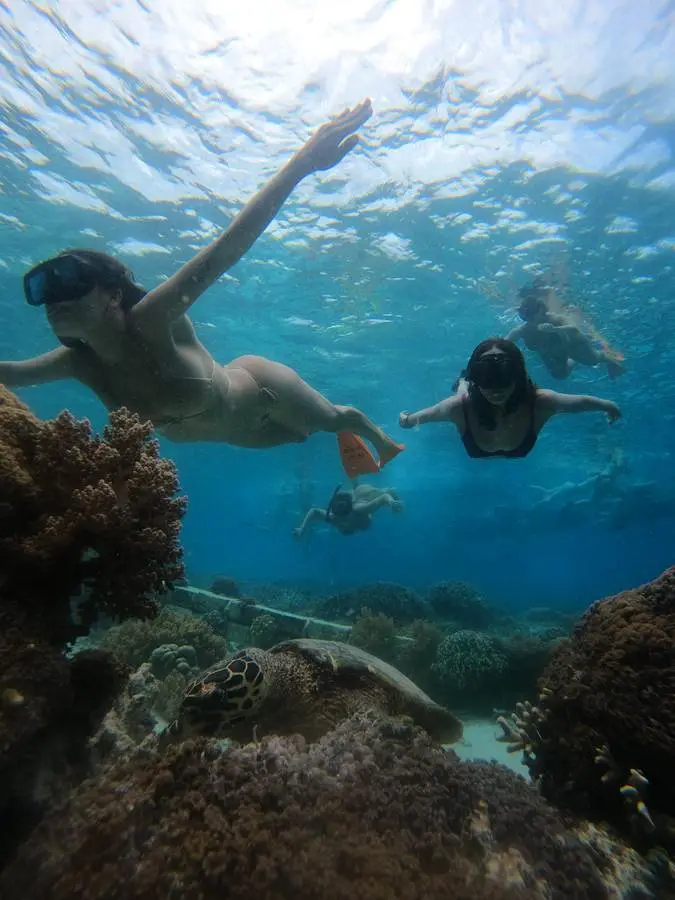
From a bottle on the beach to the fish past your mask
You are floating over a reef. A small fish picks at something in the water, then darts away. Was it plankton, or a tiny piece of plastic? You cannot tell, and very often the fish cannot either. That is the short answer to how plastic pollution reaches marine life: mostly through food. A whole object breaks into fragments, the fragments become small enough to look like a meal, and they travel up the food web from there. Following that path also explains why ocean plastic is so much harder to clean up than it looks.
It starts as something much bigger
Very little ocean plastic starts as the tiny particles most of us picture. It starts as bottles, bags, fishing line and packaging. Then sunlight (UV light), waves and rubbing against sand and rock break it slowly into smaller and smaller pieces. Pieces smaller than 5 mm are usually called microplastics, and the smallest, nanoplastics, are too small to see without a microscope. This slow breaking down is a big part of why plastic is so hard to remove once it is in the sea. One bottle can become thousands of pieces that no net or beach clean will ever collect.
A NOAA-funded study led by the U.S. National Park Service and Clemson University sampled sand at 37 national park beaches between 2015 and 2017. They found microplastics or microfibers at every single one. Microfibers, which mostly come from synthetic clothing such as fleece and reach the sea through wastewater, made up about 97% of the pieces counted. The authors call it a snapshot, one moment of sampling, and it covers U.S. park beaches, including Great Lakes shores, not the whole ocean. Still, it is a clear reminder of how common fibres are compared with the bottle caps and straws that usually end up in photos.
The base of the food web can't tell the difference
The first real entry point is not a fish eating a plastic bag. It is zooplankton, the tiny animals at the base of most ocean food webs. They meet particles the same size as their normal food and cannot always tell the two apart. NOAA's own education pages say it simply: when feeding, zooplankton may not be able to tell the difference between their usual food and these plastic pieces. Then the particles move up the food chain, as larger animals eat the zooplankton.
Researchers call this trophic transfer. A small animal swallows plastic. A slightly bigger predator eats several of those small animals, together with whatever they had swallowed. In theory, the amount of particles, and the chemicals stuck to them, can grow at each step up. But does plastic really build up (biomagnify) as it moves up the chain? That is less clear than it sounds. A 2025 study in Marine Pollution Bulletin passed polyester microfibers through a small reef food chain, from copepods to mysid shrimps to moon wrasse. The fibres moved up each step, but a build-up beyond what the prey carried showed only in the shrimp. A field study in British Columbia, Canada, found no link between how high a fish sits in the food web and how many larger microplastics it carried, and suggested that each species' biology matters more than its position. This is real, active research, not a settled number you can apply to every reef fish you see.
What happens once plastic is inside a fish?
A fish does not just carry plastic around like a backpack. NOAA notes that laboratory studies have shown microplastics and the chemicals in plastics may delay an animal's development, cause problems with reproduction, and even make it harder to fight off disease. Part of the worry is not only the plastic itself but what it carries. Microplastics can attract and concentrate other pollutants already in seawater. They can also release their own chemical additives, the ones first used to make the plastic soft or colourful, once they are inside an animal's body.
So the field evidence does not yet show one simple pattern for all species and places. NOAA itself is open that the science is still growing, and that more research is needed to understand exactly how animals are affected and how those effects spread through the food web. I think it is worth staying with that honesty, instead of making the story more dramatic than the evidence allows.
Why a reef makes this more visible, not more severe
None of this is special to coral reefs or snorkelling places. The same process happens in the open ocean, on coastal shelves and in deep-sea mud. What a reef does is make the food web unusually easy to see. Dozens of species feed at different levels within a few metres of clear water. A researcher studying deep-sea trenches has to work out plastic ingestion from samples pulled up in nets. A snorkeller can watch a parrotfish graze, a small predator hunt and a cleaner wrasse working on another fish's gills, all in the same few minutes, all part of the same food web the plastic travels through.
That visibility is part of why reef travel and simple awareness matter here, even though no single traveller will solve ocean plastic alone. It is also why we prefer to describe this plainly. The honest picture is "measurable, ongoing and not fully understood", not "every fish on the reef is full of plastic".
What actually reduces plastic in the sea?
The most useful personal actions are not glamorous. Cut single-use plastic from your own travel kit. Support places and operators that handle waste and wastewater properly. Do not add to the fragments with things like balloon releases or single-use bottles on a boat. A refillable bottle and a few reusable basics from a simple tropical travel kit cover most of a boat day, and a roll-top dry bag stops wrappers, phones and small things from blowing overboard. Because microfibers dominate beach samples, washing synthetic clothes less often, and in fuller loads, is another small step worth knowing, even if the evidence on how much it helps at sea is still developing.
None of this removes plastic already in the water, and no operator, including us, should claim it does. What it does is close the tap on a problem that always starts with a whole object, long before it is small enough to reach a fish's mouth.
If you want to see how this fits into the bigger picture of ethical ocean travel, our guide to ethical ocean travel goes further, and our guide to snorkelling without damaging coral covers the in-water side of the same conversation.
Questions people ask
How does plastic pollution reach marine life?
Mostly through food. Bigger items break into small fragments, zooplankton at the base of the food chain can mistake them for food, and predators that eat those zooplankton carry the particles further up the chain, as NOAA explains.
What are microplastics?
Plastic pieces smaller than 5 mm. Many come from larger objects breaking down in sunlight and waves. Others, like microfibers from synthetic clothing, are small from the start.
How common are microfibers on beaches?
In a NOAA-funded National Park Service study of 37 U.S. national park beaches (2015 to 2017), microplastics or microfibers were found at every beach, and microfibers were about 97% of the pieces counted. It was a one-time snapshot of U.S. beaches, not a global figure.
Does plastic build up in bigger fish?
The evidence is mixed. A 2025 lab study saw fibres pass along a small reef food chain but build up only in shrimp, and a field study in British Columbia found no link between a fish's place in the food web and its microplastic load.
Does microplastic harm fish?
Laboratory studies cited by NOAA show microplastics and plastic chemicals may delay development, affect reproduction and weaken disease resistance. NOAA also says more research is needed on what happens in the wild.
What can a traveller actually do?
Cut single-use plastic on your trip, choose operators who manage waste properly, and avoid things like balloon releases. None of this removes plastic already in the sea, but it reduces what goes in.
If this made you curious about meeting the ocean this way, you can explore our upcoming retreats.
Wildlife encounters are never guaranteed and never forced. Ocean Calling works only with vetted, ethical local operators, and every animal is free to approach, or not, entirely on its own terms.
Sources & further reading
- NOAA Ocean Service. Marine debris tutorial: microplastics and their impacts.
- NOAA Marine Debris Program. Quantification of microplastics and microfibers on U.S. national park beaches (National Park Service and Clemson University, fieldwork 2015-2017).
- NOAA Marine Debris Program. Microplastics on national park beaches (infographic).
- Miller et al., 2025. Trophic transfer of polyester microfibres across a multi-level marine food web. Marine Pollution Bulletin 221.
- Large size (>100 µm) microplastics are not biomagnifying in coastal marine food webs of British Columbia, Canada. Open-access paper, PubMed Central.
Further reading on Ocean Calling: More from the journal · Wildlife & the law · See the retreats · Ocean Atlas
Find the retreat that fits you
Small groups of up to six guests, unhurried days and local experts. Tell us how you feel in the water and we will point you to the right trip.