
What to Pack for a Red Sea Freediving Trip
Picture a Red Sea boat at midday: bright sun, sparkling water, everyone in shorts. Now picture the same deck at sunset in February, with wind and wet hair. Packing for a Red Sea freediving trip comes down to that contrast: sun protection for the day, real warmth for the evening and the water, and very little else.
Why a Red Sea freediving trip needs gear for heat and cold
Many people imagine the Red Sea as a desert coast that is simply hot. It is not that simple. Around Hurghada and along the Egyptian coast, the air temperature changes a lot between day and night, especially in winter. And the water is cooler than most people expect from a “tropical” trip. A bag packed only for the midday photo leaves someone shivering on the ride back.
So this list starts with the real numbers, then sorts everything by what it is for.
What are the real Red Sea temperatures, month by month?
Climate data for Hurghada gives a sea temperature of about 23°C in January and 22°C in February and March, the coolest months. The water warms through summer to about 28°C in August, the warmest month, then cools again to around 26°C in November and 24°C in December. Two different climate sources agree on these sea numbers, so I trust them as averages. One single day can, of course, be different.
The air is less consistent between sources. Winter daytime highs are around 21 to 22°C in January and February. The night lows are where sources disagree. One table gives minimums of about 11 to 13°C from December to February, another gives roughly 12 to 18°C. Either way, a winter evening with wind on a moving boat feels cold, especially after a session in 22°C water.
In summer it flips. Days are hot, the sun is strong, and the water is warm enough that some freedivers only need a thin suit. But even then, floating still at the surface between dives for a long session can chill you more than you expect.
For the sun and the heat
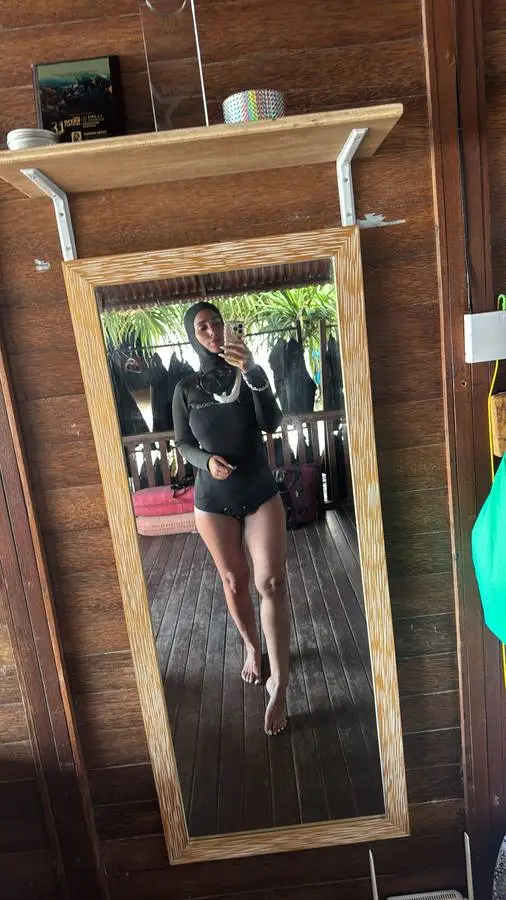
The midday sun on the Red Sea is intense, even with a breeze. On the boat, a wide-brim hat or a sun hood, sunglasses, and a long-sleeve UV layer for the hours between sessions do more than any cream. In the water, a long-sleeve rash guard or a thin suit protects your back while you float face down. That is when most people burn.
For skin that stays uncovered, choose a mineral sunscreen and read the ingredients, because “reef safe” is not a regulated term. Our mineral sunscreen picks is a starting point, but check for “non-nano” on any bottle. Put it on well before you board, not on a windy deck. A refillable water bottle helps too. Long, hot boat days are thirsty days.
For the cold, in the water and after dark
Bring a wetsuit that fits the season. In summer water around 28°C, a thin suit is often enough. In winter water around 22 to 23°C, most people want clearly more neoprene, and freedivers feel the cold during the long, still breathe-ups at the surface. Your instructor or operator can tell you what local divers wear that month. Ask before you go, because a suit that is too thin can end a session early.
After the water, you need a warm layer that does not mind being damp: a fleece or a windproof jacket, and maybe a warm hat for winter evenings. A towel poncho or a changing robe makes it easier to get out of a wet suit on a windy deck. If you are unsure between a wetsuit and a rash guard for a certain month, our wetsuit vs rash guard guide explains the trade-off.
The ethical layer: why the Red Sea deserves gentle fins
Part of what makes the northern Red Sea special for reef science is this heat tolerance. The Gulf of Aqaba, on the Sinai side, is now known as a possible climate refuge for corals, after the 2023 study by Kochman-Gino and Fine and the work that followed. But a reef that copes with heat is not strong against everything. Fins, hands, anchors and pollution are local pressures, and those are the ones we can control as visitors.
One quiet success story is the mooring network. HEPCA, an Egyptian non-governmental organisation, has built and maintained mooring buoys along the Egyptian Red Sea, so boats can tie up without dropping anchors on the reef. In its June 2026 report, HEPCA said 98% of the network was working after 470 buoys were inspected that month. It asks dive centres and visitors to report missing or damaged buoys. When you choose an operator, it is fair to ask if they always use the moorings.
In the water, the rule is simple: nothing touches the reef. Good buoyancy and calm finning matter more than any gear. Long freediving fins are efficient, but they are long, so keep an eye on your blades near coral. At Ocean Calling we work only with vetted local operators, in groups of six guests at most, and we never chase, touch or bait wildlife. And yes, flying to Egypt has a real carbon cost. Staying longer and moving less is one honest way to make the trip count. Our piece on what ethical diving looks like in Egypt’s Red Sea today goes deeper.
For the travel days
Egypt uses 220 volts at 50 Hz, and sockets are mostly type C (two round pins, the Europlug) and type F (the same round pins with side earthing clips). Travellers from much of Europe will not need an adapter. Others will. Check your chargers: most phone, laptop and camera chargers say 100 to 240 V and only need a plug adapter, but a device made only for 110 to 120 V needs a converter.
A power bank helps on long boat and transfer days, and a few packing cubes keep wet gear away from dry clothes. A small tropical travel kit with an adapter, cubes and a water bottle covers most of that in one place. For the boat itself, our guide to packing a dry bag that survives a boat day has the details.
What to leave at home
Leave very heavy cold-water gear at home unless your operator says otherwise. More neoprene means more weight to carry and more buoyancy to balance. Leave aerosol sunscreen too, because it is hard to apply evenly in the wind. And leave anything you might use to touch or move things underwater, like gloves for “steadying” yourself on the reef. You do not need them, and the reef does not want them.
A Red Sea trip rewards packing for both ends of the thermometer, not for the one number in the photos. Get that balance right, and the change from hot afternoon to cool evening becomes one of the nicest moments of the day. If this made you curious to meet the ocean this way, you can explore our retreats.
Questions people ask
How warm is the Red Sea for freediving?
Around Hurghada, climate data gives about 22 to 23°C from January to March and about 28°C in August, the warmest month. November is around 26°C and December around 24°C.
Do I need warm clothes for the Red Sea in winter?
Yes. Winter daytime highs are around 21 to 22°C, and night lows can drop to roughly 11 to 13°C according to one climate source. With wind on a boat after a wet session, a fleece or windproof layer is very welcome.
What plug adapter do I need for Egypt?
Egypt uses 220 V, 50 Hz, with mostly type C and type F sockets. Chargers marked 100 to 240 V only need a plug adapter. Devices made only for 110 to 120 V need a converter.
Are Red Sea corals resistant to heat?
Corals in the Gulf of Aqaba showed remarkable resilience to a record 2021 heatwave, and a later study found no mass bleaching over four summers to 2024. But researchers also saw new shallow bleaching, so this refuge may be near its limit.
How can I protect the reef on a Red Sea trip?
Never touch the reef, keep your fins under control, choose sunscreen carefully and cover up instead where you can. Ask your operator if they always use mooring buoys. HEPCA maintains a large mooring network along the Egyptian coast.
Wildlife encounters are never guaranteed and never forced. Ocean Calling works only with vetted, ethical local operators, and every animal is free to approach, or not, entirely on its own terms.
Sources & further reading
- HEPCA, 2026. June 2026 mooring system report.
- HEPCA. About us (the anchoring problem and the mooring programme).
- Kochman-Gino and Fine, 2023. Reef building corals show resilience to the hottest marine heatwave on record in the Gulf of Aqaba. Frontiers in Marine Science.
- Hebrew University of Jerusalem research portal, 2025. Gulf of Aqaba as a thermal refuge: four years of monitoring (2021 to 2024). Science of the Total Environment.
- Weather2Travel. Hurghada weather and sea temperature by month.
- Vialala. When to go to Hurghada (monthly temperature table).
- Trip.com. Egypt plug: types, voltage and plug adapters.
Further reading on Ocean Calling: Egypt's Red Sea reefs today · Red Sea vs the Philippines · More from the journal · Wildlife & the law · See the retreats · Ocean Atlas
Freediving certification in Bali: Amed, USAT Liberty wreck and Ubud
Freediving certification · Amed & Ubud, Bali, Indonesia
Ocean breath first, sacred water after. If this made you want to learn to freedive, this is our beginner-friendly course.