
Juani Island Turtles and Shark Bay Dugongs Are Not the Same
Two photographs of a turtle in green water can look like twins. One may be a channel off Juani, on the Tanzanian coast. The other may be the seagrass flats of Shark Bay. Treating them as one product is how rules get copied onto the wrong shore.
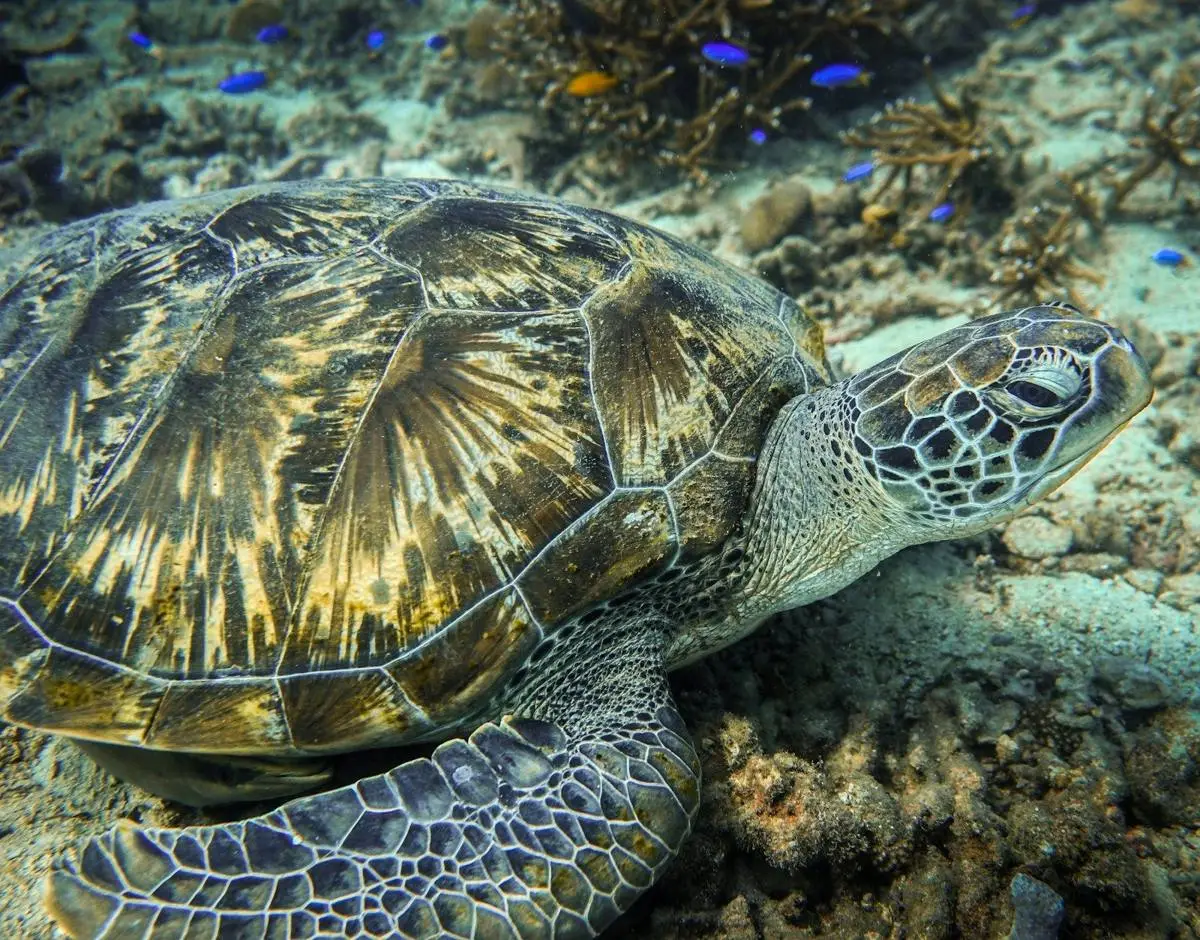
Are Juani Island turtles and Shark Bay dugongs the same kind of experience? No. They are two different places, with different water, different laws and a different way of visiting. Juani is an island in the Mafia archipelago in Tanzania. Shark Bay is a World Heritage area in Western Australia. Both hold turtles and sometimes dugongs, and that is where the likeness ends.
I write this because a booking page can use one photo to sell the other place, and a rule that is true in one lagoon is not true everywhere. So let me take each place in turn, say what I could verify, and say clearly where I could not.
Juani and the Mafia archipelago in Tanzania
Mafia Island Marine Park covers about 822 square kilometres and was created by law in 1995. The sources I found agree on both. Chole Bay, a large enclosed bay of more than 50 square kilometres, holds most of the park's dive sites, and travel guides describe its seagrass as a feeding ground for green turtles. Juani has forest around a medieval ruin, and Chole has its own Swahili and German-era ruins.
Turtles are the heart of the story. Travel sources say that green turtles nest on Juani's beaches roughly between June and September, and that a community monitoring programme works with local rangers. Another source credits the marine park, the local community and the group Sea Sense with a turtle conservation programme since 2001, focused especially on hawksbills. Sources disagree on how many turtle species use the area, from two threatened species to five, so I will not give a number.
Dugongs are the uncertain part. One travel guide says the dugong is thought to survive in the seagrass between Mafia and the Rufiji Delta, and a French guide calls it elusive. I found no recent survey that tells us how many there are. That is a good reason to treat a dugong here as a lucky moment and never as a plan.
Shark Bay is a different kind of place
Shark Bay is a UNESCO World Heritage property in Western Australia. Its listing names seagrass and dugongs among its exceptional natural features, and UNESCO describes the seagrass beds as the largest and richest in the world, at about 4,800 square kilometres. Another source gives almost 4,000, so the area depends on how it is measured.
The dugong figures are better known here. The original nomination estimated about 11,000 animals, and a summer aerial survey published in CSIRO's Wildlife Research returned 11,021, give or take 1,357. The Shark Bay tourism and conservation body says there are more than 10,000, about a tenth of the world population, while UNESCO-based sources say about 12.5 per cent. The shares differ because they use different world totals.
Dugongs also move with the seasons. The same survey found a seasonal movement linked to sea surface temperature, and tagging research suggests they avoid water colder than 18 degrees Celsius. So Shark Bay is a counted, studied population in a known system. Juani is not, and this is exactly why the two cannot share a brochure.
Why can you not copy wildlife rules from one shore to another?
A rule belongs to a place. In Tanzania, the park is run under national marine park law. There are the Marine Parks and Reserves (User Fees) Regulations of 2001, and the Mafia Island Marine Park (Prohibited and Regulated Activities) Regulations of 2006. I read the titles, not every clause, so I cannot tell you what they say about turtles. Zanzibar and Pemba have separate regimes again.
In Western Australia the rules come from state and park authorities. I could not confirm the official wording for dugong and turtle distances at Shark Bay. One local information site, which is undated and not a government source, advises slowing down around dugongs, turtles and whales, keeping at least 50 metres from dugongs and turtles, and 100 metres from whales. I would treat that as a hint, not a law. The Department of Biodiversity, Conservation and Attractions is the place to ask.
The lesson is plain: never carry a distance from one shore to another. Another Australian state, Queensland, has its own system, and we explain how it works for dwarf minke whales in our piece on holding the rope on the Great Barrier Reef.
When a photograph sells the wrong place
Ask a few quiet questions before you book. Where was this picture taken? Which park or authority sets the rules there? Is the animal even likely in the month you travel? Does the operator say, in writing, what happens when the turtle or dugong does not appear?
Entry fees are a small, real example. Recent sources give the Mafia marine park fee as around 24 US dollars per person per day, paid by everyone whether they dive or not, and the government has said it would review it. Older regulations list other amounts. The sources conflict, so check the current fee with the park office.
Our own page on dugongs as a sea cow we hope to meet by luck says the same thing about the animals: no one can promise one. And our planning piece on Mafia Island in Tanzania shows how we think about the island.
Conservation: nests, nights and hands-off
A nesting beach is a nursery, and the rule is the same on every coast: leave the sand to the animals. Keep lights and flash off at night, give a nesting turtle space, and never lift a hatchling for a photo. We explain why in how baby turtles should reach the sea.
Community monitoring matters here. The rangers who count nests are the ones who know when a beach is busy. If you meet a ranger or a local guide, listen first. Pay the park fee, and ask your skipper to keep to the channel and away from seagrass.
Flying to East Africa is a real environmental cost, and I do not hide it. A long, slow stay in one place is kinder than a quick tick on a list.
What we will and will not do
Ocean Calling will not sell Juani as Shark Bay, or Shark Bay as a quiet add-on to an East African week. We keep the names on the map. We do not run a retreat at either place, and we never feed, bait or chase wildlife anywhere.
A low-volume mask and snorkel and a rash guard are simple things that make a shore snorkel easier. They are not what makes a day good. A calm skipper and a patient morning do that.
If you would like to travel to the ocean with us, slowly and with honest rules, you can look at our small-group retreats. You can also read about the region in the Tanzania Atlas and the Australia Atlas.
Questions people ask
Are there dugongs at both places?
Dugongs are reported at both, but in different ways. Shark Bay has a counted population of roughly 10,000 or more. For Juani and Mafia, I found only travel-guide statements that dugongs are thought to survive, and no recent survey. We do not guarantee a sighting at either.
Can I copy Shark Bay distances onto Juani?
No. Read the Tanzanian park and village rules for Juani, and the Western Australian rules for Shark Bay. One local Shark Bay information site suggests 50 metres from dugongs and turtles, but it is undated and unofficial.
When do turtles nest at Juani?
Sources say roughly June to September for green turtles. Timing can shift, and I could not check the official monitoring data. Ask the park or your local guide.
Do I need to pay a park fee at Mafia?
Entry fees apply to everyone, whether you dive or not. Recent sources give about 24 US dollars per person per day, but figures conflict and a review was discussed. Check with the park office.
Is Juani inside the marine park?
I believe the Chole Bay and Juani area belongs to the Mafia archipelago and its marine park, but I did not find a boundary map. Ask the park office which rules apply to your exact beach.
Can I swim with dugongs in Shark Bay?
I did not find an official Western Australian rule that I could confirm, so I will not say. Ocean Calling does not sell it. Any operator offering it should show you a permit.
Wildlife encounters are unpredictable. Snorkelling near turtles and dugongs should always follow local regulations and experienced professional guidance. Encounters are never guaranteed and never forced. Ocean Calling works only with vetted, ethical local operators, and every animal is free to approach, or not, entirely on its own terms.
Sources & further reading
- Tanzania Marine Parks and Reserves, 2006. Mafia Island Marine Park (Prohibited and Regulated Activities) Regulations, GN 129 (TanzLII)
- Tanzania Marine Parks and Reserves (User Fees) Regulations, 2001, GN 232 (TanzLII)
- The Citizen (Tanzania), Entrance fees at Mafia Marine Park to be reviewed, says government
- UNESCO World Heritage Centre, Shark Bay, Western Australia (documents)
- UNESCO World Heritage Centre, Shark Bay World Heritage document
- Summer survey of dugong distribution and abundance in Shark Bay reveals additional key habitat area. CSIRO Wildlife Research
- sharkbay.org, Shark Bay dugongs (tourism and conservation information)
- Shark Bay local information site, boating guidance (undated, not an official source)
- Tanzania Odyssey, Travel guide to Mafia and Chole Island
- Tanzania Tourism, Turtle hatchling, Mafia Island
- Lonely Planet, Mafia Island Marine Park
Further reading on Ocean Calling: Tanzania in the Atlas · Australia in the Atlas · Dugongs and luck · Upcoming retreats
Gili Trawangan: turtles, statues and a reef that grows back
Snorkelling retreat · Gili Trawangan, Lombok, Indonesia
Turtle reefs and reef restoration, 8–14 June 2027. If you love turtles, this retreat is on reefs where they live.