
A Sperm Whale Birth Off Dominica: How the Group Helped
A newborn sperm whale has one urgent first job: reach the surface for air. Off Dominica, researchers recorded other females helping it do just that.
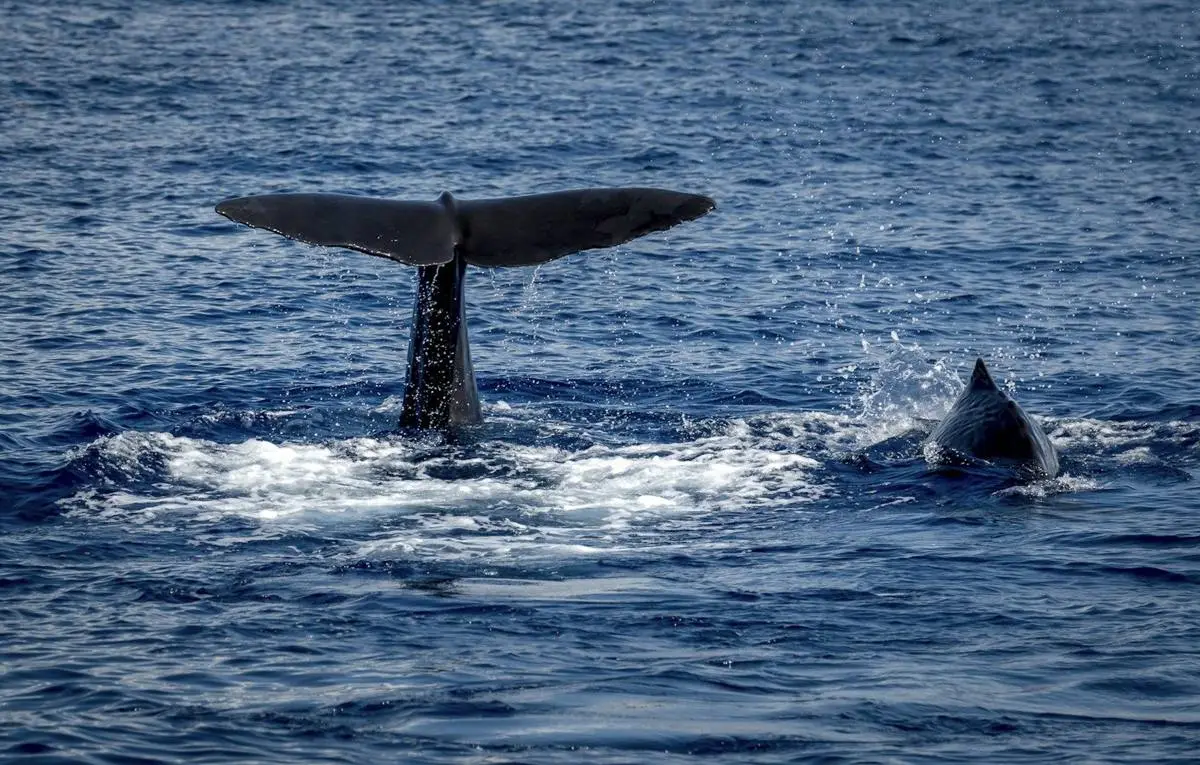
Picture the first seconds of a whale’s life. A calf the size of a small car, in open water, needing air right now. What happened at this sperm whale birth off Dominica? Female whales from the mother’s social group, and from another group, helped lift the calf to the surface. Researchers recorded it all.
The birth happened in 2023, and the detailed studies were published in March 2026. The researchers combined drone video, underwater audio, photographs and long-term observations from the Dominica Sperm Whale Project.
What did the whales actually do?
In the Science paper, researchers used video analysis to measure how much help there was during the birth. Females took turns supporting the newborn at the surface. Some of the helpers were not close relatives of the mother.
A companion paper in Scientific Reports describes the birth in detail. It reports changes in the click patterns, called codas, around key moments. These included the start of labour and meetings with short-finned pilot whales after the birth.
The footage makes the moment easy to feel. The science helps us say more precisely what happened.
Is this “midwifery”?
It is tempting to call it that. A better description is cooperative birth assistance. Other whales supported the newborn and took part in the event. The researchers argue that cooperation between whales that are not related may help explain why sperm whale society is so complex.
But one observed birth does not prove that every sperm whale birth follows the same pattern. It also does not show what the whales intended. The researchers documented behaviour, and our human labels should stay careful.
Why Dominica mattered to the discovery
The whales off Dominica have been studied for years. That gave researchers a rare combination: a moment captured with modern tools, and a social group whose members were already known. The long-term record placed the birth inside relationships that a one-off encounter could never show.
That is the quiet power of long-term wildlife research. A dramatic few minutes can answer more questions when you know who the animals are and what they have been doing for years.
What happens after the first breath?
A sperm whale calf depends on its mother and its social group. The footage is a reminder that these are not lonely giants drifting through a blue backdrop. They live inside social networks that can include lasting family and clan relationships.
The next time someone says the ocean is silent, remember that under the surface the whales were clicking through one of the most important moments of a calf’s life. There is something humbling about watching a newborn whale find the surface with help from a whole group. Read more on our sperm whale page.
Questions people ask
When did the birth take place?
The birth happened in 2023. The detailed studies were published in March 2026.
What did the researchers use to study it?
They combined drone video, underwater audio, photographs and long-term observations from the Dominica Sperm Whale Project.
Did the click patterns change?
The Scientific Reports paper reports changes in codas around key moments, including the start of labour and meetings with short-finned pilot whales after the birth.
Does this prove all sperm whale births work this way?
No. One observed birth does not prove that every birth follows the same pattern, or what the whales intended.
Wildlife encounters are never guaranteed and never forced. Ocean Calling works only with vetted, ethical local operators, and every animal is free to approach, or not, entirely on its own terms.
Sources & further reading
- Gero et al. (2026), “Cooperation by non-kin during birth underpins sperm whale social complexity,” Science.
- “Description of a collaborative sperm whale birth and shifts in coda vocal styles during key events,” Scientific Reports.
- Project CETI / Dominica Sperm Whale Project, publications.
Further reading on Ocean Calling: Dominica in the Ocean Atlas · Sperm whale in the Ocean Atlas · Ocean Atlas · Sperm whales in Dominica
Swim with humpback whales in Moʻorea: an ethical whale retreat
Whale encounter retreat · Moʻorea, French Polynesia
Time in the blue, on the whales’ terms. September 2027. If you love whales, this is our whale retreat: small group, slow pace, on the animals’ terms.