
Sperm Whale Birth Off Dominica: Why Families Gather
The most moving part of a sperm whale birth off Dominica may also be the most useful for science: the mother was not alone.
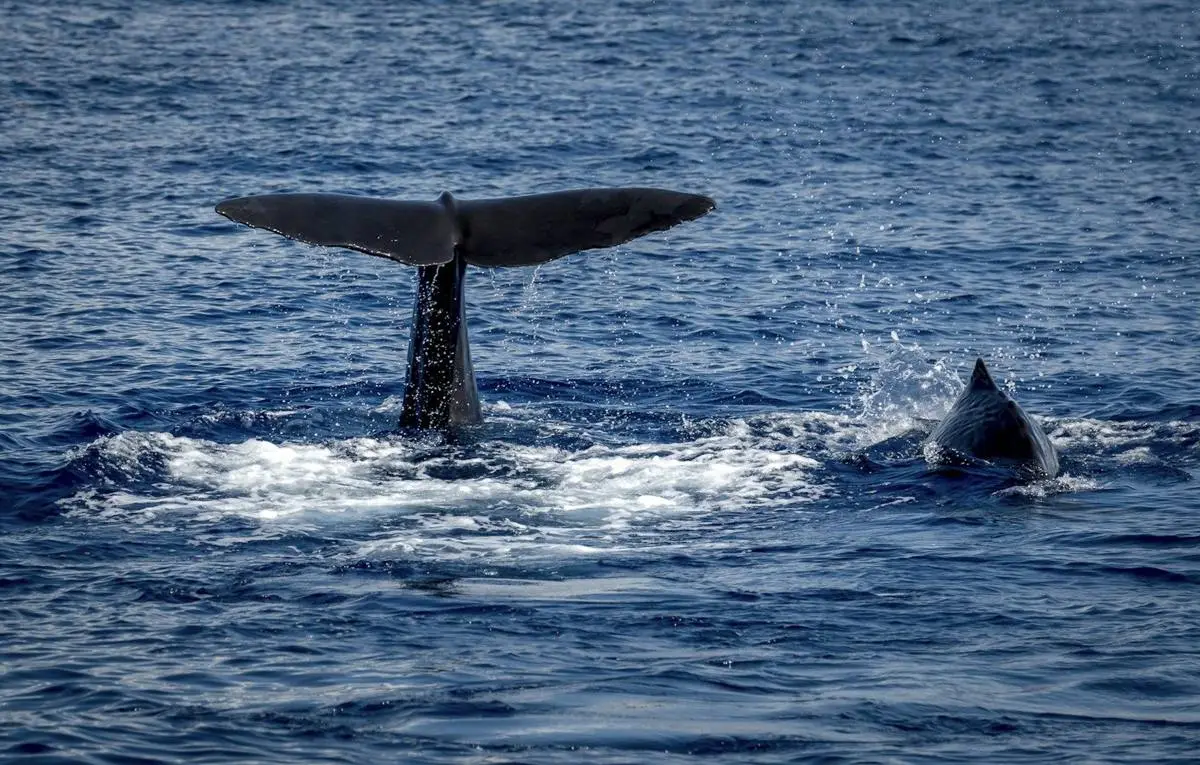
Picture a newborn sperm whale, only minutes old, at the surface. Around it, adult females take turns pushing it up so it can breathe. That is what researchers saw off Dominica in 2023. In March 2026 they published a careful analysis of it, and the short answer is this: the females shared the work of supporting the calf, and some of the helpers were not even from the mother's own family line. They belonged to another matriline.
What counts as help?
The researchers studied high-resolution drone footage together with long-term records about these whales. They tracked where each whale was and what it did during the birth. Then they used computer vision and network analysis to measure how the help was shared.
This matters because we humans are very good at seeing a story in animal behaviour. A calf being lifted looks tender, and maybe it is. But science needs a description of what can be seen first. The paper measures coordinated support. It does not claim to know what each whale felt.
A second paper, in Scientific Reports, describes the same event in detail. It found that the whales' click sequences, called codas, changed around key moments of the birth.
Why would a whale help another whale's calf?
The Science paper looks at how this kind of shared care could add to the social complexity of sperm whales. If animals help others beyond close family, the benefit may come back later, through group life, shared protection or future cooperation. These are possible evolutionary explanations. They are not a reading of what the whales intended.
It is also one documented birth. It cannot tell us how common this is across all sperm whale populations. Scientists will need more observations to see which parts of the behaviour repeat.
How a long record made a rare moment readable
The birth happened off Dominica, where researchers have followed sperm whales for many years. Because they already knew the individuals and their relationships, the team could ask who was there and how the helpers were connected.
Without that history, a video would only show several whales around a calf. With it, the footage becomes a way to test ideas about social units, vocal clans and cooperation.
The part visitors should remember
A whale family is not an attraction that owes us a close pass. A research team recorded this moment with special methods and permissions. It is not an invitation for visitors to fly drones, approach a newborn or crowd a group.
These whales were doing something remarkable without an audience. We can be moved by the footage and still give wild whales the space to care for each other. Their story is still unfolding, and the best thing we can do is protect the quiet, connected lives that make it possible. Wildlife encounters are unpredictable. Whale watching should always follow local regulations and experienced professional guidance.
To learn more about these deep divers, visit our sperm whale page in the Ocean Atlas.
Questions people ask
When did the birth happen and when were the studies published?
The birth was recorded in 2023. The detailed analysis was published in March 2026.
Were the helpers all close relatives of the mother?
No. Some helpers belonged to another matriline, so the help was not limited to the mother's closest family.
Does this show that all sperm whale births work this way?
No. This is one documented birth, so it cannot show how common the pattern is. More observations are needed.
Why do scientists think whales might help non-kin?
The Science paper suggests shared care could add to sperm whale social complexity, with possible benefits through group life, shared protection or future cooperation. These are possible explanations, not proof of intent.
Wildlife encounters are never guaranteed and never forced. Ocean Calling works only with vetted, ethical local operators, and every animal is free to approach, or not, entirely on its own terms.
Sources & further reading
- Gero et al. (2026), “Cooperation by non-kin during birth underpins sperm whale social complexity,” Science.
- “Description of a collaborative sperm whale birth and shifts in coda vocal styles during key events,” Scientific Reports.
- American Museum of Natural History, research summary.
Further reading on Ocean Calling: Dominica in the Ocean Atlas · Sperm whale in the Ocean Atlas · Sperm whales in Dominica · Dominica’s sperm whales and ship noise
Swim with humpback whales in Moʻorea: an ethical whale retreat
Whale encounter retreat · Moʻorea, French Polynesia
Time in the blue, on the whales’ terms. September 2027. If you love whales, this is our whale retreat: small group, slow pace, on the animals’ terms.