
How to Choose an Ethical Dive Operator
Two dive shops sit on the same beach. Same reef, same boats, almost the same price. One will protect that reef while you dive it, and one will slowly wear it down. An ethical dive operator is the first kind: small groups, guides who correct divers in the water and not only at the briefing, no touching or feeding wildlife, and honest answers before you pay.
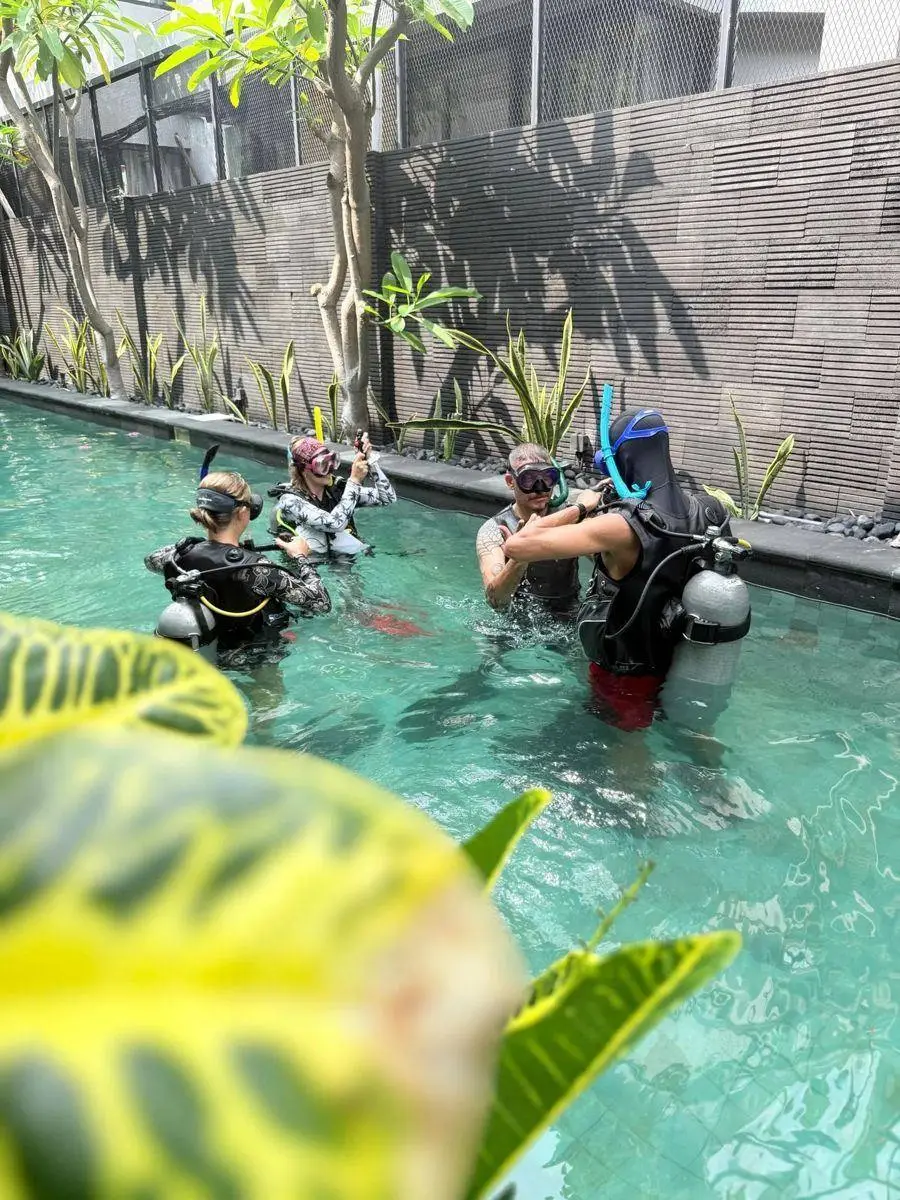
From the street, the two shops look exactly the same. The difference lives in small habits you only see once you are underwater. And by then, you have already booked. So this guide is about seeing those habits a little earlier.
What does an ethical dive operator actually do differently?
"Ethical" is a soft word, so let us make it concrete. In practice it means a short list of things done every single day, not only when a guest is watching.
- Groups are small enough that the guide can really see each diver.
- Briefings explain buoyancy, fin position and distance from wildlife, not only "please don't touch".
- Guides step in, kindly, when a diver is about to kick or grab the reef.
- Marine life is watched, never chased, handled, baited or fed.
- Boats use mooring buoys or anchor on sand, never on coral.
- Instructors have realistic schedules and real rest, because a tired guide watches less.
Most of the time, an ethical dive operator is simply a normal dive operator that refuses to cut the small corners that make a day cheaper or faster.
Why a briefing alone is not enough
There is an old study from Egypt that many dive professionals still quote. In 1997, Medio and colleagues watched divers in Ras Mohammed National Park, in the Sinai. Before a short environmental briefing, divers touched the reef about 1.4 times per diver in a seven-minute observation. After the briefing, it dropped to about 0.4. Contacts with living coral fell from 0.9 to 0.15. A good start, and an encouraging one.
Then a later study in St Lucia, in the Caribbean, found something less comfortable. Barker and Roberts (2004) followed 353 divers for whole dives. A one-sentence request in the standard briefing, asking divers not to touch the reef, had no measurable effect on how often they touched it. What did work was the dive leader stepping in underwater. When a guide corrected a diver who was touching the reef, contact rates dropped, for example from about 0.3 to 0.1 contacts per minute.
So here is the honest summary. A real briefing can help. A token briefing does almost nothing. What changes behaviour most is a guide who is close enough, and calm enough, to correct you in the moment. That needs time and attention, and attention needs small groups.
Group size, cameras and the attention of one guide
The same St Lucia study found that divers carrying cameras touched the reef more often than divers without them: about 0.4 contacts per minute, compared with 0.1. Shore dives and night dives also had more contacts than boat dives and day dives. None of this is a reason to ban cameras or night dives. It is a reason to understand where a guide's attention is needed most.
A camera pulls your focus into a tiny screen, and your fins quietly drop out of your awareness. A guide with two or three divers can notice that. A guide with ten, on a tight schedule, mostly cannot. When you compare operators, the number of divers per guide is one of the simplest and most honest signals you will get.
If you want to bring a camera, be truly comfortable with your buoyancy first. A low-volume mask that fits well also helps: less fiddling, more attention for the reef around you.
Green Fins: an independent reference point
It is hard to judge an operator from a website, so an outside standard helps. Green Fins is one of the best known. It started in 2004 under the UN Environment Programme, and today it is led by the UK charity The Reef-World Foundation in partnership with UNEP.
Green Fins has a 15-point code of conduct aimed at the most common and damaging effects of diving and snorkelling, from diver contact with the reef to anchoring, fish feeding and waste. Trained assessors visit members, usually once a year, score their day-to-day practices and give advice on how to improve. In this scoring system, a lower score means a lower environmental impact.
Two honest caveats. Many careful operators are not members, often simply because Green Fins is not active in their country. And membership does not promise a perfect day. But if an operator is a member, someone independent has looked at how they work, and that tells you more than most marketing can.
Wildlife, sunscreen and the small things on the boat
Some of the clearest signals appear on the boat, before anyone gets wet. Listen to how the crew talks about the animals. If they promise you a turtle, a shark or a manta "guaranteed", be careful. Wild animals do not keep appointments, and operators who guarantee them sometimes use food to make it happen. Feeding changes how animals behave, and we never support it.
Sunscreen is another quiet signal. NOAA's Coral Reef Conservation Program says many common UV filters in sunscreen have negative effects on coral reefs and other aquatic life, with oxybenzone and octinoxate as the best-known examples. These chemicals reach the sea both from swimmers and from wastewater. In 2018 Hawaiʻi became the first US state to ban the sale of sunscreens containing those two filters, and places such as Palau have restricted more. Scientists still debate how much bans alone can help, and rules keep changing, so check the current rule before you travel.
The simplest answer is to need less sunscreen in the first place: a long-sleeved rash guard, a hat on the boat, shade between dives. When you do use some, a mineral sunscreen is worth choosing with the ingredient list in your hand. We go deeper in our reef-safe sunscreen guide.
What your choice can and cannot do
Let me be honest about the limits. Choosing an ethical dive operator will not stop ocean warming, and it will not cancel the carbon of the flight that took you to the reef. Travel has a real environmental cost, and pretending otherwise would not be fair to you or to the ocean.
What your choice can do is still real. It decides whether the boat drops its anchor on coral or on sand. It decides whether a guide has the time to stop a fin before it breaks a branch. It decides whether the local money from your trip rewards careful work or careless work. Reefs already under pressure from heat and storms have very little room for extra, avoidable damage, and divers are one of the few pressures that can change in a single afternoon. If you want to see what one anchor can do, read what happens to a reef when anchors drop in the wrong spot.
How we choose operators at Ocean Calling
We work only with vetted local operators, and our hosted retreats keep groups to a maximum of six guests, so a guide always has room to watch, explain and slow down. Nobody is ever pushed into a dive, and any guest can skip any activity without giving a reason. We never chase, touch, bait or feed wildlife, and we never promise an encounter.
When we vet an operator, we ask the same questions as in the box above. We watch how the crew briefs and moves underwater, and we listen to how they talk about the reef and about their own team. If you are planning on your own, our list of questions to ask a dive operator before booking and our guide to choosing a dive operator as a solo traveller go into more detail. For a boat day, a roll-top dry bag keeps your phone and papers dry while you are in the water.
Choosing well does not mean being perfect. Mostly it means asking a few calm questions and trusting what the answers tell you. If this made you curious about diving with us, you can explore our retreats.
Questions people ask
What is an ethical dive operator?
An operator that keeps groups small, gives real briefings, corrects divers underwater, uses mooring buoys or sand for anchoring, and never touches, chases, baits or feeds wildlife. Being honest that sightings are never guaranteed is part of it too.
Does a dive briefing really protect the reef?
It depends on the briefing. A 1997 study in Ras Mohammed, Egypt, found that a proper environmental briefing cut reef contacts from about 1.4 to 0.4 per diver in seven minutes. A 2004 study in St Lucia found a one-sentence "please don't touch" had no measurable effect, while guides correcting divers underwater did reduce contacts.
What is Green Fins?
An environmental standard for dive and snorkel operators, started in 2004 under the UN Environment Programme and now led by The Reef-World Foundation with UNEP. Members follow a 15-point code of conduct and are assessed, usually every year, by trained assessors.
Do underwater cameras damage reefs?
Cameras themselves do not, but in the St Lucia study divers with cameras touched the reef more often, about 0.4 contacts per minute compared with 0.1 for divers without. Good buoyancy first, and a guide who watches, make the difference.
Is a "guaranteed sighting" a good sign?
Usually not. Wild animals cannot be guaranteed. Operators who promise them sometimes rely on feeding or baiting, which changes animal behaviour. An honest operator tells you what is possible, not what is certain.
How many divers per guide is reasonable?
We did not find one international number that all agencies use, and local rules differ, so ask the operator directly. On our hosted retreats, groups are never more than six guests, so a guide can really watch each person.
Wildlife encounters are never guaranteed and never forced. Ocean Calling works only with vetted, ethical local operators, and every animal is free to approach, or not, entirely on its own terms.
Sources & further reading
- NOAA Coral Reef Conservation Program. Effects of ultraviolet filters in sunscreen on corals. NOAA CoRIS.
- Stateline (Pew), 2019. Some sunscreens may kill corals. Should they be banned?
- Medio, D. et al., 1997. Effect of briefings on rates of damage to corals by SCUBA divers. Biological Conservation 79: 91 to 95.
- Barker, N. and Roberts, C.M., 2004. Scuba diver behaviour and the management of diving impacts on coral reefs. Biological Conservation 120: 481 to 489 (UK research outputs record).
- PANORAMA Solutions (IUCN/UNEP partners). Green Fins: an approach to managing a sustainable diving industry.
- Coral Triangle Center. Sustainable tourism: Green Fins.
Further reading on Ocean Calling: More from the journal · Questions to ask a dive operator · Reef-safe sunscreen guide · Wildlife & the law · See the retreats · Ocean Atlas
Find the retreat that fits you
Small groups of up to six guests, unhurried days and local experts. Tell us how you feel in the water and we will point you to the right trip.