
Freediving Buddy System Rules: One Up, One Down
The freediving buddy system rules fit in one line: one person dives, the other watches, and watching is a full job. Here is what that really means for two people in the water, from where the buddy floats to what happens if a diver blacks out.
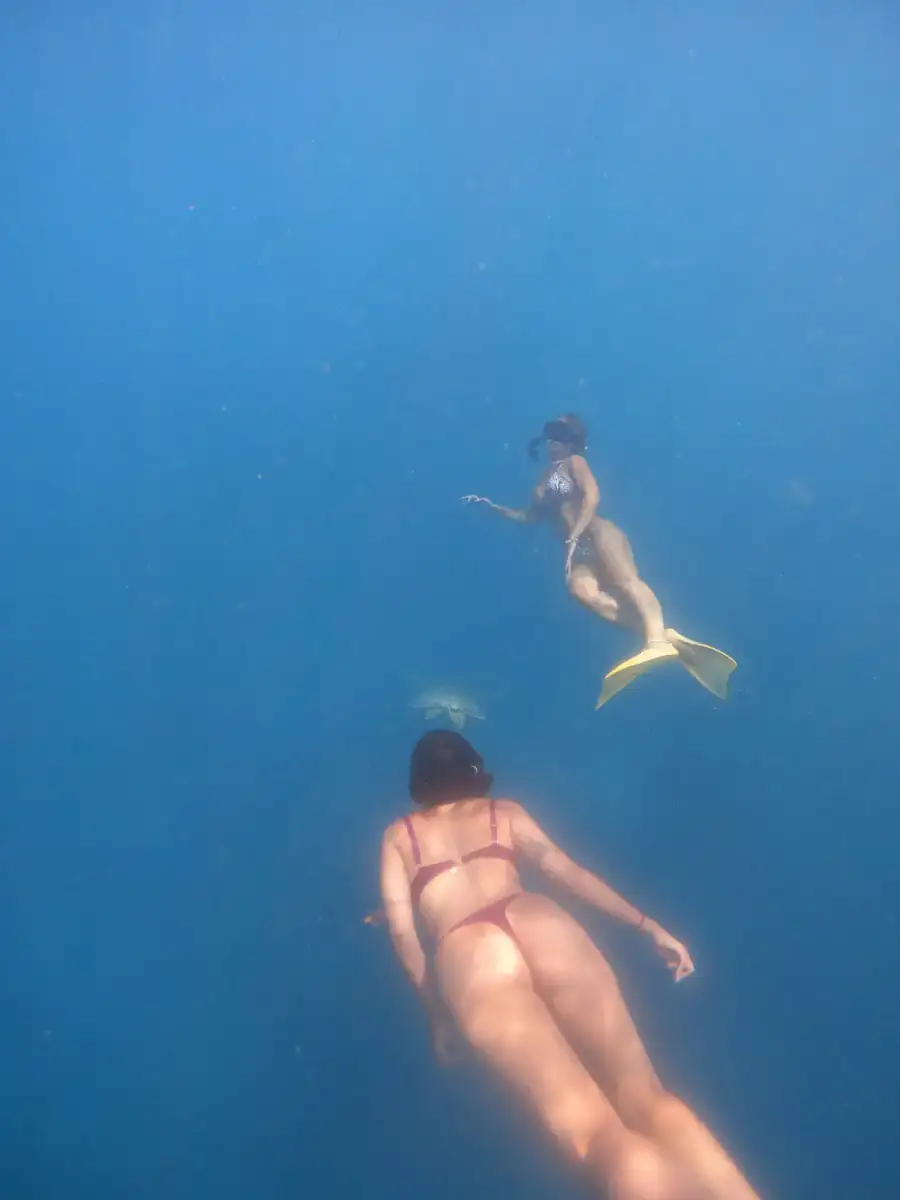
Two friends float side by side on a still morning, both ready to dive. One says, “We can keep half an eye on each other.” It sounds kind, and it feels safe. It is not what the buddy system asks for. Half an eye is not enough. While one of you is under, the other one is doing nothing but watching.
We have written before about freediving safety basics. This piece zooms in on one part that everyone mentions and few people explain well: what a buddy actually does, and why nearly all the risk sits close to the surface.
Rule one: one up, one down is a job
At the heart of buddy freediving, one person dives while the other stays on the surface and watches. You will find this “one up, one down” approach in guidance from different places, including Water Safety New Zealand and PADI’s standard safe diving practices. Scuba Diving magazine adds a detail I like a lot: the next diver goes only after the first has come back and taken a few breaths to show they are fine.
In real life this is the rule that bends most easily, usually because two friends both want to dive on the same breath-hold. While you are the buddy, watching is the whole job. No photos, no fiddling with your own gear, no chatting with someone on the boat.
Why does the danger sit at the surface?
This is the fact that changes how most people think about it. Divers Alert Network (DAN) writes in its Alert Diver magazine that 99 percent of blackouts happen at the surface or within about 16 feet (5 metres) of it. DAN explains that losing consciousness is most likely in the last part of the ascent, where the pressure drop is biggest, or just after surfacing, before the fresh oxygen from the first breaths reaches the brain. RAID, a training agency, says in its rescue manual that surface blackouts are the most common kind and usually happen as, or shortly after, a diver surfaces.
So the buddy system is really a surface safety system. The deep, hard part of the dive is not where things most often go wrong. The last few metres and the first breaths are. A blackout on its own is not rare in the sport, and DAN’s point is that it can stay a story you learn from, as long as your buddy is close enough to keep your face out of the water.
Positioning: how close is close enough?
DAN says that if your buddy is close enough to protect your airway when you black out, they can hold your head above water until you breathe again. For deeper or longer dives, DAN notes that buddies may need to meet the diver on the way up, at around one third of the target depth, so they are already in place if a blackout happens underwater. The logic is simple: a buddy already swimming toward you is a very different safety net from a buddy waiting at the top.
A freediving instructor article I read also describes the buddy staying within arm’s reach of the surfacing diver. I could not confirm an exact distance in an official standard, so please treat it as a good habit, not a rule. The best rule is the one your instructor teaches you, and it will depend on the depth and on the agency.
What recovery looks like
If a diver loses motor control or blacks out, the method most agencies teach is often called tap, blow, talk. DAN says most agencies consider it the most effective way to bring someone back to consciousness. The RAID manual describes the same steps: keep the diver’s airway above water, remove the mask, blow across the cheeks, tap the face gently and call their name loudly.
The RAID Open Water Freediver rescue manual also gives a timeline. If the diver is still unresponsive after thirty seconds, rescue breaths begin. If they have not revived within another minute, help is called, the diver is taken out of the water and CPR starts. Timings differ between agencies, so I am not presenting this as a universal rule, only as an example of how clear a trained plan can be.
DAN also advises that a diver who has lost motor control or blacked out is finished for the day and should stay out of the water for at least 24 hours. It is not a punishment. It is protection.
A buddy is a trained person, not a bystander
None of this works if your buddy is someone you met on the boat five minutes ago, who has never learned to spot a blackout or protect an airway. Go Freediving, a UK school led by instructor trainer Emma Farrell, says students are expected to learn to be a safe buddy as well as a safe diver, and that a responsible freediver dives with a qualified partner who can perform a rescue. A buddy system is two trained people, not one trained diver and one well-meaning spectator.
That is also why a good course takes the buddy role as seriously as the dive itself. When you look at a school or a retreat, ask who the safety diver is, what rescue training they have, and whether they ever dive on the same breath as the person they are watching. If you are curious about the very first day, we describe it in what a freediving retreat actually feels like on day one.
Safe in the water, kind to the water
Safety and respect for the sea are really one habit. A calm, organised team disturbs animals less, because nobody is rushing, chasing or panicking. At Ocean Calling we work only with vetted local operators, keep groups to six guests at most, and let anyone skip what they do not feel ready for. Good equipment helps too. Freediving fins that fit well mean less kicking and less effort, and a low-volume mask and snorkel is easier to clear and more comfortable when you spend a long time watching a buddy. Fit matters more than the brand, so try gear on before you buy.
The buddy system is not a formality to get through before the real freediving starts. For the half minute around every surface, it may be the most important part of the dive. If this made you curious to try it yourself, you can explore our retreats, and if you want to see how we think about group size and supervision, read about our ethical freediving retreats.
Questions people ask
What is the buddy system in freediving?
One person dives while the other stays at the surface and watches, a method often called one up, one down. The buddy stays close and is trained to help if the diver blacks out.
Why is the surface the most dangerous part?
DAN reports that 99 percent of blackouts happen at the surface or within about 16 feet (5 metres) of it, often in the last part of the ascent or just after surfacing.
Can I freedive with a friend who is not trained?
It is not a good idea. A buddy needs to recognise a blackout, protect the airway and perform a rescue. Training agencies teach the buddy role as a skill of its own.
What does tap, blow, talk mean?
It is a recovery method taught by most agencies, according to DAN: keep the airway above water, blow across the face, tap gently and call the diver’s name loudly.
How long should a buddy watch after the diver surfaces?
I could not find one universal figure. Each agency teaches its own protocol, so follow the one from your instructor. As one example, the RAID rescue manual starts rescue breaths after thirty seconds without a response.
Can I dive again after a blackout or loss of motor control?
DAN advises staying out of the water for at least 24 hours after such an event, and talking to an instructor or a doctor.
Wildlife encounters are never guaranteed and never forced. Ocean Calling works only with vetted, ethical local operators, and every animal is free to approach, or not, entirely on its own terms.
Sources & further reading
- Shallow-Water Blackout. Alert Diver, Divers Alert Network (DAN)
- Freediving Safety. Alert Diver, DAN
- RAID Open Water Freediver, Rescue (15 Dec 2023). RAID, via Go Freediving
- Free diving and snorkelling safety. Water Safety New Zealand
- Standard safe diving practices for both scuba divers and freedivers. PADI Pros blog
- Article on freediving safety. Freediving Instructors International
- Solo freedive leads to disaster. Scuba Diving magazine
Further reading on Ocean Calling: Freediving safety basics · What a freediving retreat actually feels like on day one · More from the journal · Ocean Atlas
Freediving certification in Bali: Amed, USAT Liberty wreck and Ubud
Freediving certification · Amed & Ubud, Bali, Indonesia
Ocean breath first, sacred water after. If this made you want to learn to freedive, this is our beginner-friendly course.