
Freediving Retreat Day One: What It Really Feels Like
What a first day at a freediving retreat really feels like: the nerves, the safety rules, the first short breath-hold, and why by evening the day has usually done its real job.
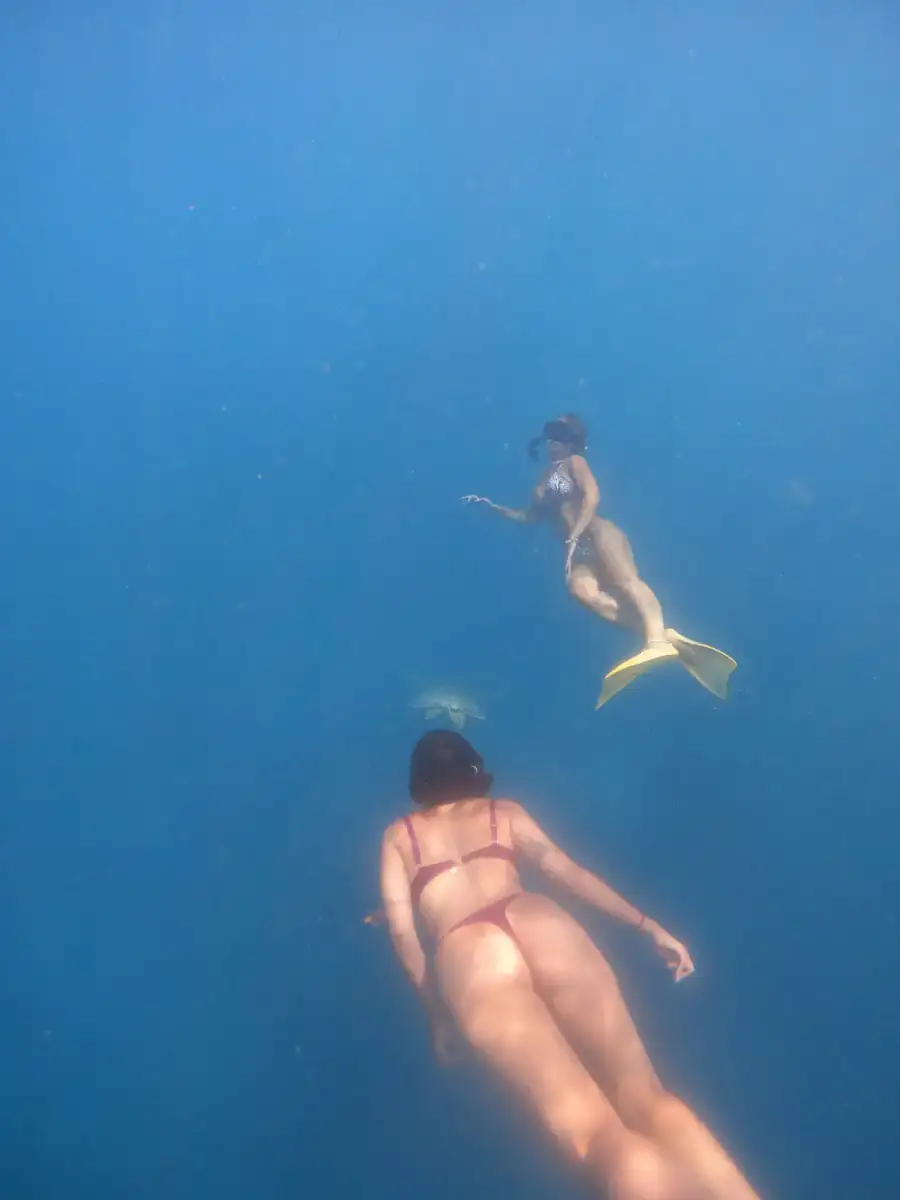
It is the morning of your first freediving retreat day. You slept a little badly, you checked your phone too many times, and somewhere in your head there is a quiet calculation: is everyone else already good at this, and am I the only beginner? So what does day one really feel like? Mostly, slower and gentler than you expect. You talk, you learn the safety rules, you breathe, and your first breath-hold is short, supervised and done at the surface.
Here is a first day the way we like it to run, and the plain science behind why the body often relaxes before the mind does.
The morning: people before water
Day one does not start in the sea. It starts with a few people, a coffee, and names. On our hosted retreats the group is small, six guests at most, so everyone is visible. There is no back row. That can feel uncomfortable for a few minutes, and that is normal. We let it be, instead of filling it with loud ice-breakers.
Then the instructors talk through the things that make the rest of the week make sense: how a session will run, how we communicate in the water with simple signals, what a comfortable breath-hold feels like, and what “stop” looks like. Nobody has to prove anything. You can sit out part of the morning, ask the same question twice, or simply listen. Our article on what “small group” really means when you travel solo goes deeper into how we keep that space calm.
The first rule of a freediving retreat: never alone
Before any breath-hold, there is one rule above all others. Freediving training around the world uses a buddy system often called “one up, one down”: only one person in a pair is under the water at a time, and the other watches from the surface, ready to help. The Divers Alert Network (DAN) has written that serious freediving incidents have been linked to dives that skipped the one-up-one-down rule, bypassed the buddy system, or pushed limits without proper safety.
The reason is a blackout. A freediver can lose consciousness from low oxygen. DAN notes this can happen in any body of water when someone pushes their limits, and that it can have tragic results in open water when the person is alone. Instructors teach how to recognise it, how to bring a buddy to the surface while protecting the airway, and the simple “tap, blow, talk” recovery, which DAN says most agencies consider the most effective way to help someone regain consciousness. DAN describes a big release of bubbles from the mouth as a classic sign of a blackout.
This sounds serious, and it is. But on day one it is explained the way a seatbelt is explained: not because something is expected to go wrong, but because the habit keeps a small problem small. If you want the details, our guide to what the freediving buddy system really requires explains each role.
Why is the first breath-hold so short?
The first time in the water usually happens in shallow, calm water or at a buoy, with an instructor right beside you. You float face down, as still as you can, and hold your breath for a short, comfortable time. Then you come up, breathe, and rest. That is all. Day one is not about numbers.
What often changes is the face of the person who comes up. Not triumphant, usually. More like someone who just found out a fear was bigger in their head than in their body. There is a simple reason this can happen. Reviews of breath-hold physiology describe the diving response as a slowing of the heart through the parasympathetic nervous system, a rise in blood pressure as blood vessels in the limbs narrow, and, in longer holds, a squeeze of the spleen. Studies with cold water on the face show a stronger slowing of the heart than breath-holding in air alone.
We want to be careful here. Some lab results disagree with each other, many studies are small, and the response in beginners is mild. We cannot promise that one breath-hold will calm your mind. But many people find that floating still, face in the water, feels very different from the panic they imagined. Our article on what happens in your body when you hold your breath underwater explains it step by step.
When the day is also about the group
Many people who choose a small-group freediving retreat do so because big, loud programmes have not worked for them before. Some are solo travellers, some are highly sensitive people, some are neurodivergent. For them, day one does double work: learning to freedive, and testing whether this group of strangers is a calm place to do it.
We take that seriously in small, unglamorous ways. The schedule is predictable and shared in advance. Nobody is pushed into the getting-to-know-you parts. You can sit out a session and join again when you are ready, and that is never a problem. None of it is announced as a special accommodation. It is simply how the day runs.
The ocean is not a training pool
A freediving retreat happens in someone’s home. Reefs, seagrass, turtles, fish and the local people who fish and dive there all share the same water. So from the first day we teach a few habits that protect them as much as us. We train over sand or in open water, away from coral. We do not stand on, hold or kick the reef. If an animal comes near, we stay still and let it decide the distance. We never chase, touch or feed wildlife.
We also work only with local operators we have vetted, and the diving itself is taught by local professionals. And we are honest that travel has a cost: flights to a warm sea are not free for the planet, and no retreat makes them so. A slower trip, with fewer flights and more days in one place, is one of the few simple things that helps.
Gear can help you be gentle too. A well-fitting low-volume mask and snorkel is the most useful first piece, and a long-sleeve rash guard protects your skin from the sun without needing as much sunscreen in the water. Proper freediving fins come later for most people, once you know you love it.
By evening: what day one has really done
Dinner on the first night often looks different from breakfast. The question that took so much space in the morning, “do I belong here?”, has usually gone quieter. Not because anyone performed well, but because the day showed you that slow, careful and supervised is not a lesser way to learn. It is the way.
What surprises many people, later in the week, is how little of day one was about skill. It was about trust: in the rules, in the buddy beside you, and in your own body. If day one feels hard for you, that is common too, and our piece on why freediving feels hard at the beginning may help.
If this made you curious about how your own day one might feel, you can explore our upcoming retreats.
Questions people ask
Do I need to be a strong swimmer for day one?
You need to be comfortable in the water, but day one is gentle: short, supervised breath-holds at the surface, in calm conditions, with an instructor beside you. Ask the retreat what swimming level it expects before you book.
What is “one up, one down”?
It is the basic freediving buddy rule: only one person in a pair is underwater at a time, while the other watches from the surface, ready to help. DAN links serious incidents to dives that ignored this rule.
Can I freedive alone after my course?
No. DAN warns that a blackout can happen in any water when a diver pushes their limits, and that it is especially dangerous in open water when alone. Always dive with a trained buddy.
Why does my heart slow down when I hold my breath?
That is the diving response, present in all mammals. Holding your breath, especially with your face in cool water, slows the heart and moves blood towards vital organs. In beginners it is usually mild.
What if I panic or want to stop?
You stop. On our retreats you can skip or leave any session, and nobody is pushed to hold longer or go deeper than feels comfortable.
Wildlife encounters are never guaranteed and never forced. Ocean Calling works only with vetted, ethical local operators, and every animal is free to approach, or not, entirely on its own terms.
Sources & further reading
- Divers Alert Network (DAN), Alert Diver. Safety 101 (freediving buddy system and one-up-one-down).
- Divers Alert Network (DAN Europe), Alert Diver, 2023. Shallow-water blackout.
- Lindholm, P. and Lundgren, C.E.G., 2009. The physiology and pathophysiology of human breath-hold diving. Journal of Applied Physiology 106(1): 284-292.
- Physiology, pathophysiology and (mal)adaptations to chronic apnoeic training: a state-of-the-art review, 2021. PubMed Central.
- Breath-Hold Diving: The Physiology of Diving Deep and Returning, 2021. Frontiers in Physiology (PubMed Central).
- The Physiological Society. The effect of various breath-hold techniques on the cardiorespiratory response to facial immersion (abstract).
Further reading on Ocean Calling: More from the journal · Freediving safety basics · Wildlife & the law · See the retreats · Ocean Atlas
Freediving certification in Bali: Amed, USAT Liberty wreck and Ubud
Freediving certification · Amed & Ubud, Bali, Indonesia
Ocean breath first, sacred water after. If this made you want to learn to freedive, this is our beginner-friendly course.