
Learn to Dive for the First Time: What It Really Feels Like
The nerves, the course itself, and why confidence usually arrives after you start, not before.
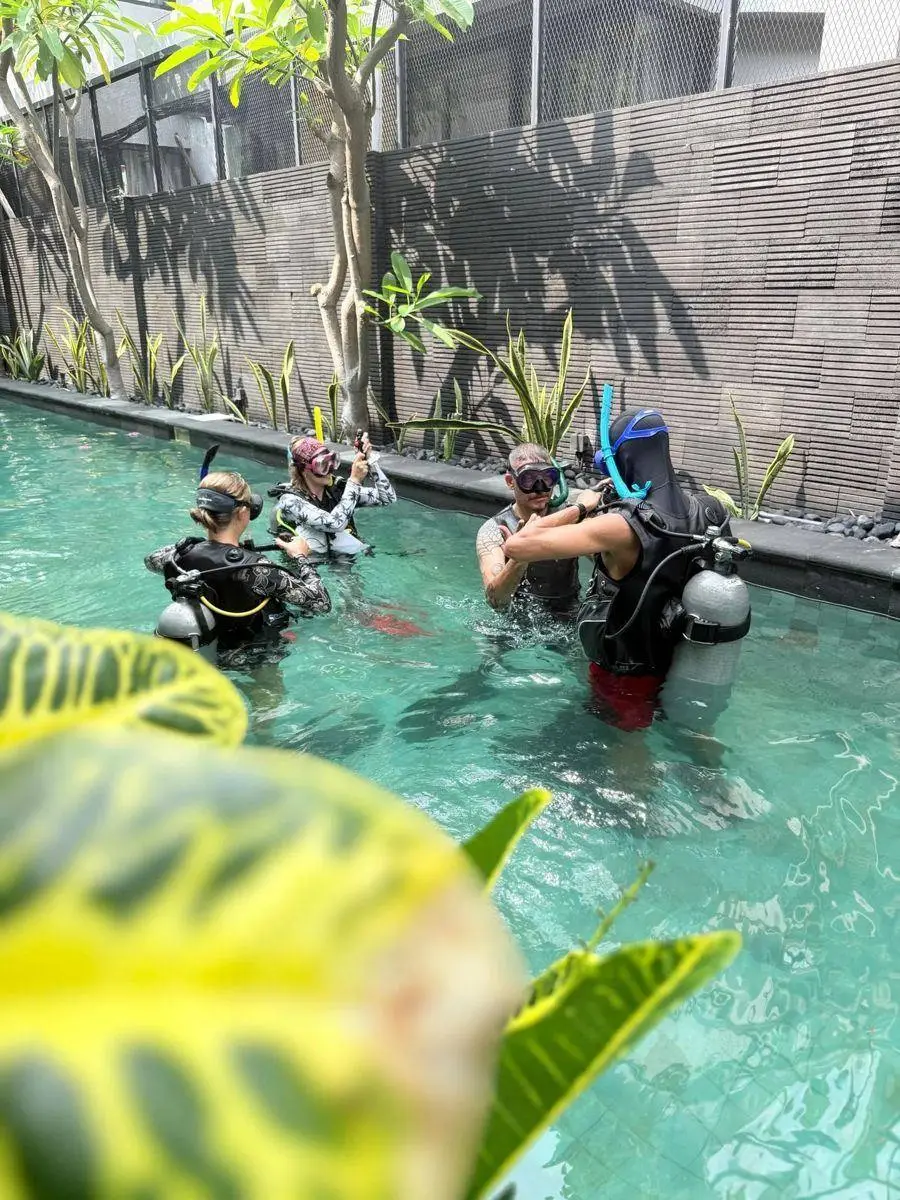
You put the regulator in your mouth, lower your face into the water, and for a second your whole body says "no". Then you breathe. If you want to learn to dive for the first time, that is the honest picture: nerves are normal, a beginner course is built step by step for exactly those nerves, and confidence usually comes after you start, not before.
Why so many people put it off
If you are thinking about learning to dive, you have probably also thought about the harder questions underneath. Will I be calm enough? Will I understand the equipment? Is this really something I can do? That is a very normal way to arrive here.
Many people save a course link, close the tab, and tell themselves they will book next season, when life is calmer, when they feel more ready. Often the delay is not really about time. It is about trust. Not trust in the ocean, but trust in yourself to handle something new and a little out of your control. That is fair to sit with. Beginner scuba diving asks you to start before you feel fully sure, and for many people that is exactly where the interesting part begins.
What a first scuba course is actually like
Nobody needs to arrive feeling brave. Most first-time divers come with a mix of excitement and nerves. Breathing underwater for the first time, wearing gear you have never touched, going into water where you cannot see the bottom: none of that is small, and it is fine to feel it.
A well-run beginner course is built for exactly that starting point. Take the PADI Open Water Diver course as an example. It has three parts: knowledge development (the theory, often done online at your own pace), confined water dives in a pool or calm shallow water to learn the equipment and basic skills, and then four open water dives with your instructor. Other international agencies follow a similar shape. The number of sessions and days changes from one dive centre to another, so ask for the schedule before you book.
Before you start, you fill in a medical questionnaire. If you answer yes to any health question, a doctor needs to check it and sign it before you dive. There is usually a simple water skills test too, like a swim and a ten-minute float. The distance depends on the course and how it is taught, so ask your centre. The minimum age for the PADI course is 10, and younger divers are certified as Junior Open Water Divers.
Nobody hands you a tank and leaves you to figure it out. Someone experienced is with you at every stage, and you never dive alone. Diving with a buddy is one of the most basic safety habits in the sport, not an extra.
The moment that surprises people most
For almost everyone, it is the first breath. Not the gear, not the wetsuit, not even getting into the water. It is the moment you put the regulator in your mouth and realise you can breathe, normally, underwater. It sounds obvious on paper. In real life, nothing you read prepares you for it, and it is usually where the nerves either jump or start to melt.
That is why the confined water session comes before any open water dive. You practise breathing through the regulator, clearing water from your mask and becoming more stable in the water, all in a place where very little can go wrong. A mask that fits your face helps more than people expect in that first session, which is why some beginners prefer their own instead of whatever rental is left. By the time you do the same things in open water, your body has already done them once. That repetition does much more of the mental work than people think.
Is it normal to feel scared before your first dive?
Yes, often. And it is worth being honest about that instead of pretending. What most beginners feel before a first dive is closer to unfamiliarity than real danger. Your body reacts strongly to things it has never done, especially somewhere as different from daily life as underwater. That reaction does not mean diving is wrong for you.
This is exactly why the learning environment matters so much. A calm instructor, a clear explanation of what is about to happen and why, and a pace that does not rush you can change the whole feeling of a first dive. When you understand what is going on, fear tends to lose some of its grip.
So yes, it can feel scary at first. That does not predict how it will go. For many people, that early nervousness is simply the first layer they move through on the way to feeling steady underwater.
Why it can feel bigger than "just a course"
Many thoughtful travellers, and solo women in particular, describe learning to dive as something that stayed with them longer than a normal activity. Most adults are good at their everyday lives: work, planning, staying in situations where they already feel capable. Learning to dive interrupts that. You are a beginner again. You listen, you adjust, and you trust a process instead of controlling every detail.
That can feel exposed, but it also feels alive. You do not need to become braver or more adventurous before you try. You just need a well-run, well-paced course that lets you begin honestly, nerves included. What people often bring home is not only the certification card. It is proof that they could sit with uncertainty and keep going anyway.
Scuba diving and freediving are not the same experience
People often mix the two. Freediving is about the breath-hold: relaxation, stillness, moving through the water on one breath. Scuba diving is different. You learn to use breathing equipment, an instructor supports you the whole time, and confidence grows through structured, guided steps, not breath control. If you want to compare them properly, read the difference between snorkelling, scuba diving and freediving. And if you are curious what a first course looks like in one specific place, we wrote about beginner diving in Indonesia.
The ethical layer: learning to dive without hurting the reef
Most first dives happen over coral reefs, and beginners are, of course, the divers most likely to bump into things. That is not a reason to feel guilty. It is a reason to choose a course that takes buoyancy and awareness seriously. A good instructor keeps beginners over sand while they practise, teaches you to keep fins and hands away from the reef, and treats "don't touch anything" as part of the skill, not a lecture.
Wildlife is part of this too. Nothing underwater is there for us. Turtles, rays and fish should never be chased or touched, and no good centre promises a sighting. Before the boat, think about the sun as well. A rash guard covers your skin with less need for cream. If you use sunscreen, our mineral sunscreen list is one place to start, and our reef-safe sunscreen guide explains what the labels do and do not mean.
Learning to dive while travelling solo
Many people who learn to dive are travelling alone. Diving suits solo travel well, because a course gives you structure and a shared experience without needing to arrive with anyone. You show up with strangers, spend a few days learning something real together, and usually leave having shared something true: a wobbly first descent, a first fish, the relief of finally feeling stable in the water.
For solo women especially, this often becomes a quiet, real kind of confidence, built by doing the thing, not by being told to feel empowered. What makes the difference is the setting: a properly vetted instructor, a small group, and no pressure to show bravery you do not feel yet. That is why we only work with local operators and instructors we have vetted. The person teaching you matters more than almost anything else.
What to expect once you actually start
Confidence in diving is built, not something you bring with you. It comes from understanding, repetition and a pace that does not rush you. The days before are often more intense in your head than the real thing. Once the course begins, most people find the fog lifts quite fast. Instead of one big unknown, it becomes a series of small, manageable steps.
A first course is not about being perfect. It is about letting new sensations become familiar, one step at a time. People who understand this relax faster, and the whole course usually goes more smoothly.
If you would like to take your first course somewhere calm, we can connect you with a vetted local scuba team in Amed through our Bali Amed scuba referral via Ocean Match. You book directly with the local team.
Questions people ask
How is a beginner scuba course structured?
Taking the PADI Open Water Diver course as an example: theory (knowledge development), confined water dives in a pool or calm water, and four open water dives with an instructor. The number of sessions changes from one dive centre to another.
Do I need a medical check to learn to dive?
You fill in a medical questionnaire before the course. If you answer yes to any question, a doctor must review it and sign it before you can dive.
How old do you need to be?
The minimum age for the PADI Open Water course is 10. Children aged 10 to 14 receive a Junior Open Water Diver certification.
Do I need to be a strong swimmer?
You need basic comfort in the water. Courses usually include a swim test and a ten-minute float. The exact distance depends on the course and how it is taught, so ask your centre.
Is it normal to feel scared the first time?
Yes. Early fear is usually about unfamiliarity, and it tends to settle with clear instruction, a calm pace and practice in shallow water first.
What is the most important safety rule for new divers?
Never hold your breath while scuba diving. Breathe slowly and continuously, especially while going up, and always dive with a buddy.
Wildlife encounters are never guaranteed and never forced. Ocean Calling works only with vetted, ethical local operators, and every animal is free to approach, or not, entirely on its own terms.
Sources & further reading
- PADI Pros Blog. Standard Safe Diving Practices for scuba divers and freedivers.
- PADI Blog. The golden rules of scuba diving.
- PADI Travel. PADI Open Water Diver course (course structure and prerequisites).
- Scuba School UK. PADI Open Water Diver (age, swim test, medical questionnaire).
- Scuba Diver Life. Ten rules for safe scuba diving.
Further reading on Ocean Calling: More from the journal · Wildlife & the law · See the retreats · Ocean Atlas
Scuba diving certification in Bali: PADI course and USAT Liberty wreck
Scuba certification · Amed & Tulamben, Bali, Indonesia
Learn to dive slowly, in warm calm water. If this made you want to learn to dive, this is our beginner-friendly course.