
Maldives Shark Fishing Ban Change: What Divers Should Know
You are hanging in blue water off Fuvahmulah, and a tiger shark slowly takes shape below you. Back on the boat, someone reads a headline out loud: the Maldives shark fishing ban has changed. Suddenly everyone has the same question. What does this mean for the sharks we just met?

The short answer: only one group of deep-water sharks, the gulper sharks, can now be fished, and every other shark in the Maldives is still protected. The full story is less dramatic than the headline, and more interesting. It is a story about two kinds of sharks. The ones divers cross the world to see, and the ones almost nobody will ever see at all.
What does the Maldives shark fishing ban change really mean?
For about 15 years, the Maldives had a full ban on shark fishing, built on earlier limits. Then the government reopened fishing for one group of species only, the gulper sharks, with a season from December to June.
The management plan sets clear edges. No more than 40 vessels can hold licences. Fishing is allowed only in designated offshore areas, and every vessel must carry a tracking device so it can be followed at all times. Reporting on the plan adds that fishing is not allowed inside the atolls, or near protected areas and fish aggregating devices, and that landings are limited to four islands.
And the most important line for divers: catching or using any shark species other than gulper sharks is still prohibited.
Meet the shark almost nobody sees
Gulper sharks live in the deep, described as below 150 to 300 metres, and deeper still. They have very large livers full of oil. That oil is sold as squalene and used in cosmetics and vaccines.
In the Maldives, shark liver oil was historically exported rather than used at home. Shark fishing once ranked second only to tuna among the country’s marine exports.
The problem is how slowly these sharks live. For one well-studied species, an Australian shark report card gives only one pup per litter, after a pregnancy of about two years. It has been recorded from 98 to 1,700 metres deep, mostly between 300 and 800 metres. In the Northeast Atlantic, population declines of 80 to 95% have been estimated for that species. An animal that breeds this slowly is easy to overfish and slow to come back.
What that global listing does, and does not do
CITES is the global agreement on trade in wild animals and plants. Appendix II is not a trade ban. It means that selling gulper sharks from one country to another now needs permits, and a scientific finding that the exports will not harm the wild population.
So it regulates trade. It does not stop fishing. How much it helps will depend on how carefully catches and exports are recorded.
Why Fuvahmulah divers pay attention
Fuvahmulah is a small atoll in the far south of the Maldives, sitting on the Chagos-Laccadive Ridge. The IUCN shark specialists recognise it as an Important Shark and Ray Area, where six threatened shark and ray species regularly occur.
Their factsheet reads like a diver’s dream. It records 236 identified tiger sharks, 84% of them female. Schools of 30 to 60 scalloped hammerheads, seen mostly from February to May and from October to December. And the only known pelagic thresher cleaning station in the Western Indian Ocean, at 40 to 88 metres deep.
Silvertip sharks tell a quieter story. Dive guides once recorded more than 40 silvertips on single dives at one site. A later one-year survey logged 104 sightings in total, with no more than 10 on any dive. The factsheet gives no reason.
None of these animals is a gulper, and the fishery works offshore in deep water. The worry is enforcement. Critics note that the plan has no stock assessment, no hard catch limits per vessel and no independently checked monitoring of bycatch, the animals caught by accident. More than 60 environmental organisations asked the government to stop it.
A live shark is worth more
There is also a simple money story here. A survey of dive tourists and operators estimated that shark divers brought US$14.4 million in direct revenue to Maldivian businesses in one year, plus US$51.4 million in related travel spending.
In an earlier estimate, when the local shark fishery earned about US$0.5 million a year, shark diving already brought in about US$2.3 million in direct revenue. Adjusted for inflation, that revenue has almost doubled since. In other words, a living shark is worth far more to the country.
How to dive Fuvahmulah with respect
The law still protects every shark in the Maldives except gulper sharks. So the sharks you meet on a Fuvahmulah dive are protected animals, and we treat them that way. Wildlife encounters are unpredictable. Diving with sharks should always follow local regulations and experienced professional guidance.
Keep a calm distance. Never touch, chase or block a shark’s path, and let each animal decide how close it comes. Near cleaning stations, stay low and still. For the long hours on the boat between dives, I like a long-sleeve rash guard for the sun.
Ask your operator how it works with sharks before you book. Some Fuvahmulah dives use food, and that changes the encounter completely. Good operators brief you on distances and keep groups small. And if you want to help from home, some travellers choose products labelled as plant-based squalene.
If you are still deciding which ocean fits you, our Ocean Match is a gentle place to start.
Questions people ask
Is shark fishing now legal everywhere in the Maldives?
No. Only gulper sharks may be caught, by licensed vessels, in designated offshore areas, from December to June. Catching any other shark species is still prohibited.
Will the change affect Fuvahmulah’s tiger sharks and hammerheads?
Nobody can say yet. They are not the target species, and the fishery works offshore in deep water. The open questions are enforcement and bycatch monitoring.
What does the CITES listing change?
Gulper sharks are now on Appendix II, so their international trade needs permits and a finding that exports do not harm wild populations. It regulates trade. It does not ban fishing.
Wildlife encounters are never guaranteed and never forced. Ocean Calling works only with vetted, ethical local operators, and every animal is free to approach, or not, entirely on its own terms.
Sources & further reading
- Blue Marine Foundation, 2025. Maldives allows gulper shark fishing, lifting years-long blanket ban.
- The Scuba News, 2025. Maldives to lift 15-year shark fishing ban.
- PSM News, 2025. Gulper shark fishing resumes in Maldives under management plan.
- Maldives Independent, 2025. Dead on arrival: a shark fishery with no fishers.
- Atoll Times, 2025. Maldives reopens gulper shark fishery despite concerns.
- Humane World for Animals, 2025. CITES protects whale sharks and gulper sharks.
- WCS, 2025. Trade protections for sharks and rays adopted at CITES CoP20.
- Guallart, J. et al., 2019. Gulper Shark, Centrophorus granulosus Report Card. Fish.gov.au.
- IUCN SSC Shark Specialist Group. Fuvahmulah Atoll Important Shark and Ray Area factsheet.
- Zimmerhackel, J.S. et al., 2019. Evidence of increased economic benefits from shark-diving tourism in the Maldives. Marine Policy 100: 21-26.
- Oceanographic, 2025. More valuable alive.
Further reading on Ocean Calling: Maldives in the Ocean Atlas · Why so many Fuvahmulah tiger sharks are female · Fuvahmulah tiger sharks and wild food · How tourism can protect sharks · Scalloped hammerhead in the Ocean Atlas · Pelagic thresher in the Ocean Atlas · Silvertip shark in the Ocean Atlas
Tiger shark diving in Fuvahmulah, Maldives
Dive retreat · Fuvahmulah, Maldives
Dive with wild tiger sharks around a quiet local island in the far south of the Maldives. This story is about the Maldives, where we run our Fuvahmulah retreat.
Explore in the Ocean Atlas
Places in this article
Animals in this article
 Tiger sharkGaleocerdo cuvier
 Scalloped hammerheadSphyrna lewini
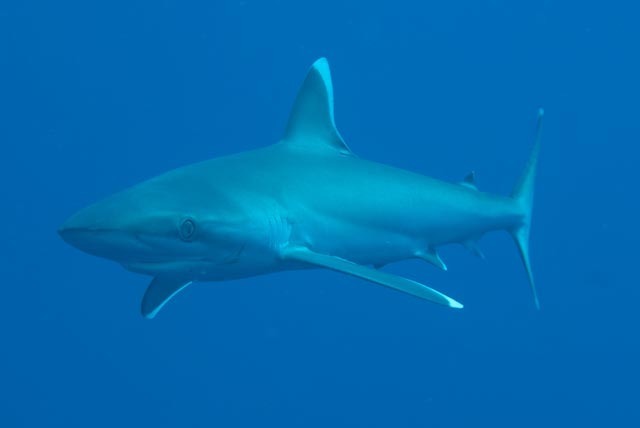 Silvertip sharkCarcharhinus albimarginatus
 Pelagic thresherAlopias pelagicus