
Scalloped hammerhead
Sphyrna lewini
Seeing a school of scalloped hammerheads glide past a blue-water drop-off is a rare privilege, and a reminder of why these ocean travellers need protecting.
Critically Endangered (IUCN, 2018) means it is at extremely high risk of extinction in the wild.


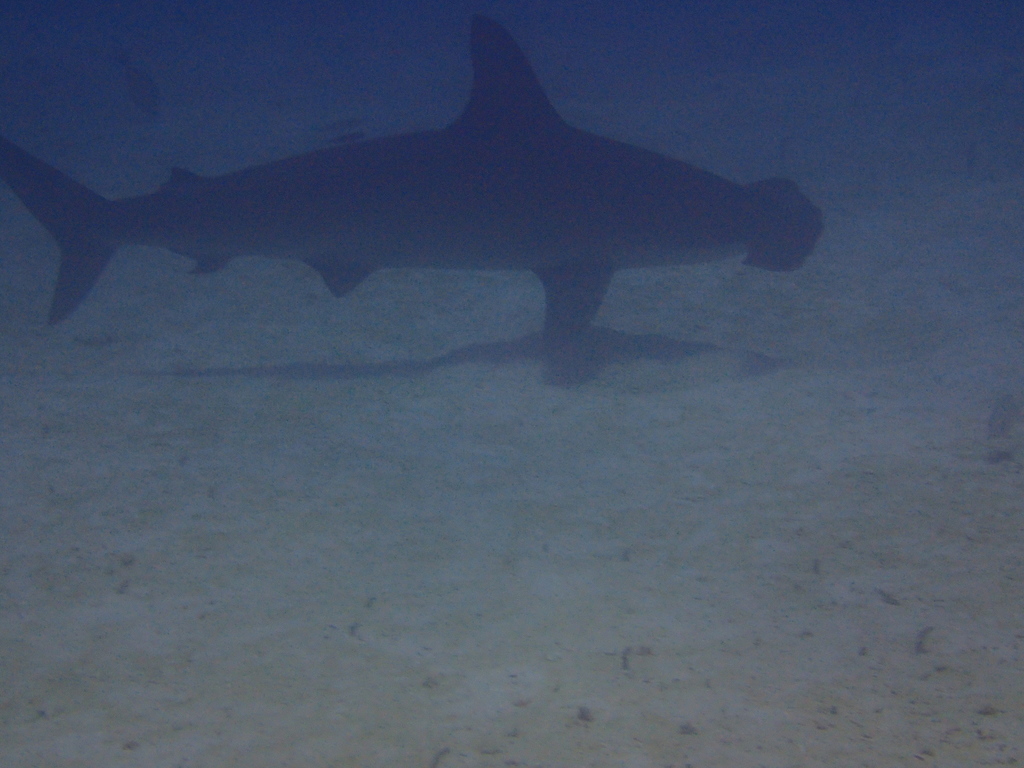
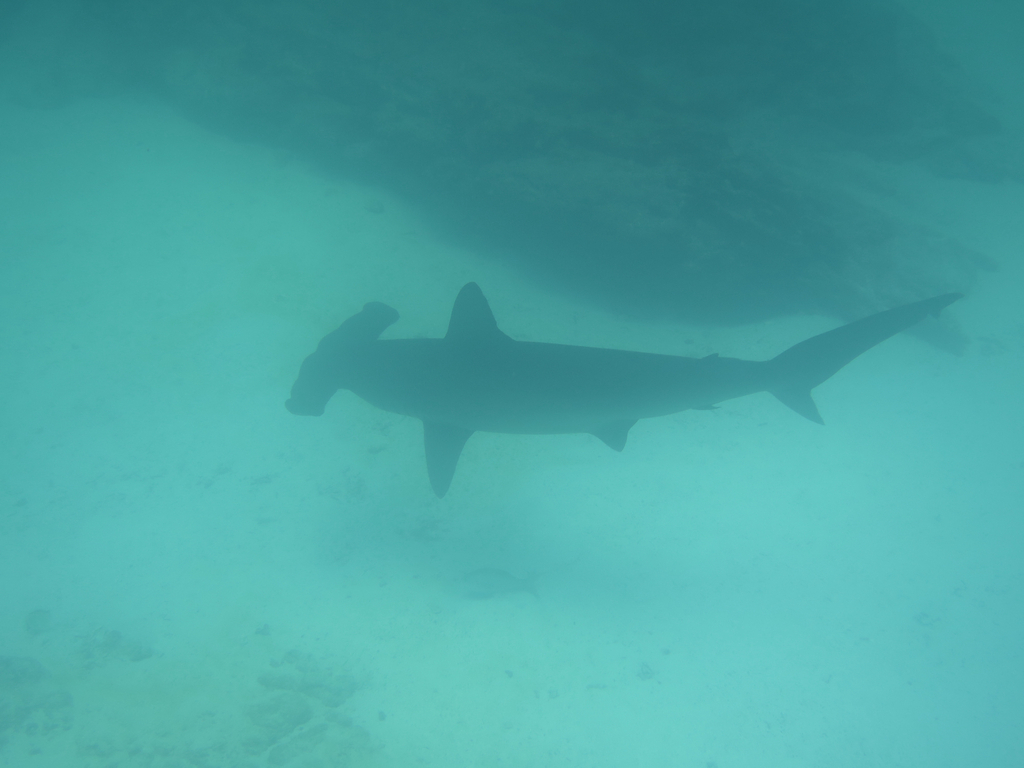
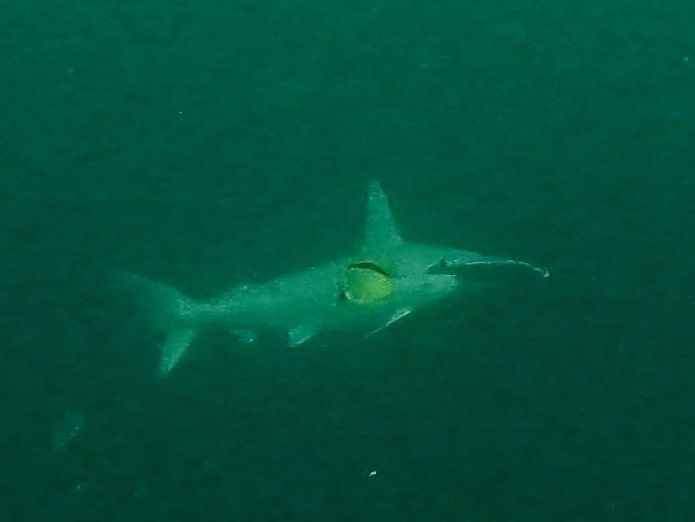
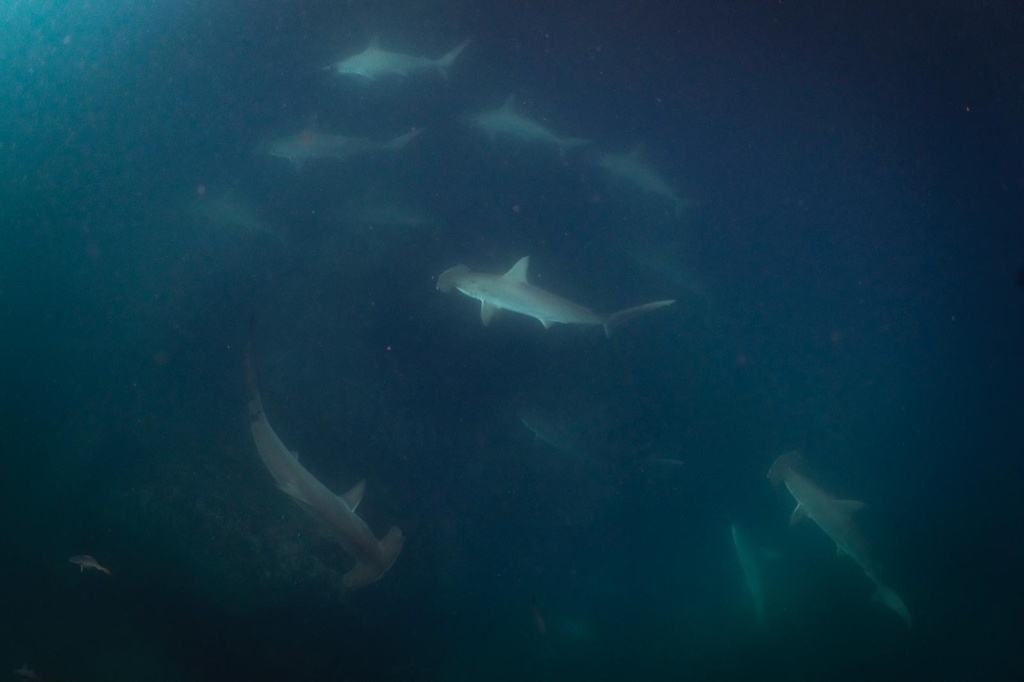
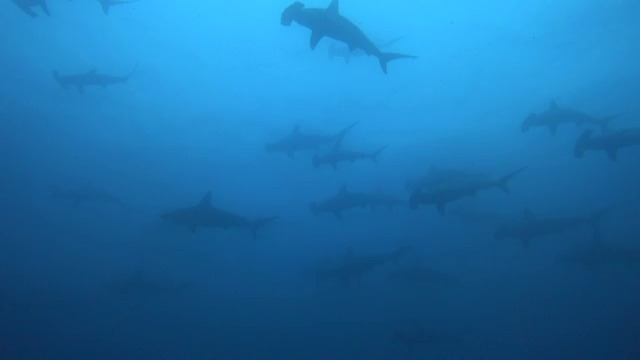
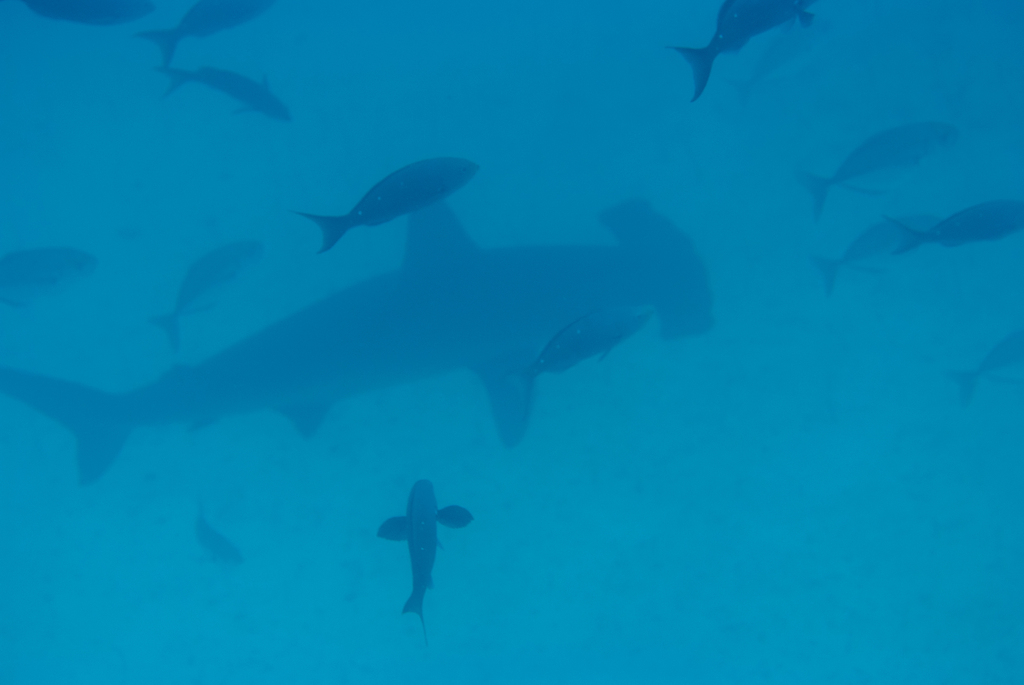
Photos show the species, not always the places on this page.
Length
Adults about 2.2 to 3.5 m (7.2 to 11.5 ft); largest recorded 4.3 m (14 ft)
Weight
Typical adult weight not reliably measured; heaviest published about 152.4 kg (336 lb)
Next to a person
About one-and-a-half to two times as long as an adult person; the heaviest recorded weigh about as much as two adults
What it eats
Reef and schooling fish, squid, octopus, crustaceans, stingrays and smaller sharks.
Around people
Calm, give space
How it lives
Scalloped hammerheads hunt mainly at night, moving offshore to feed on fish, squid and other prey. By day, adults often gather in large schools separated by sex, a famous sight at seamounts and drop-offs. Females give birth to 12 to 41 live pups after 9 to 12 months.
Where it goes
By day, adults school at seamounts and drop-offs; at night they move offshore to feed. At Darwin and Wolf in the Galápagos, schools stay all year but thin out from March to June, when some sharks swim about 690 km to Cocos Island. Tagged sharks also linked Malpelo and Cocos, but only a few made these trips. At Mikomoto Island, Japan, four tagged females stayed from August to November, left, and came back the next summer.
Populations
Scalloped hammerheads live in warm coastal seas worldwide: the Americas, the Mediterranean to Namibia, South Africa, the Red Sea, India, Japan, Indonesia, Australia, Hawaiʻi and Tahiti. Atlantic and Indo-Pacific populations are largely separate. Famous schooling sites such as Cocos, the Galápagos, Malpelo and the Red Sea reflect regional gathering behaviour, not separate subspecies.
Meet it respectfully
Hammerhead schools are easily disturbed by bubbles, chasing and sudden movement. Stay low and calm, close to the reef where it is safe, and let the sharks choose the distance. Never chase, surround, block or swim into a school, and never bait or feed sharks. Many hammerhead sites are protected areas with their own rules; in the Galápagos, for example, park rules ask for at least 2 m from all wildlife.
Fun fact
Tap the bulb to light it up.
Off Hawaiʻi, scalloped hammerheads dive deeper than 1,000 m and hold their breath to keep warm.
At a Gulf of California seamount, tracked sharks swam on very straight paths, perhaps following the Earth's magnetic field.
It is a different species from the great hammerhead.
Off Hawaiʻi, scalloped hammerheads hunt as deep as 1,044 m, where the water is about 5°C. There they close their gill slits, holding in body heat like a held breath.
At a seamount in the Gulf of California, tracked scalloped hammerheads swam out and back on very straight paths. Scientists think they may follow the Earth's magnetic field.
Source: Klimley, 1993, Marine Biology, Highly directional swimming by scalloped hammerhead sharks
Of 84 scalloped hammerheads tagged at Cocos Island over nine years, only one was later found at another island in the region. Sharks from the Galápagos and Malpelo visited Cocos more often.
Source: Nalesso et al., 2019, PLOS ONE, island connectivity of scalloped hammerheads
At Darwin and Wolf in the Galápagos, surveys in 2013 and 2014 found 17.5 tonnes of fish per hectare, the largest reef fish biomass reported. Scalloped hammerheads made up 48% of it. Ecuador made the area a no-take sanctuary in March 2016.
Source: Salinas-de-León et al., 2016, PeerJ, Largest global shark biomass found in the northern Galápagos
At Madivaru off Rasdhoo Atoll, Maldives, divers once saw dozens or even hundreds of scalloped hammerheads early in the morning. Over the last decade, sightings have become rare.
Source: IUCN SSC Shark Specialist Group, Eastern Rasdhoo Atoll ISRA factsheet, 2023
Off Cape Irizaki on Yonaguni, Japan, groups of up to 200 scalloped hammerheads gather from December to March. Most are large females, and some look pregnant.
Source: IUCN SSC Shark Specialist Group, Yonaguni Island ISRA factsheet, 2024
Follow its journey
Choose a journey and watch it travel. Every line comes from satellite tracking or documented research, and the source is named.
StartEndJourney (the line joins documented areas; real paths vary)
Scalloped hammerhead in the Ocean Atlas
Places we have researched where this animal is recorded. It is never guaranteed, and some places are for watching from the boat only.
Travel with usComing soonTrusted referralExploringOn pause, story onlyEthics pass
Country colour: pink where we travel, blue where we are exploring or refer, grey for story only.
 Angola
 Australia
 The Bahamas
 Bangladesh
 Benin
Benin Brazil
 Cabo Verde
 Cameroon
 China
China Colombia
 Costa Rica
 Côte d'Ivoire
 Djibouti
 Ecuador
 Egypt
Egypt Faroe Islands
 Fiji
Fiji France
 French Polynesia
 Gabon
Gabon Germany
 Ghana
Ghana Guam
Guam Guinea
 Guinea-Bissau
 India
India Indonesia
 Iran
Iran Japan
Japan Kenya
Kenya Liberia
 Madagascar
 Malaysia
 Maldives
 Mexico
 Mozambique
 Myanmar
 Namibia
 New Caledonia
 Nigeria
 Pakistan
 Panama
 Papua New Guinea
 Philippines
 Saudi Arabia
 Senegal
 Seychelles
 Sierra Leone
 Singapore
 South Africa
 Sri Lanka
 Sudan
Sudan Taiwan
 Thailand
 Trinidad and Tobago
 United Kingdom
 United States
Read more about the scalloped hammerhead
Sources for this page
- Florida Museum of Natural History, 2026
- FishBase, 2018
- NOAA Fisheries, 2025
- Duncan et al., 2006
- Daly-Engel et al., 2012
- Nalesso et al., 2019
- Bessudo et al., 2011
- Salinas-de-León et al., 2025
- IUCN SSC Shark Specialist Group, Darwin-Wolf, 2023 ISRA factsheet
- IUCN SSC Shark Specialist Group, Cocos Island and Seamounts, 2022 ISRA factsheet
- IUCN SSC Shark Specialist Group, Malpelo Ridge, 2022 ISRA factsheet
- IUCN SSC Shark Specialist Group, Layang Layang, 2024 ISRA factsheet
- IUCN SSC Shark Specialist Group, Yonaguni Island, 2024 ISRA factsheet
- IUCN SSC Shark Specialist Group, Mikomoto Island, 2024 ISRA factsheet
- IUCN SSC Shark Specialist Group, Eastern Rasdhoo Atoll, 2023 ISRA factsheet
- IUCN SSC Shark Specialist Group, Fuvahmulah Atoll, 2023 ISRA factsheet
- IUCN SSC Shark Specialist Group, Daedalus Reef, 2023 ISRA factsheet
- Salinas-de-León et al., 2016, PeerJ
Facts checked 26 September 2026. Photos: Unsplash licence, or Creative Commons as shown on each photo.
Work in ocean travel?
We are always happy to hear from exceptional local operators, accommodation, conservation organisations and destination experts. If your work fits responsible, small-group ocean travel, we would love to learn more.
Partner with Ocean CallingShop with Ocean Calling
Visit the Ocean Calling storefront on Amazon.
As an Amazon Associate I earn from qualifying purchases. You are not only choosing products that respect the ocean, you are also helping us keep going: paying our local partners fairly and keeping our retreats ethical, sustainable and honestly priced for you. 💗