
Bargibant's pygmy seahorse
Hippocampus bargibanti
On a deep sea fan, a fingertip-sized seahorse can hide in plain sight. A guide may point it out, but the find is never promised.
Least Concern (IUCN, 2024) means it is not at high risk of extinction worldwide today.


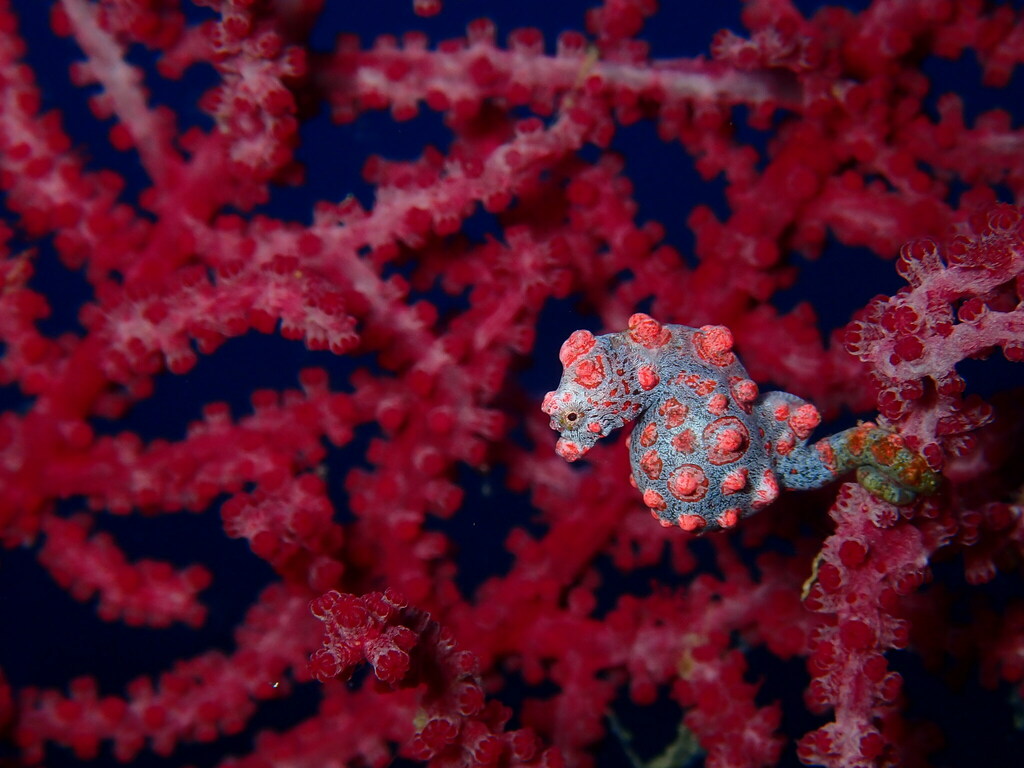
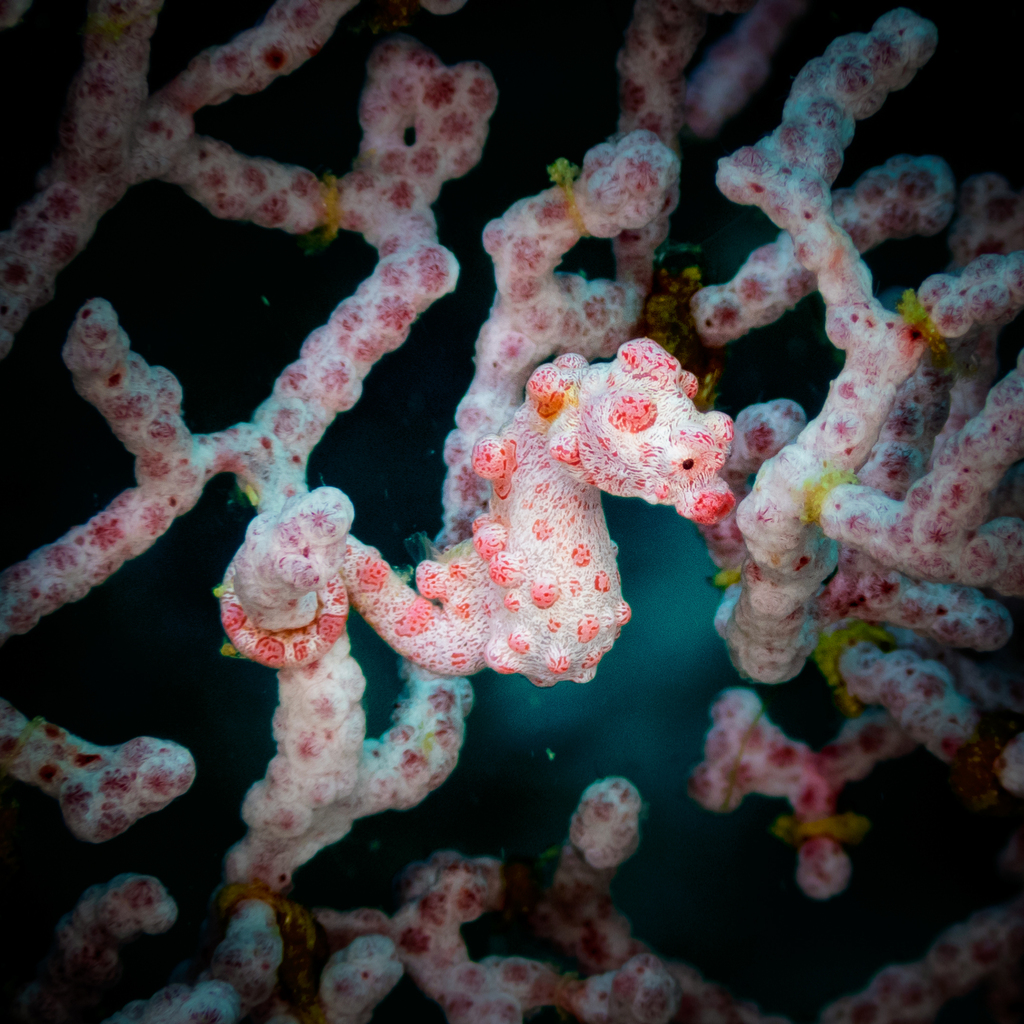
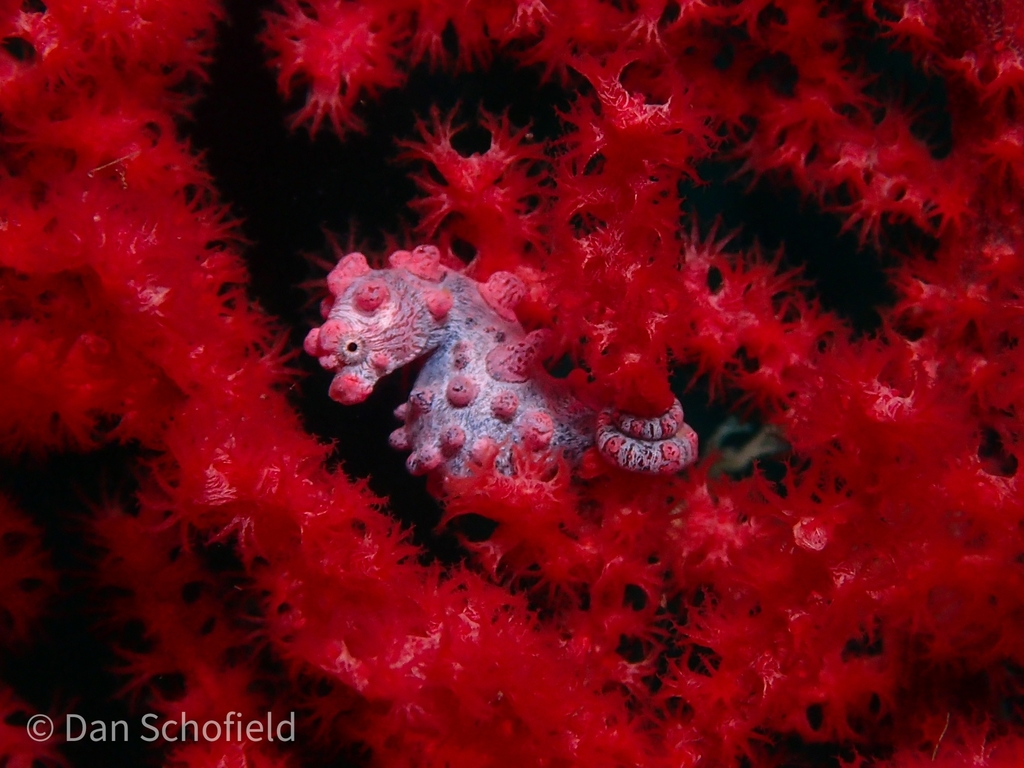
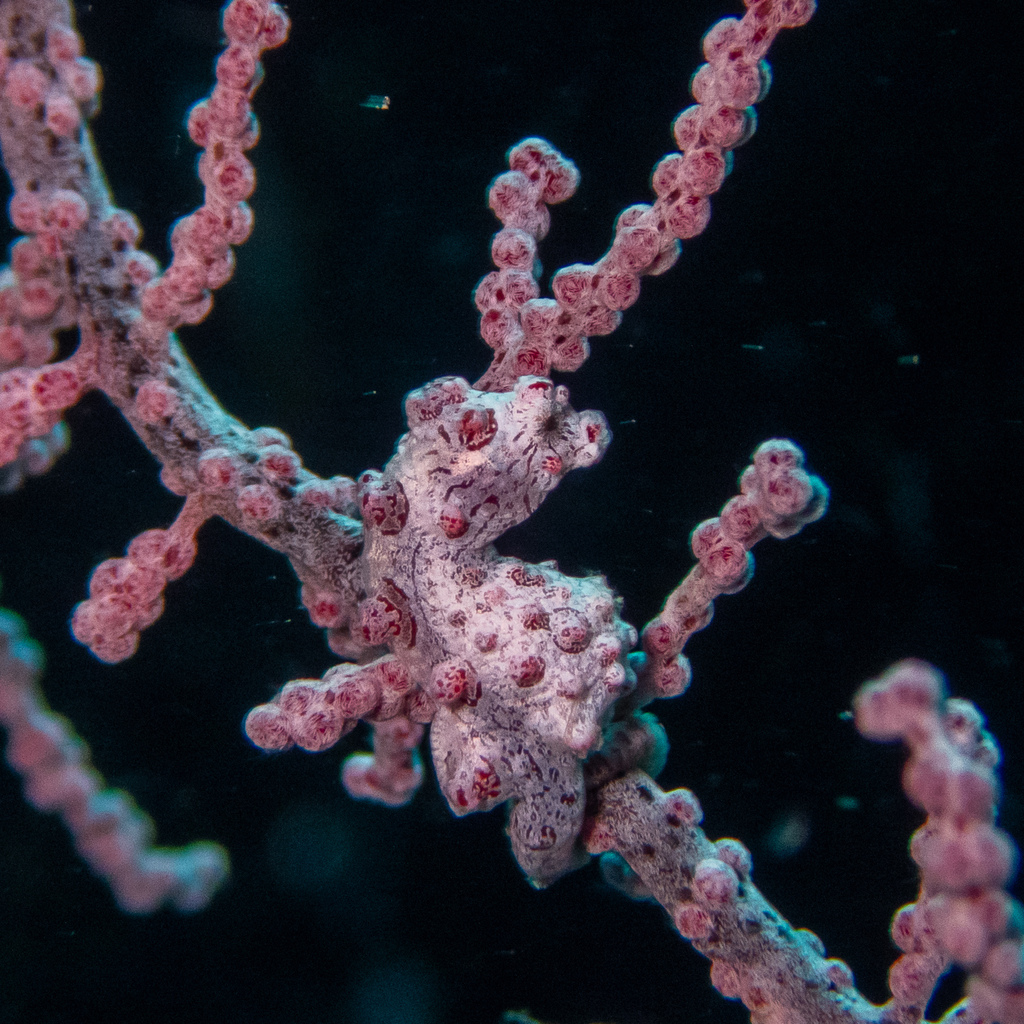
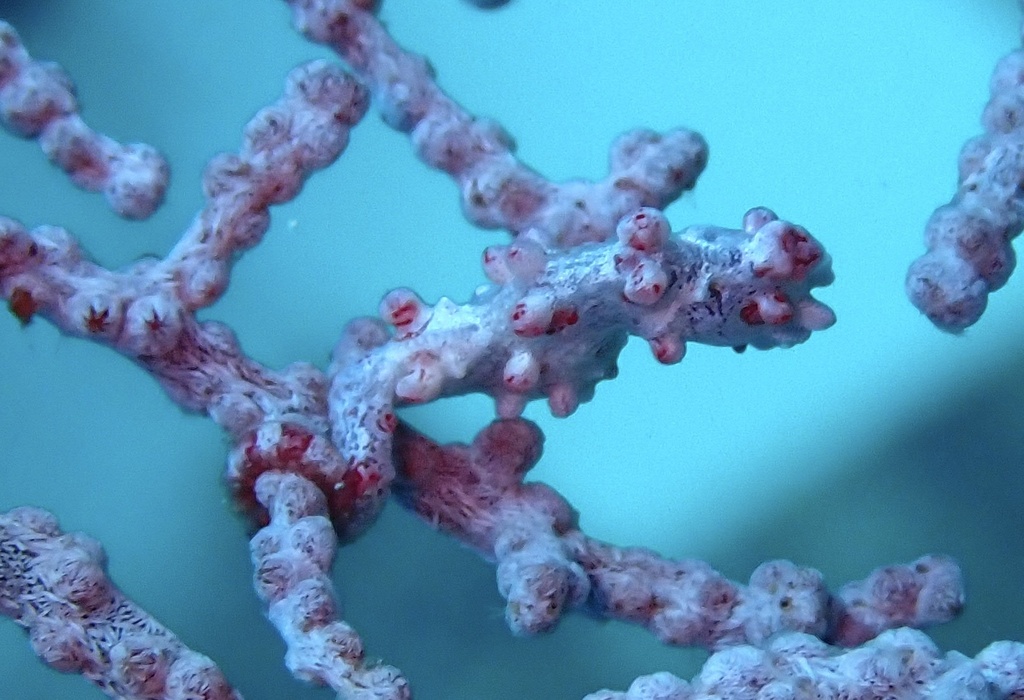
Photos show the species, not always the places on this page.
Length
Usually about 2 cm (0.8 in) tall; largest standard figure about 2.4 cm (0.9 in). Mature from about 1.3 cm (0.5 in)
Weight
Not reliably measured
Next to a person
Tiny, about the size of a fingertip
What it eats
Tiny crustaceans and other zooplankton, picked from the surface of its sea fan, between the polyps.
Around people
Harmless
How it lives
This tiny seahorse lives its adult life on Muricella sea fans, matching the fan's colour and bumps almost perfectly. It is a poor swimmer and holds on with its tail. It is often found in pairs or small groups, sometimes many on one fan. The male carries the eggs in a pouch for about two weeks.
Where it goes
Adults are not known to migrate. Studies have not seen them move from one sea fan to another, and they are very poor swimmers. Young ones drift in open water for about 18 days before they settle on a fan.
We only draw a journey on the map when scientists have tracked it or clearly documented it. For this animal we have not found one yet.
Populations
Found in the Indo-West Pacific, from Indonesia and the Philippines to Japan, Papua New Guinea, Australia, New Caledonia and Vanuatu, always on Muricella sea fans. There are two main colour forms: pale grey or purple with pink-red bumps, and yellow with orange bumps. Both usually match their fan.
Meet it respectfully
Look only. Never touch, move or chase the seahorse, and never touch its sea fan, which grows very slowly. Keep good buoyancy and stay off the reef. Use lights gently and follow the local or guide rules on flash, which differ from place to place.
Fun fact
Tap the bulb to light it up.
In aquariums, babies took the colour of the fan they settled on, not the colour of their parents.
It is rare even where it lives. In one study in Sulawesi, only about 1 in 5 suitable sea fans had one.
Not every tiny seahorse is Bargibant's. Denise's pygmy seahorse is slimmer and lives on other sea fans.
This tiny seahorse stayed hidden from science until 1969, when it was found by accident on a sea fan collected for the Nouméa Aquarium in New Caledonia.
Source: Australian Museum, Pygmy Seahorse, Hippocampus bargibanti
Described in 1970, it was the first pygmy seahorse in the world to get a scientific name. A grown male can be only 13 mm long.
Source: Australian Museum, Pygmy Seahorse, Hippocampus bargibanti
Bargibant's pygmy seahorse in the Ocean Atlas
Places we have researched where this animal is recorded. It is never guaranteed, and some places are for watching from the boat only.
Travel with usComing soonTrusted referralExploringOn pause, story onlyEthics pass
Country colour: pink where we travel, blue where we are exploring or refer, grey for story only.
 Indonesia
 Japan
Japan Malaysia
 New Caledonia
 Philippines
 Taiwan
 United States
Sources for this page
- FishBase, 2023
- Australian Museum
- Reijnen et al., 2011
- IUCN Red List, Vaniartha and Pollom, 2024
- Smith, Grutter and Tibbetts, 2012, Marine Ecology Progress Series
- Shepherd, Wandell and Ross, 2017, AACL Bioflux
Facts checked 26 September 2026. Photos: Unsplash licence, or Creative Commons as shown on each photo.
Work in ocean travel?
We are always happy to hear from exceptional local operators, accommodation, conservation organisations and destination experts. If your work fits responsible, small-group ocean travel, we would love to learn more.
Partner with Ocean Calling5-day freediving course in Bali
CHF 1,180