
Blonde ray
Raja brachyura
A broad, spotted ray that spends its days on sandy seabeds, mostly out of sight. No sighting is ever a promise.
Near Threatened (IUCN, 2023) means it is close to qualifying as threatened. It is slow-growing and late to mature, and numbers are falling in parts of its range.
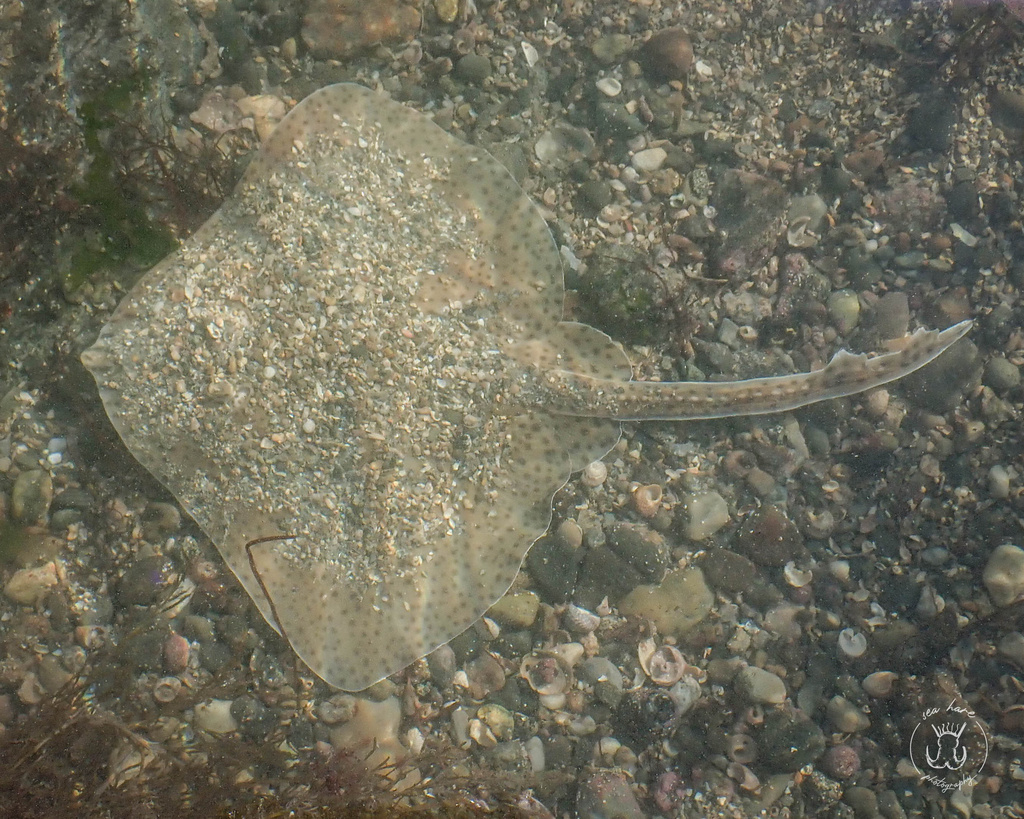
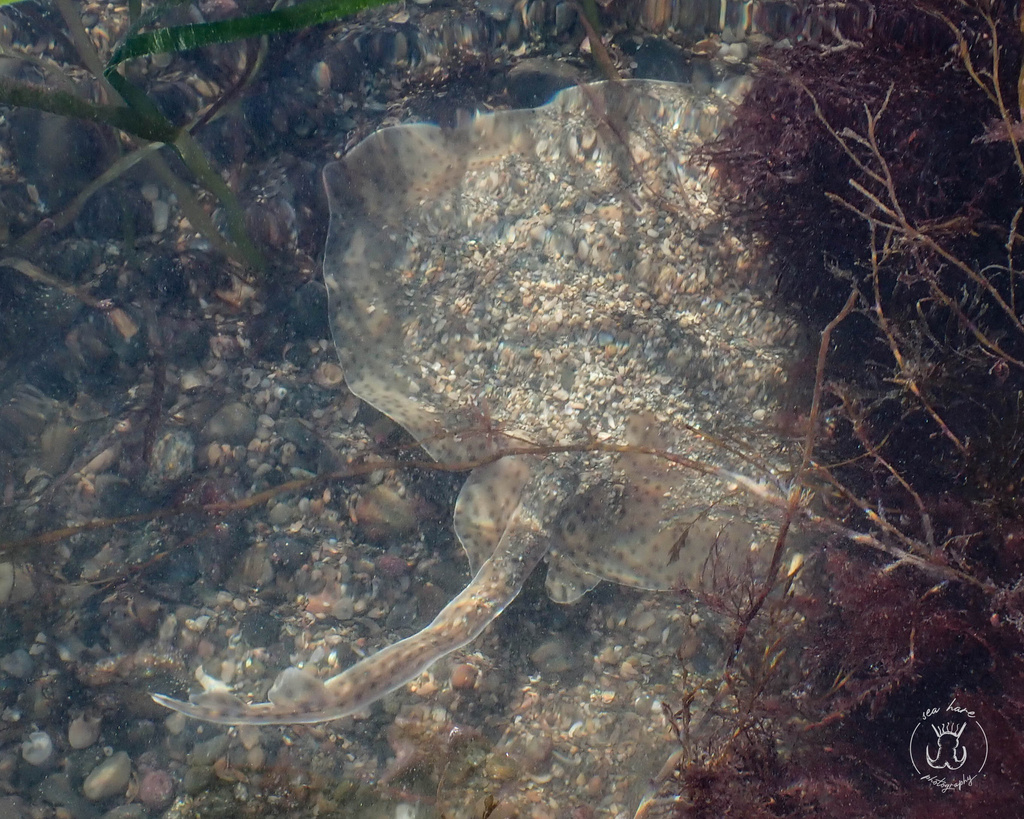

Photos show the species, not always the places on this page.
Length
Up to about 1.2 m (3 ft 11 in) long; FishBase gives 120 cm for males and 125 cm for females, and 90 cm at first maturity
Weight
Up to about 14.3 kg (31.5 lb) in FishBase; Fisheries Ireland gives up to 18 kg (40 lb); the sport-fishing record is 17 kg (37 lb) (Wikipedia)
Next to a person
Up to about the height of a seven or eight year old child, and as heavy as a large dog
What it eats
Crustaceans, worms and fish. Young rays take smaller crustaceans, while larger adults eat prey such as dragonets and sand eels (MarLIN). Wikipedia also lists small cephalopods and brown shrimp.
Around people
Calm, give space
How it lives
It lives on sand and mud in temperate water, from about 10 to 380 m, though Fisheries Ireland describes it as mostly inshore down to 100 m. Shallow coastal water is used as a nursery. It lays eggs in oblong capsules with pointed corners, about 10 to 14 cm long. Sources differ on how many a female lays in a year: FishBase says about 40 to 90, Fisheries Ireland about 30 on average, and Wikipedia gives clutches of 40 to 140. Laying is mainly from February to August. Rays mature at about 85 to 92 cm, which Wikipedia puts at 8 to 10 years, and live about 15 years on average.
Where it goes
In one Irish tagging programme, 734 blonde rays were tagged between 1971 and 2009, and some individuals moved more than 100 km. The sources read describe no fixed migration route.
We only draw a journey on the map when scientists have tracked it or clearly documented it. For this animal we have not found one yet.
Populations
Assessed as Near Threatened worldwide in April 2023. Wikipedia describes it as slow-growing, long-lived and late to mature, which makes it sensitive to fishing. Fisheries Ireland reports population declines in Irish waters, even though it is locally common in places, and says it is often caught as bycatch. FishBase records a minor commercial fishery and use as a game fish. The range runs from the Shetland Islands to Morocco, and it is rare in the Mediterranean.
Meet it respectfully
Rays lie half-hidden on sand, so look before you wade or kneel. Watch from a calm distance, and never chase, touch, lift, feed or bait one. If you find an egg capsule on the shore, leave it where it is. Follow your guide, and follow local rules where they apply.
Fun fact
Tap the bulb to light it up.
Its body is kite-shaped, and its tail is about as long as its disc.
Rays mature at about 85 to 92 cm, around 8 to 10 years old, so they breed late in life.
Its egg capsules are oblong with pointed corners, about 10 to 14 cm long.
Blonde ray in the Ocean Atlas
Places we have researched where this animal is recorded. It is never guaranteed, and some places are for watching from the boat only.
Travel with usComing soonTrusted referralExploringOn pause, story onlyEthics pass
Country colour: pink where we travel, blue where we are exploring or refer, grey for story only.
 Belgium
 Denmark
 France
 Germany
 Ireland
 Italy
Italy Netherlands
 Portugal
 Spain
Spain United Kingdom
Sources for this page
- FishBase, Raja brachyura
- Wikipedia, Blonde ray
- Inland Fisheries Ireland, Blonde ray
- MarLIN, Blonde ray
- IUCN Red List record via GBIF
Facts checked 5 October 2026. Photos: Unsplash licence, or Creative Commons as shown on each photo.
Work in ocean travel?
We are always happy to hear from exceptional local operators, accommodation, conservation organisations and destination experts. If your work fits responsible, small-group ocean travel, we would love to learn more.
Partner with Ocean Calling