
Blue-ringed octopuses
Hapalochlaena spp.
Small, shy and beautiful, blue-ringed octopuses carry one of the ocean's strongest venoms. Enjoy them with your eyes only, never with your hands.
Least Concern (IUCN, 2018) means it is not at high risk of extinction worldwide today.
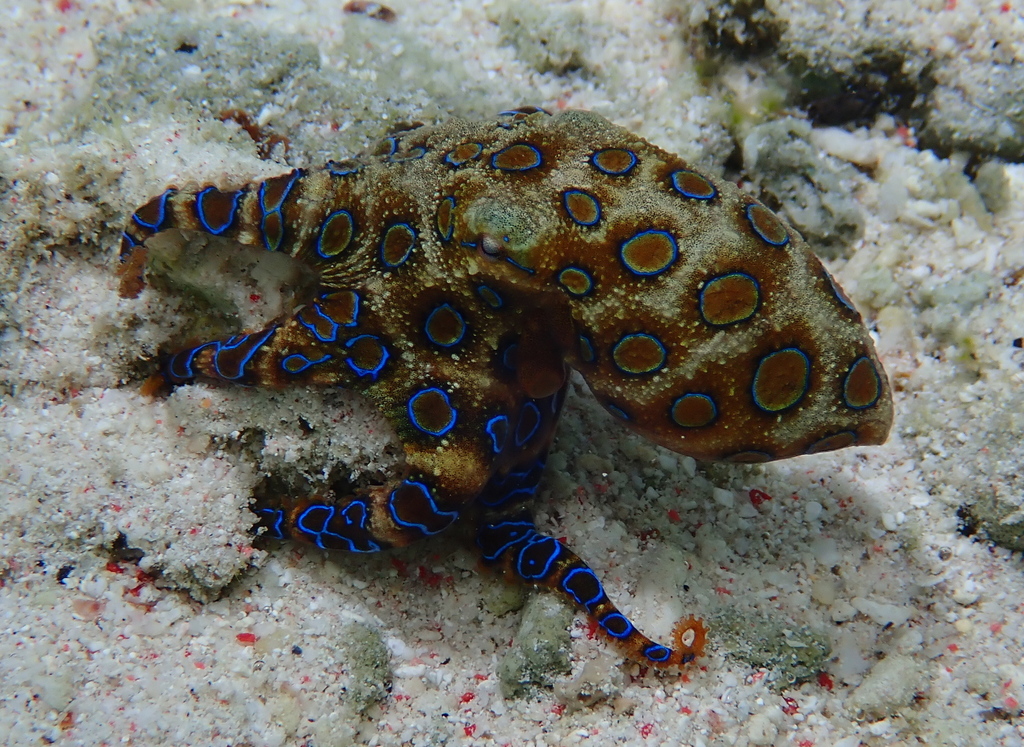
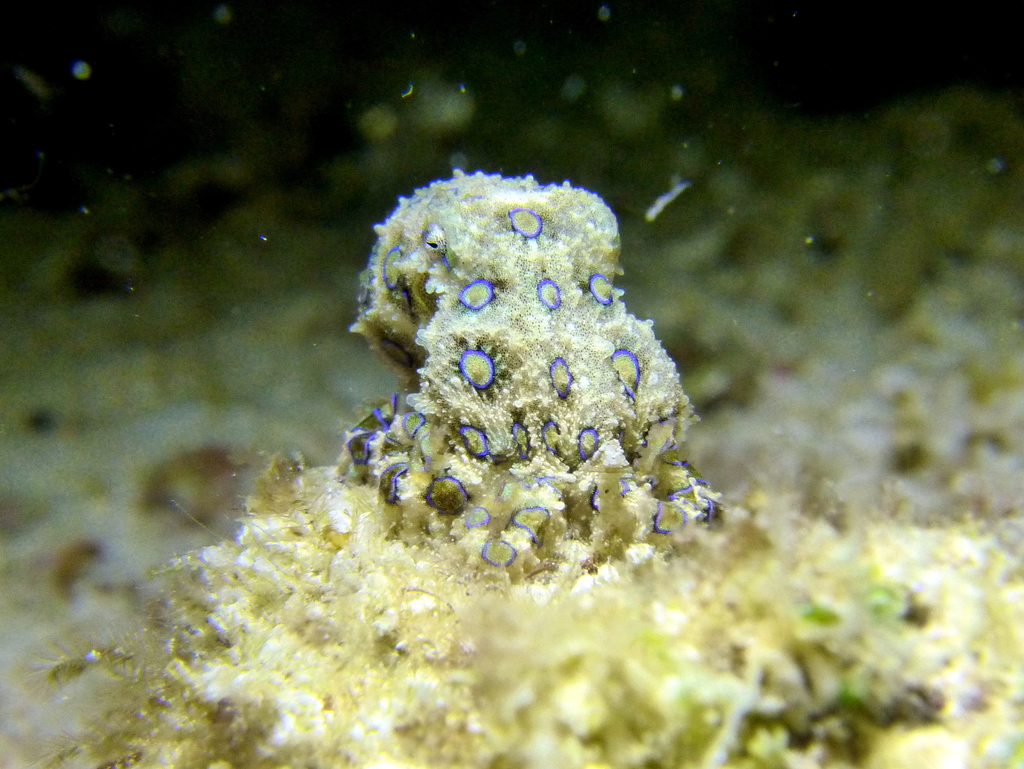
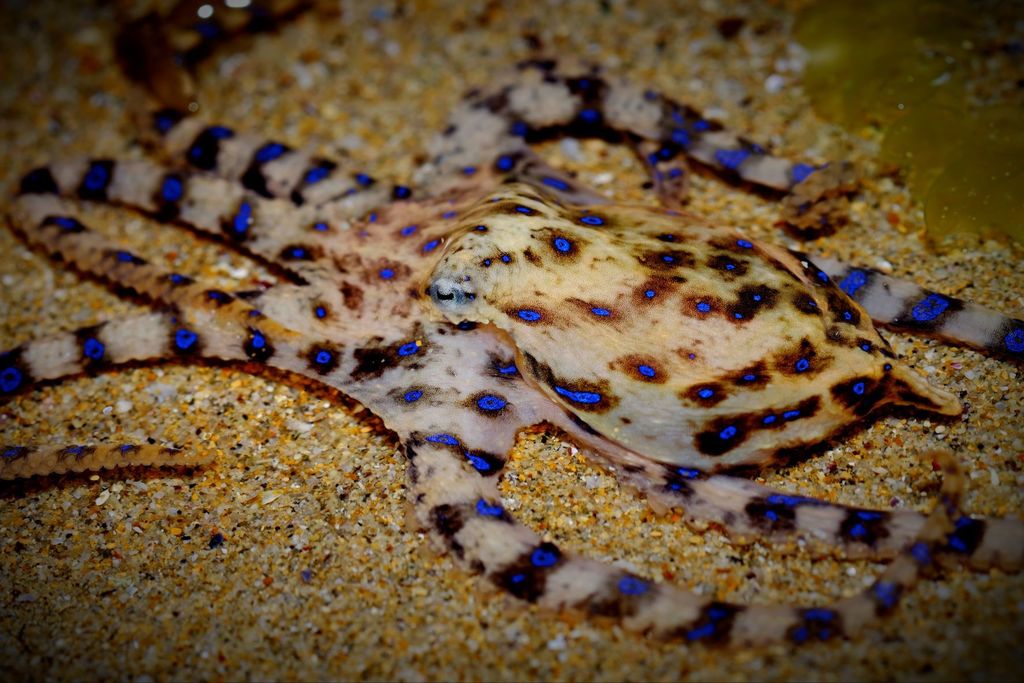
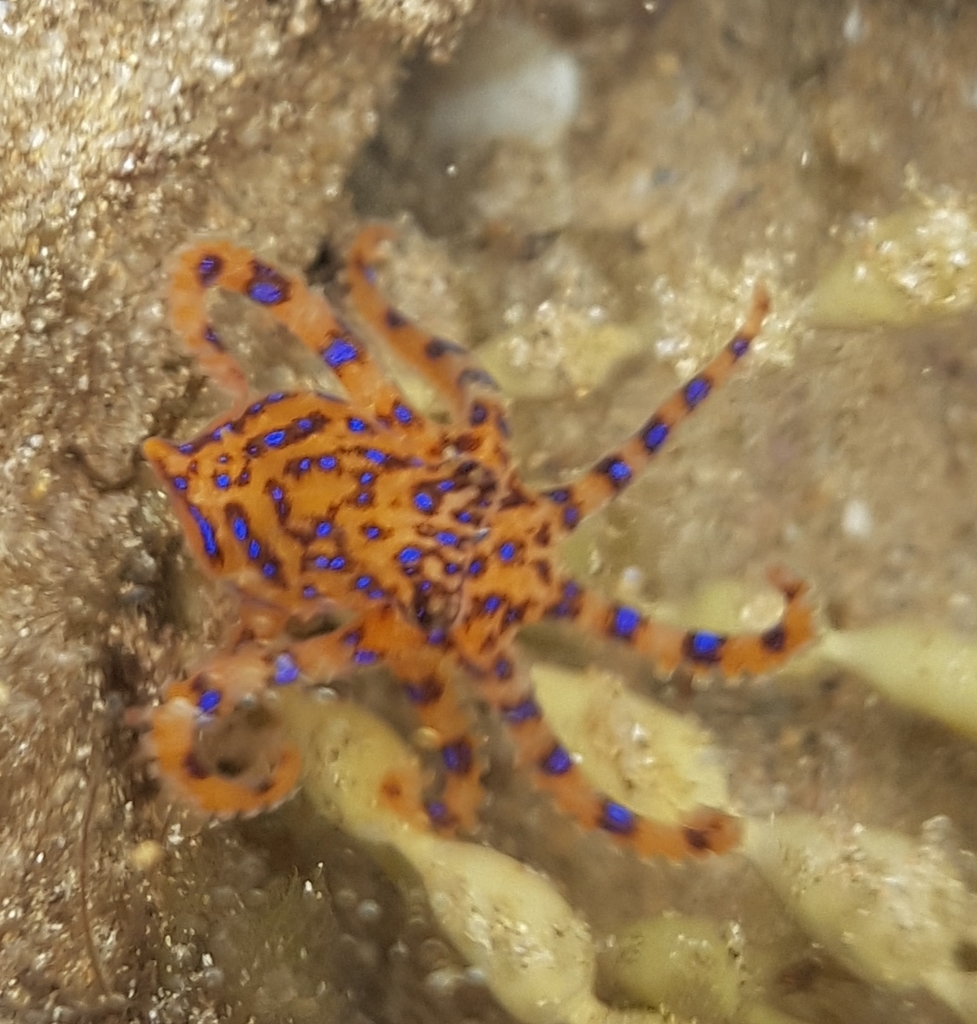
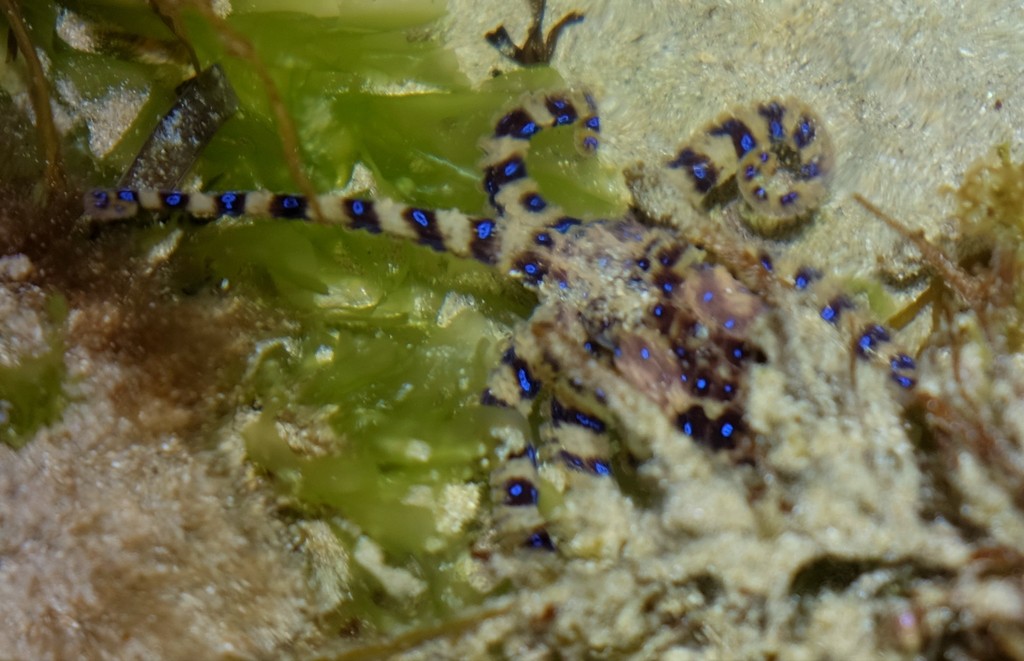
Photos show the species, not always the places on this page.
Length
Largest recorded with arms about 12 cm (4.7 in) for the greater, 15 cm (5.9 in) for the blue-lined and 22 cm (8.7 in) for the southern blue-ringed octopus; body up to about 5 cm (2 in)
Weight
Very light. Reported averages about 55 g (1.9 oz) for the greater and 26 g (0.9 oz) for the southern blue-ringed octopus; rarely more than about 100 g (3.5 oz)
Next to a person
Arms included, about as long as an adult's hand
What it eats
Small crabs, shrimps and small fish.
Around people
Potentially dangerous, respect
How it lives
Blue-ringed octopuses are small octopuses of rock pools, shallow reefs, seagrass and rubble. Most of the time they are brownish and hard to see; the bright blue rings or lines are a warning of strong toxicity. Their saliva carries tetrodotoxin, made by bacteria that live in the octopus. They hunt small crabs, shrimps and fish, and some species are mainly active at night.
Where it goes
Blue-ringed octopuses do not migrate. Adults live in a small area of reef, rock pool or jetty. Young southern blue-ringed and blue-lined octopuses crawl away on the bottom when they hatch, while young greater blue-ringed octopuses drift in the plankton first.
We only draw a journey on the map when scientists have tracked it or clearly documented it. For this animal we have not found one yet.
Populations
Four species are named, and a 2023 genetic study found at least 11 distinct groups from southern Australia to Japan, so more species will likely be described. The greater blue-ringed octopus lives on tropical Indo-West Pacific reefs; the southern blue-ringed and blue-lined octopuses live in Australia. Octopuses with blue lines have also been found along the coast of Korea since 2012, but they may not be the same species as the Australian blue-lined octopus.
Meet it respectfully
Look, never touch, and never chase one. Do not pick up a blue-ringed octopus, or a shell, bottle or rock it may hide in, in a rock pool or on a dive. A bite can be painless, yet it can stop breathing. Australian first aid guidance: call an ambulance, keep the person still, use a pressure bandage and start CPR or rescue breathing if they stop breathing normally, until medical help takes over. There is no antivenom. This is not medical advice; outside Australia, follow local emergency services.
Fun fact
Tap the bulb to light it up.
The blue rings are usually hidden and flash bright only as a warning.
There is no antivenom, but breathing support can save a life.
The bite is often painless, and a small spot of blood may be the only sign at first.
These octopuses are shy and usually dart for cover when people come close.
Male blue-lined octopuses have venom glands about three times heavier than females. In lab trials, males bit the female near her main blood vessel at the start of mating, so she stayed still while he mated. Females are about twice the size of males.
Source: Chung et al., 2025, Current Biology, blue-lined octopus males envenomate females
A person paralysed by blue-ringed octopus venom may not be able to move, yet can still hear what people say. Stay calm and keep talking kindly to them while you help.
Source: ANZCOR Guideline 9.4.6, Envenomation: blue-ringed octopus and cone shell
From 2012 to 2021, 26 blue-lined octopuses were collected along the coast of Korea, and all tested specimens carried tetrodotoxin. One non-fatal bite was reported there in June 2015.
Source: Kim et al., 2023, Toxins, blue-lined octopus on the Korean coast
Blue-ringed octopuses in the Ocean Atlas
Places we have researched where this animal is recorded. It is never guaranteed, and some places are for watching from the boat only.
Travel with usComing soonTrusted referralExploringOn pause, story onlyEthics pass
Country colour: pink where we travel, blue where we are exploring or refer, grey for story only.
 Australia
 Indonesia
 Japan
Japan Malaysia
 Philippines
Sources for this page
- SeaLifeBase, Hapalochlaena lunulata
- SeaLifeBase, Hapalochlaena maculosa
- SeaLifeBase, Hapalochlaena fasciata
- ANZCOR Guideline 9.4.6, Envenomation: blue-ringed octopus and cone shell, 2025
- Whitelaw et al., 2023, Molecular Phylogenetics and Evolution
- Asakawa et al., 2019, Toxins
- Britannica, Blue-ringed octopus, 2026
- Australian Museum, 2021, Southern blue-lined octopus
Facts checked 26 September 2026. Photos: Unsplash licence, or Creative Commons as shown on each photo.
Work in ocean travel?
We are always happy to hear from exceptional local operators, accommodation, conservation organisations and destination experts. If your work fits responsible, small-group ocean travel, we would love to learn more.
Partner with Ocean Calling