
Box jellyfish
Chironex fleckeri and other box jellyfish (Cubozoa)
Clear, cube-shaped swimmers of warm coasts. Their stings can be medically serious, so follow local signs and season advice.
Not Evaluated means IUCN has never assessed box jellyfish. Like most jellyfish, there is no global status yet.
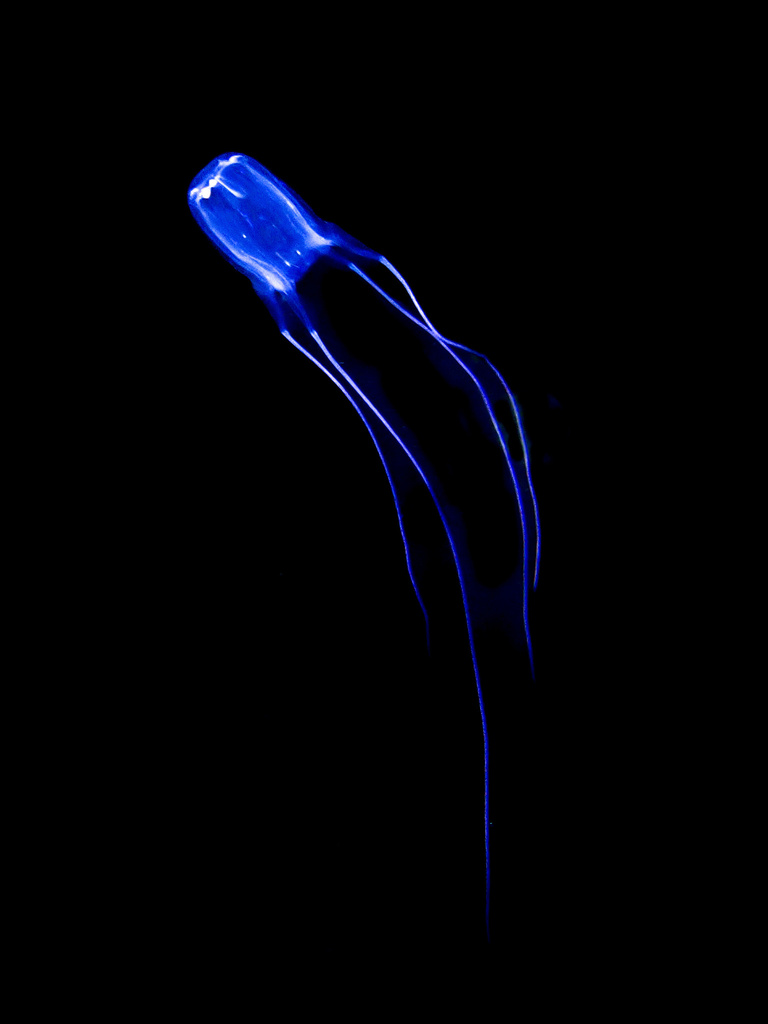
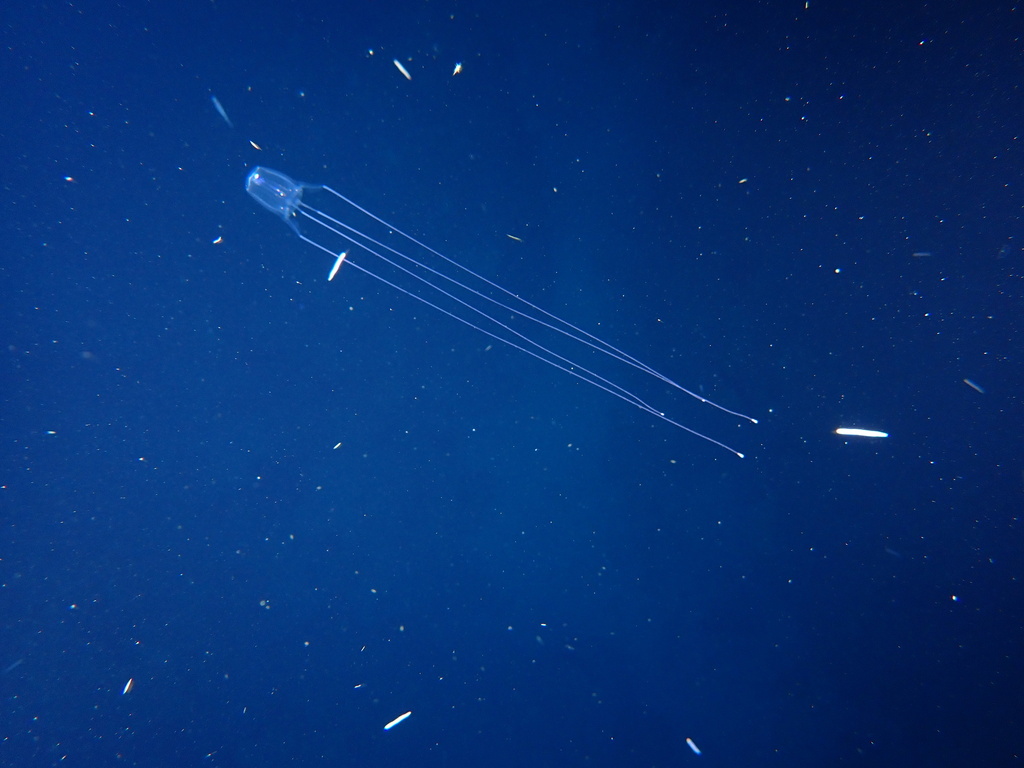
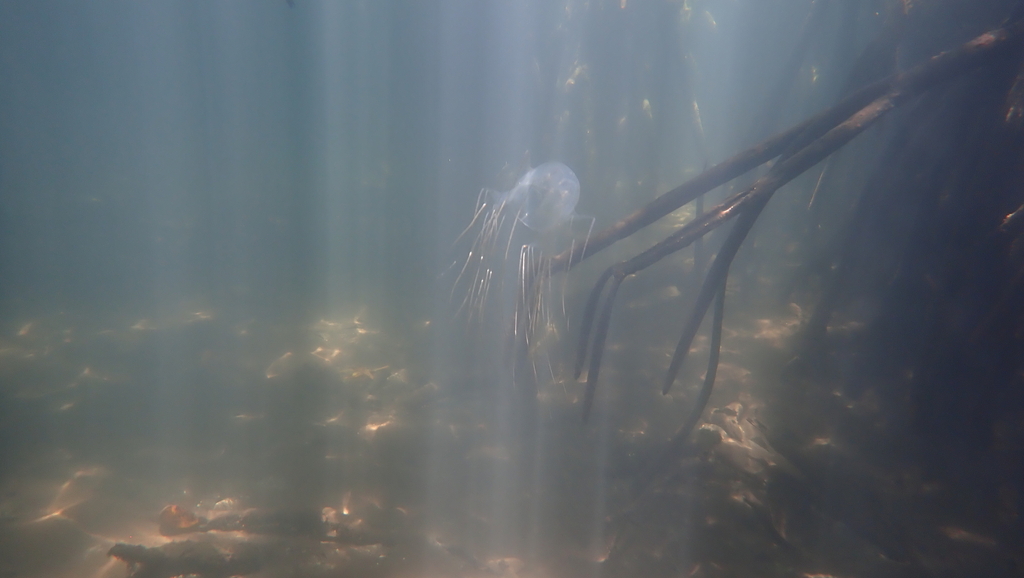
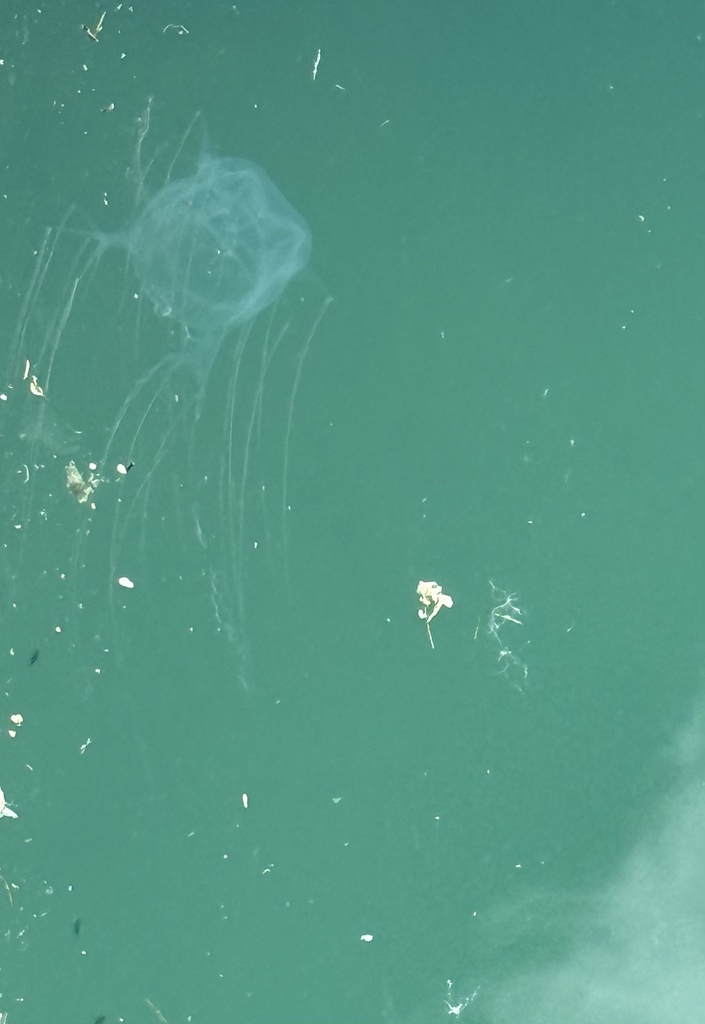
Photos show the species, not always the places on this page.
Length
Varies by species. Large Australian box jellyfish (Chironex fleckeri): bell up to about 30 cm (12 in), tentacles up to about 3 m (10 ft)
Weight
Not reliably measured
Next to a person
Bell about the size of a person's head or smaller; tentacles can trail several metres
What it eats
The Australian box jellyfish hunts prawns, shrimps and small fish near coasts and mangrove creeks. Other box jellies eat different prey, depending on the species.
Around people
Potentially dangerous, respect
How it lives
Box jellyfish have a box-shaped bell and swim actively, they do not only drift. They have 24 eyes on four sensory clubs. The Australian box jellyfish, Chironex fleckeri, lives in coastal and estuary water in northern Australia, and its sting can be very dangerous. Related but different box jellies live in Thailand, the Philippines, Malaysia and Japan. In Hawaiʻi, a smaller and different box jelly comes to the beaches in monthly waves.
Where it goes
Not a long migrant, but seasonal and lunar, and seasons differ by place. In Queensland the stinger season is November to May, with some risk all year. The Northern Territory has used 1 October to 1 June. On Oʻahu, box jellies arrive at Waikīkī about 8 to 12 days after each full moon to spawn (counts 1998 to 2011). Tagged Chironex in Australia moved both with the tide and on their own.
We only draw a journey on the map when scientists have tracked it or clearly documented it. For this animal we have not found one yet.
Populations
At Waikīkī, 66,605 box jellies (not Chironex) were counted between 1998 and 2011, from 5 to 2,365 per monthly arrival, with numbers going up and down in cycles. On Koh Samui and Koh Pha-ngan in Thailand, 15 severe stings were recorded from 1997 to 2015, 6 of them fatal, most in July to October.
Meet it respectfully
We never touch jellyfish, also washed-up tentacles on the beach. In stinger season, swim at patrolled beaches, inside stinger nets where provided, and wear a full lycra stinger suit. Australian first aid guidance: call 000, start CPR if needed, get the person out of the water, consider vinegar on the sting for 30 seconds, pick off tentacles, then use a cold pack. Never use fresh water, and do not use hot water where Chironex is possible. Vinegar is not for bluebottles. This is not medical advice, and outside Australia follow local emergency advice.
Fun fact
Tap the bulb to light it up.
Box jellyfish have 24 eyes, and some of these eyes have real lenses.
A large Australian box jellyfish can have up to about 60 tentacles in four bunches.
Box jellies are active hunters and can swim toward movement.
The Portuguese man o' war is not a box jellyfish, and not even a true jellyfish.
At Waikīkī, Oʻahu, box jellies came to the beach 8 to 12 days after each full moon for 14 years in a row, from 1998 to 2011.
University of Hawaiʻi researchers found that the arriving box jellies were full of eggs or sperm, so the monthly waves are spawning trips to the shore.
Source: University of Hawaiʻi News, 2022
In 2025, Philippine scientists confirmed a dangerous box jellyfish known from Japan, Chironex yamaguchii, in Philippine waters.
Box jellyfish have 24 eyes on four sensory clubs, and some of these eyes have real lenses. They use their vision to steer while they swim.
Source: Petie, Garm & Nilsson, 2011, Journal of Experimental Biology
Some box jellyfish eyes have lenses that make an almost perfectly sharp image, something once thought to exist only in much more complex animals.
Source: Nilsson et al., 2005, Nature
In 2019, University of Sydney scientists used CRISPR gene editing on human cells to learn how Chironex venom kills cells. The venom needs cholesterol in cell membranes, and a cholesterol-removing compound blocked pain and skin damage in mice when given up to 15 minutes after contact. It is not yet a human treatment.
Box jellyfish in the Ocean Atlas
Places we have researched where this animal is recorded. It is never guaranteed, and some places are for watching from the boat only.
Travel with usComing soonTrusted referralExploringOn pause, story onlyEthics pass
Country colour: pink where we travel, blue where we are exploring or refer, grey for story only.
 Australia
 Japan
Japan Malaysia
 Philippines
 Thailand
 United States
Sources for this page
- ANZCOR Guideline 9.4.5, First aid management of marine envenomation
- Queensland Government, Dangerous marine life
- Northern Territory Government, Box jellyfish
- Australian Museum, 2024, Box jellyfish
- Chiaverano et al., 2013, PLOS ONE
- Thaikruea & Siriariyaporn, 2016, BMC Research Notes
- Petie, Garm & Nilsson, 2011, Journal of Experimental Biology
- Gordon & Seymour, 2009, Hydrobiologia
Facts checked 26 September 2026. Photos: Unsplash licence, or Creative Commons as shown on each photo.
Work in ocean travel?
We are always happy to hear from exceptional local operators, accommodation, conservation organisations and destination experts. If your work fits responsible, small-group ocean travel, we would love to learn more.
Partner with Ocean CallingShop with Ocean Calling
Visit the Ocean Calling storefront on Amazon.
As an Amazon Associate I earn from qualifying purchases. You are not only choosing products that respect the ocean, you are also helping us keep going: paying our local partners fairly and keeping our retreats ethical, sustainable and honestly priced for you. 💗