
Clymene dolphin
Stenella clymene
A small, quick dolphin of deep Atlantic water. Whether one appears is up to the sea, and no sighting is ever a promise.
Least Concern (IUCN, 2018) means the species is not close to being threatened at present, though there is no estimate of its total population or its trend.

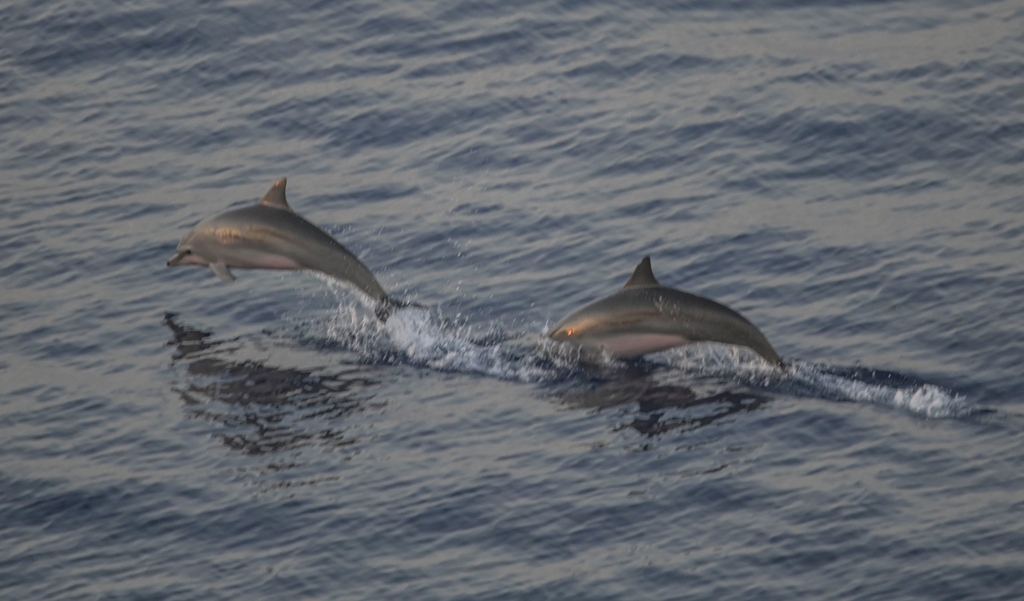
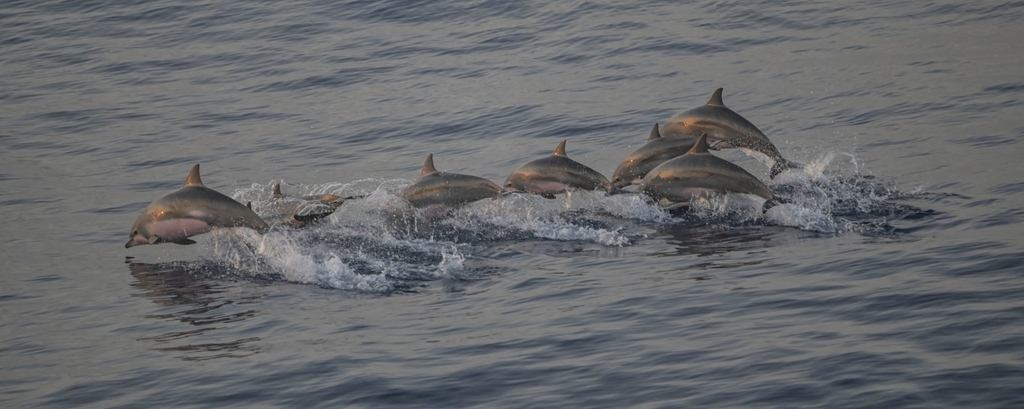
Photos show the species, not always the places on this page.
Length
About 1.8 to 2 m (6 to 6.5 ft); sources give roughly 1.8 m up to 2 m
Weight
About 75 to 90 kg (165 to 200 lb); one source gives 75 to 80 kg
Next to a person
About as long as an adult is tall, and about as heavy as one adult
What it eats
Small fish and squid. Clymene dolphins are thought to feed at night, when prey move up toward the surface, or in deep water where there is little light.
Around people
Calm, steady boat
How it lives
Groups are usually around 40 animals, with reports from 2 up to 200. NOAA gives 60 to 80 as typical for its stocks. Many groups are made up of one sex and one age class. Clymene dolphins are lively: they leap and spin, though less regularly than spinner dolphins, and they sometimes ride the bow wave of boats. Calving and lifespan are not covered by the sources read.
Where it goes
Clymene dolphins live in deep Atlantic water, usually deeper than 100 m, so most meetings happen well offshore. No set migration is described in the sources read. Off West Africa the species is known from few records: the northernmost is a stranding north of Nouakchott (about 19°N) and the southernmost a sighting off northern Angola (about 6°S). It does not occur in the Mediterranean.
We only draw a journey on the map when scientists have tracked it or clearly documented it. For this animal we have not found one yet.
Populations
There is no estimate for the whole species and no known trend. NOAA lists about 513 animals for the northern Gulf stock and about 21,778 for the western North Atlantic stock (counts for US waters only). In the eastern tropical Atlantic the species is confirmed from only eight countries, out of some twenty possible range states, so West African records are patchy. Some are taken in Caribbean harpoon fisheries and in nets, including possibly off West Africa. IUCN lists the species as Least Concern (2018).
Meet it respectfully
Let the dolphins choose the distance. If they come to your boat, hold a steady course and speed, and never chase, circle, touch, feed or swim into a group. Keep noise low and give them room to leave. Clymene dolphins live far offshore, so meetings are brief and never promised. Follow your skipper and local guidance.
Fun fact
Tap the bulb to light it up.
At about 2 m long, it is the smallest dolphin in the genus Stenella.
It lives only in the Atlantic Ocean and has not been recorded in the Mediterranean.
Many groups are all one sex and one age class, rather than mixed families.
Clymene dolphin in the Ocean Atlas
Places we have researched where this animal is recorded. It is never guaranteed, and some places are for watching from the boat only.
Travel with usComing soonTrusted referralExploringOn pause, story onlyEthics pass
Country colour: pink where we travel, blue where we are exploring or refer, grey for story only.
 Brazil
 Guadeloupe
 Senegal
 United States
 Western Sahara
Sources for this page
- IUCN Red List category via GBIF, 2018
- NOAA Fisheries, Clymene dolphin
- Mammals of Texas Online, Texas Tech University
- Mammal Diversity Database
- CMS, Proposal II/4 (Guinea-Bissau)
- Wikipedia, Clymene dolphin
Facts checked 5 October 2026. Photos: Unsplash licence, or Creative Commons as shown on each photo.
Work in ocean travel?
We are always happy to hear from exceptional local operators, accommodation, conservation organisations and destination experts. If your work fits responsible, small-group ocean travel, we would love to learn more.
Partner with Ocean Calling5-day freediving course in Bali
CHF 1,180