
Eastern rockhopper penguin
Eudyptes filholi
A small crested penguin on a rocky shore far from the mainland. Where birds come ashore is their choice, and no sighting is ever a promise.
Not Evaluated means the IUCN Red List record I read has no category for this species on its own. BirdLife and the IUCN penguin specialists recommended Vulnerable in February 2026 for the 2026 Red List.
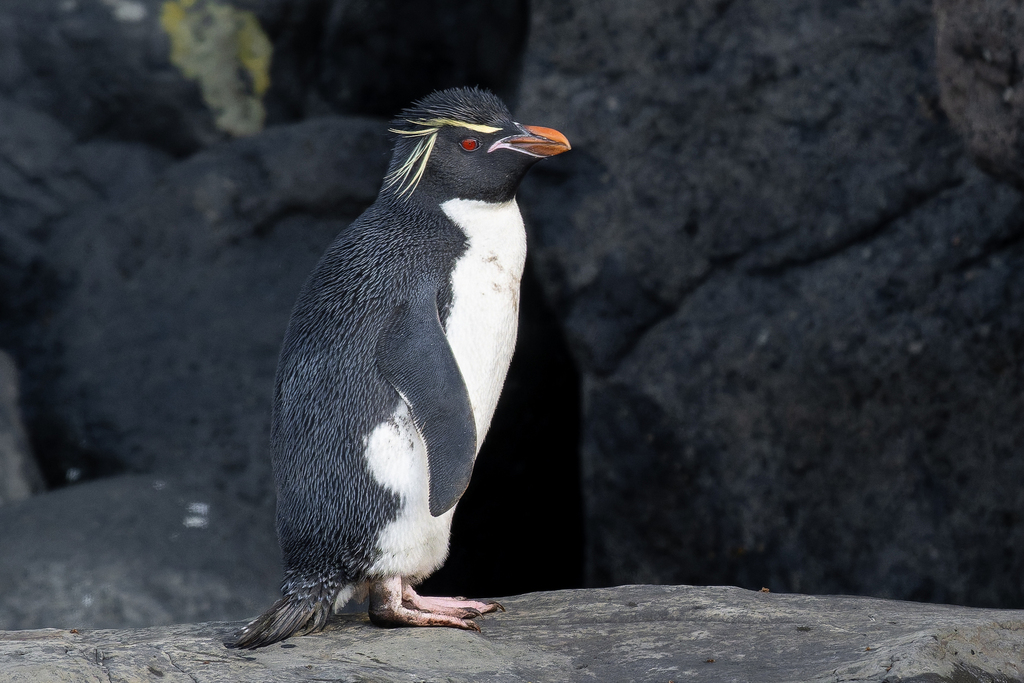
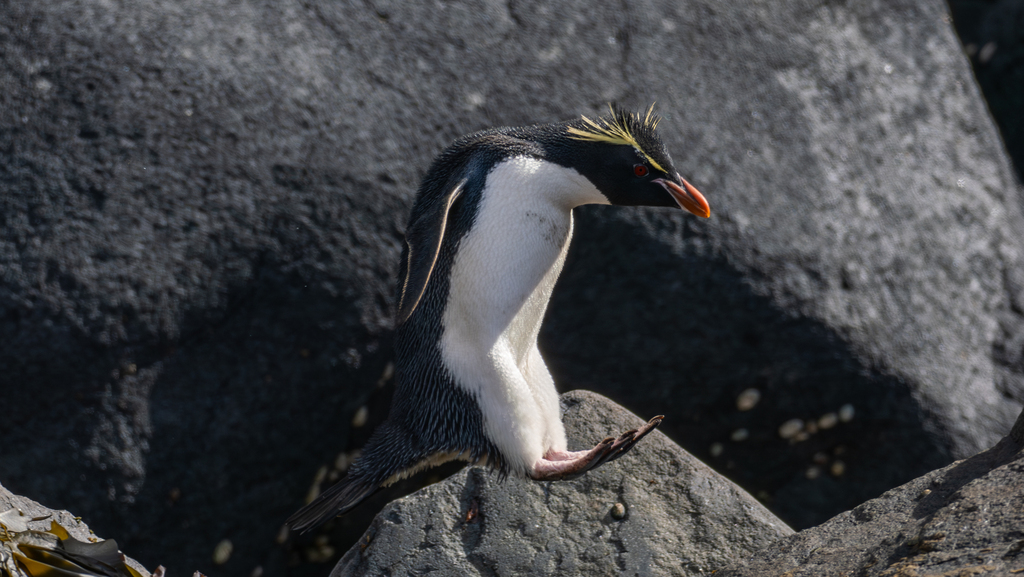
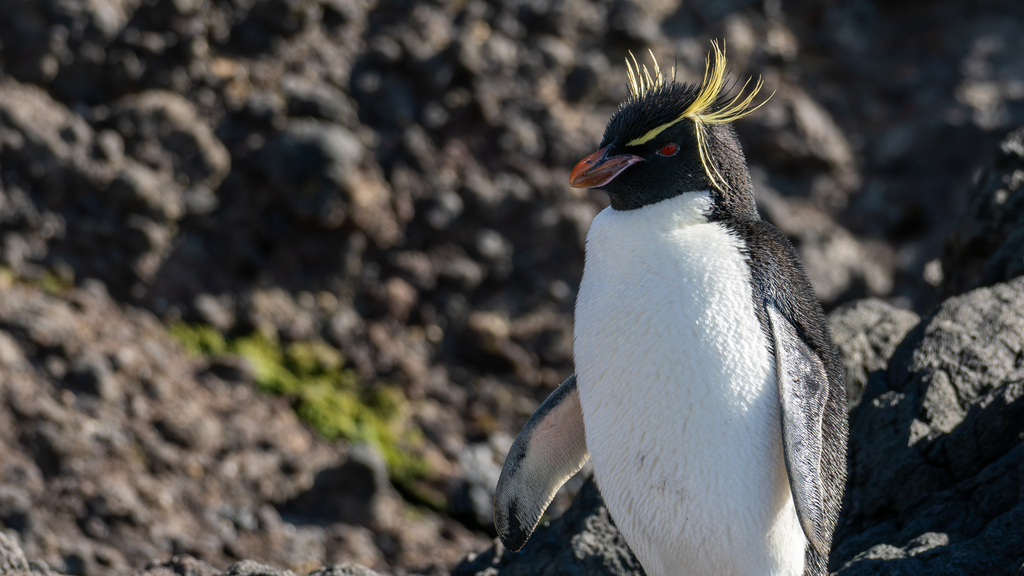
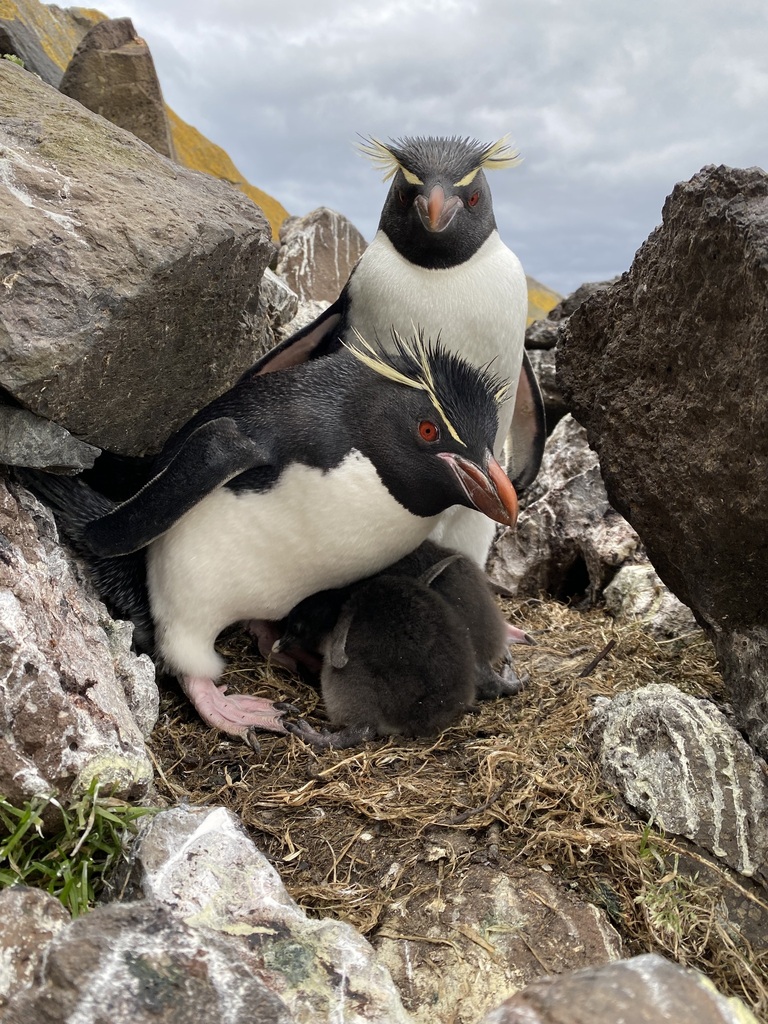
Photos show the species, not always the places on this page.
Length
About 45 to 55 cm (18 to 22 in) tall
Weight
About 2 to 4 kg (4.4 to 8.8 lb); sources give 2 to 4 kg and 2.2 to 4.3 kg (4.9 to 9.5 lb)
Next to a person
About knee height on an adult, and as heavy as a large house cat
What it eats
Small fish, squid, octopus and krill-like crustaceans. The mix changes by place and by whether birds are feeding chicks. At Campbell Island in 1985 to 1986, southern blue whiting made up about three quarters of the prey fed to chicks.
Around people
Calm, give space
How it lives
Breeding starts in October, when males arrive first. Eggs are laid around November, and chicks leave the nest about 65 days after hatching, around February. Colonies are often on steep slopes near the sea, with nests among and under boulders. Parents take turns incubating and feeding. Chicks gather in groups called creches when they are about 24 days old.
Where it goes
Eastern rockhoppers breed on subantarctic islands in the southern Indian and Pacific Oceans, from the Prince Edward Islands to the Antipodes Islands, including Macquarie Island. Colonies sit on steep slopes near the sea. I did not find a clear account of where birds go outside the breeding season. Records on mainland New Zealand are extremely rare, with only four documented between 2017 and 2024, and experts have noted more stray birds reaching Tasmania.
We only draw a journey on the map when scientists have tracked it or clearly documented it. For this animal we have not found one yet.
Populations
The IUCN Red List record I read lists the species as Not Evaluated. In early 2026 BirdLife and the IUCN penguin specialists recommended Vulnerable for the 2026 Red List, after the eastern and southern rockhoppers were treated as separate species; I could not confirm the final listing. In New Zealand it is classed as Nationally Vulnerable. Campbell Island fell from about 800,000 breeding pairs in 1942 to 33,200 in 2012, and Auckland and Antipodes Islands each hold fewer than 3,000 pairs. One summary page gives about 1.6 million breeding pairs overall and a falling trend, but I did not find the primary count.
Meet it respectfully
Most people will see this penguin only from a boat near subantarctic islands, and a bird on a mainland shore is a rare stray. Keep well back, move slowly and stay quiet. Never chase, touch, feed or crowd it, and keep out of nesting areas. A tired stray needs space more than company.
Fun fact
Tap the bulb to light it up.
It is the smallest of the crested penguins.
It moves over steep, rocky shores by hopping with both feet together.
Campbell Island's colony fell from about 800,000 breeding pairs in 1942 to 33,200 in 2012.
Eastern rockhopper penguin in the Ocean Atlas
Places we have researched where this animal is recorded. It is never guaranteed, and some places are for watching from the boat only.
Travel with usComing soonTrusted referralExploringOn pause, story onlyEthics pass
Country colour: pink where we travel, blue where we are exploring or refer, grey for story only.
 Australia
 New Zealand
 South Africa
Sources for this page
- Wikipedia, Eastern rockhopper penguin
- New Zealand Birds Online, Eastern rockhopper penguin
- BirdLife International forum, 2026 Red List proposal
- GBIF, Eudyptes filholi record
- GBIF, IUCN Red List category record
- Penguin Place, Eastern rockhopper penguin
Facts checked 5 October 2026. Photos: Unsplash licence, or Creative Commons as shown on each photo.
Work in ocean travel?
We are always happy to hear from exceptional local operators, accommodation, conservation organisations and destination experts. If your work fits responsible, small-group ocean travel, we would love to learn more.
Partner with Ocean CallingShop with Ocean Calling
Visit the Ocean Calling storefront on Amazon.
As an Amazon Associate I earn from qualifying purchases. You are not only choosing products that respect the ocean, you are also helping us keep going: paying our local partners fairly and keeping our retreats ethical, sustainable and honestly priced for you. 💗