Greenland shark
Somniosus microcephalus
A slow grey shape in deep, cold water, older than most countries. It is rarely seen, and no sighting is ever a promise.
Vulnerable (IUCN, assessed 2019, published 2020) means the Greenland shark is at high risk of extinction in the wild, because it grows and breeds very slowly and is caught by accident in fisheries.


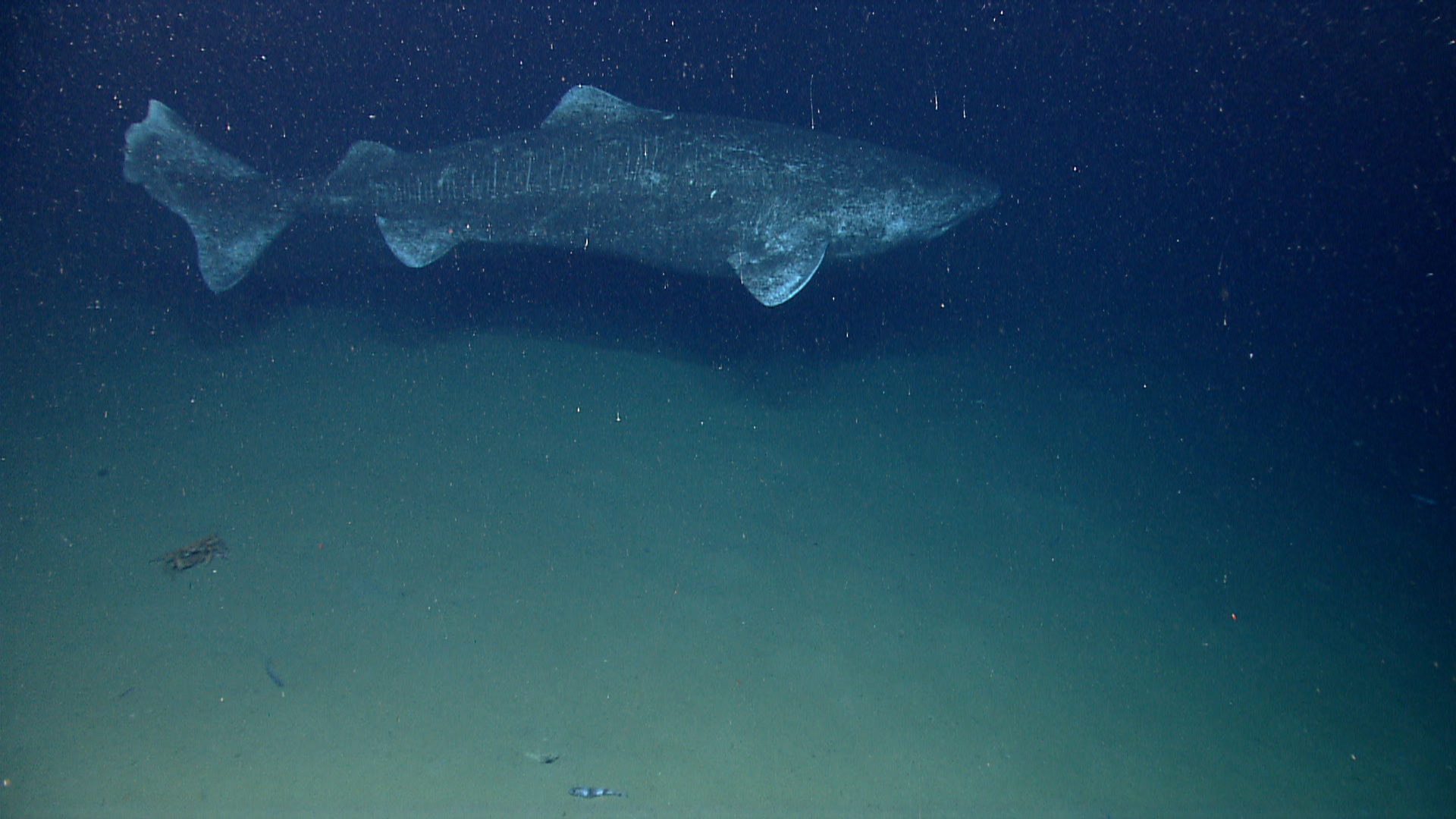
Photos show the species, not always the places on this page.
Length
Most adults about 3 to 5 m (9.8 to 16 ft); the largest confirmed about 6.4 m (21 ft). FishBase gives a maximum of about 5.5 m for females and Save Our Seas up to 7.3 m, so the upper limit is debated
Weight
The largest confirmed specimen weighed about 1,023 kg (2,255 lb). Most are much lighter, and no typical weight is given in the sources read
Next to a person
A typical adult is two to three times as long as a person is tall
What it eats
A flexible feeder and scavenger. It takes fish such as herring, salmon, cod and halibut, plus squid and seals. Stomachs have held seals and even a reindeer, and large animals may be eaten as carrion. Despite its slow swimming it also hunts, and some prey seem to have been caught alive.
Around people
Rare, deep and slow
How it lives
Greenland sharks grow very slowly, about 1 cm a year, and reach maturity very late. Radiocarbon dating of eye lenses from 28 females suggested a life span of at least 272 years, with the oldest estimated at about 392 years, and maturity at about 156 years, give or take 22. Females give birth to live young, and litters are thought to be up to about 10 pups of roughly 38 cm. Gestation is not known well; one estimate is 8 to 18 years. Nearly every shark carries a parasitic copepod on the cornea of the eye, which probably reduces its vision.
Where it goes
The Greenland shark lives in cold water of the North Atlantic and Arctic Ocean, from the surface down to depths of nearly 3,000 m, although it is most often reported at about 200 to 600 m. In a camera study in the Canadian Arctic, about three quarters of the sharks were seen at 0 to 0.5 degrees C. It is described as a mobile, non-shoaling predator and scavenger. Its long-distance movements are not well described in the sources read.
We only draw a journey on the map when scientists have tracked it or clearly documented it. For this animal we have not found one yet.
Populations
The IUCN lists the Greenland shark as Vulnerable (assessed 2019, published 2020), an upgrade from Near Threatened. The main threat is accidental catch in fisheries, for example bottom trawls and gillnets for Greenland halibut, and Wikipedia gives a figure of about 3,500 sharks caught per year. FishBase rates the shark as very highly vulnerable to fishing because it grows and breeds so slowly. The global population size is not known. A baited-camera study in five areas of northern Nunavut, Canada, found local densities of about 0.4 to 15.5 sharks per square kilometre, and most sharks seen were not yet mature. I did not find a population estimate for Greenland waters.
Meet it respectfully
Most people will never see a Greenland shark, because it lives in deep, cold water. If one does appear near a boat or an ice edge, keep still and keep your distance. Never chase, touch, feed or bait it, and never lift or pull a shark out of the water. Local fishing and wildlife rules differ by place and I did not read them, so follow local rules and your guide. Treat any encounter as a chance moment, not something to expect.
Fun fact
Tap the bulb to light it up.
It is the longest-lived vertebrate known. Eye-lens dating found animals at least 272 years old, and one of about 392 years.
Almost every Greenland shark carries a small parasite on each eye, and its vision is probably poor.
In a baited-camera study its mean swimming speed was about 0.27 m per second, roughly 1 km an hour.
Greenland shark in the Ocean Atlas
Places we have researched where this animal is recorded. It is never guaranteed, and some places are for watching from the boat only.
Travel with usComing soonTrusted referralExploringOn pause, story onlyEthics pass
Country colour: pink where we travel, blue where we are exploring or refer, grey for story only.
 Canada
 Denmark
 Greenland
 Iceland
 Norway
 Russia
 Sweden
 United Kingdom
Sources for this page
- FishBase, Somniosus microcephalus
- GBIF, IUCN Red List category, 2026
- Nielsen et al., 2016, Science
- Scientific Reports, 2018, Greenland shark local abundances in Arctic waters
- Save Our Seas Foundation, Greenland shark
- Oceana Canada, Greenland shark
- Wikipedia, Greenland shark
Facts checked 5 October 2026. Photos: Unsplash licence, or Creative Commons as shown on each photo.
Work in ocean travel?
We are always happy to hear from exceptional local operators, accommodation, conservation organisations and destination experts. If your work fits responsible, small-group ocean travel, we would love to learn more.
Partner with Ocean Calling5-day freediving course in Bali
CHF 1,180