
Guanay cormorant
Leucocarbo bougainvilliorum
A dark and white seabird that gathers in huge, tightly packed colonies on the Peruvian coast. Colonies are busy but easy to disturb, and no sighting is ever a promise.
Near Threatened (IUCN) means it is close to qualifying as threatened, mainly because of competition with fisheries and habitat loss. The assessment year was not shown on the pages I could open.


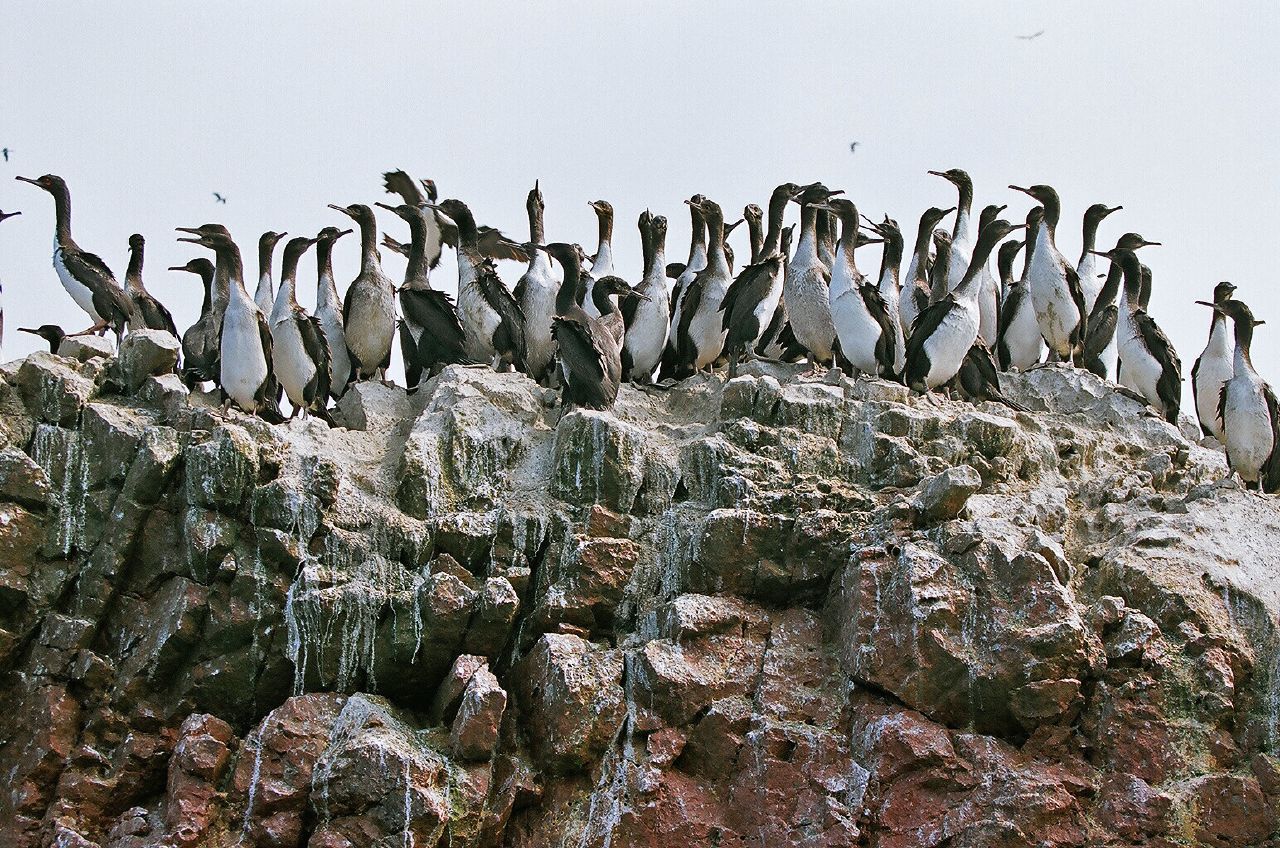
Photos show the species, not always the places on this page.
Length
About 71 to 78 cm (28 to 31 in) from bill to tail
Weight
About 2.2 kg (4.9 lb) for males and 2.0 kg (4.3 lb) for females in one study at Punta San Juan; other sources give slightly higher figures
Next to a person
About as long as a one-year-old child is tall, and as heavy as two bags of sugar
What it eats
Mainly Peruvian anchoveta, plus Peruvian silverside, sardines, mote sculpin and squid. Guanay cormorants chase fish underwater, with average dive depths of about 8 to 12 m in the Punta San Juan study.
Around people
Calm, give space
How it lives
Guanay cormorants breed in dense colonies on offshore islands and headlands. Nests are built of guano on flat ground, at densities of up to about three per square metre. Pairs lay two or three eggs. Breeding can happen all year, with peaks in November and December. The species is the main producer of guano, the seabird droppings once prized as fertiliser. Incan law protected nesting birds, and Peru still protects guano islands today.
Where it goes
Guanay cormorants live along the Pacific coast of Peru and northern Chile. After breeding they spread south to southern Chile and north to Ecuador. In El Niño years, when food runs short, they have been recorded as far north as Panama and Colombia.
We only draw a journey on the map when scientists have tracked it or clearly documented it. For this animal we have not found one yet.
Populations
IUCN lists the species as Near Threatened. The population was estimated at about 3 million birds in 1984 (some sources say 3.7 million). It has since fallen by about 30 percent, linked to competition with fisheries, bycatch, and habitat loss. A study at Punta San Juan reports further declines from avian influenza in 2022 to 2023 and from El Niño in 2023 to 2024, without giving a total. After the January 2022 oil spill off Lima, guanay cormorants were among the most affected species. Peru's wildlife service SERFOR recorded 1,852 dead wild animals of 28 species, but the exact total is unknown.
Meet it respectfully
Watch colonies from a boat and keep your distance, because nesting birds flush easily and leave eggs or chicks exposed. Never land on guano islands, and never chase, feed or approach nesting birds. One source reports that walls keep visitors out of sensitive nesting areas on the Guañape Islands, which are part of the Guano Islands and Capes National Reserve System. Follow your guide and the reserve rules.
Fun fact
Tap the bulb to light it up.
It has a red face patch and a green eye-ring, with pink-orange feet.
It is called the "billion-dollar bird" because its guano fed a huge fertiliser trade in the 19th century.
Colonies are so dense that nests can be about three to a square metre.
Guanay cormorant in the Ocean Atlas
Places we have researched where this animal is recorded. It is never guaranteed, and some places are for watching from the boat only.
Travel with usComing soonTrusted referralExploringOn pause, story onlyEthics pass
Country colour: pink where we travel, blue where we are exploring or refer, grey for story only.
 Chile
Chile Colombia
 Ecuador
 Peru
PeruSources for this page
- Wikipedia, Guanay cormorant, 2026
- PMC, guanay cormorants and Peruvian pelicans at Punta San Juan, 2025
- Oiseaux.net, Guanay cormorant, 2026
- GBIF, IUCN Red List category lookup, 2026
- Save Our Seas Magazine, Guano: the bird's bounty, 2026
- Wikipedia, Guañape Islands, 2026
- Mongabay, animals killed in the Peru oil slick, 2022
- Mongabay, 2022 Repsol oil spill update, 2025
Facts checked 5 October 2026. Photos: Unsplash licence, or Creative Commons as shown on each photo.
Work in ocean travel?
We are always happy to hear from exceptional local operators, accommodation, conservation organisations and destination experts. If your work fits responsible, small-group ocean travel, we would love to learn more.
Partner with Ocean CallingShop with Ocean Calling
Visit the Ocean Calling storefront on Amazon.
As an Amazon Associate I earn from qualifying purchases. You are not only choosing products that respect the ocean, you are also helping us keep going: paying our local partners fairly and keeping our retreats ethical, sustainable and honestly priced for you. 💗