
Japanese cormorant
Phalacrocorax capillatus
A dark seabird on a rocky ledge or breakwater, drying its wings between dives. Birds come and go with the season, and no sighting is ever a promise.
Least Concern (IUCN, 2018) means it is not currently considered at risk of extinction.
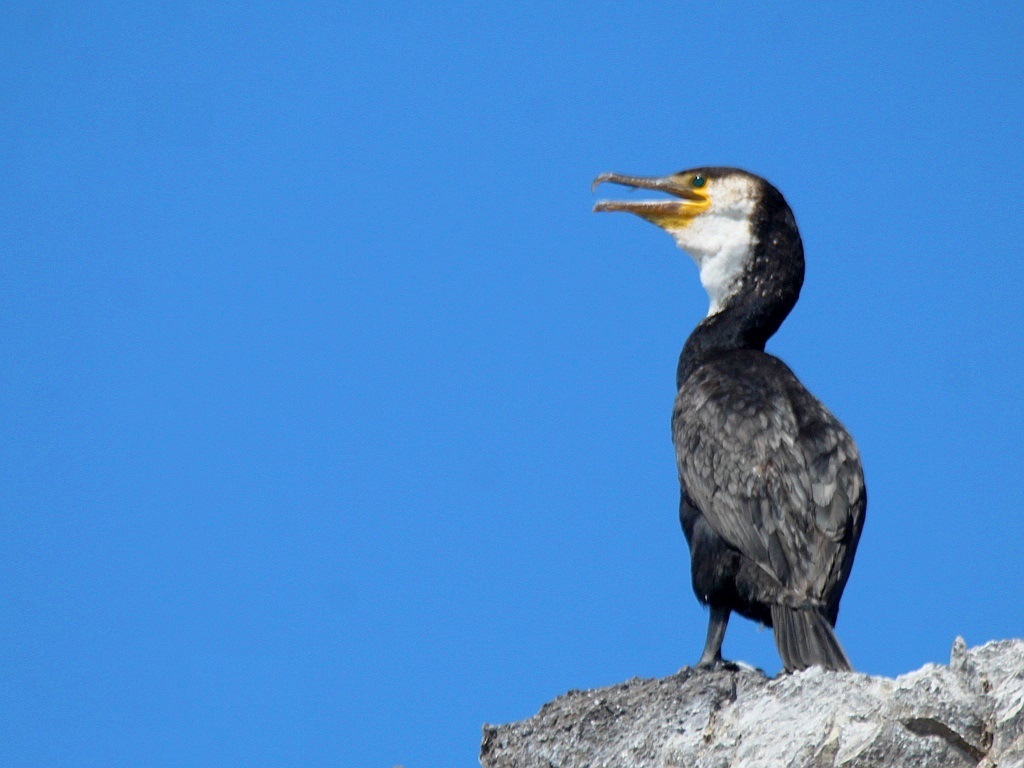
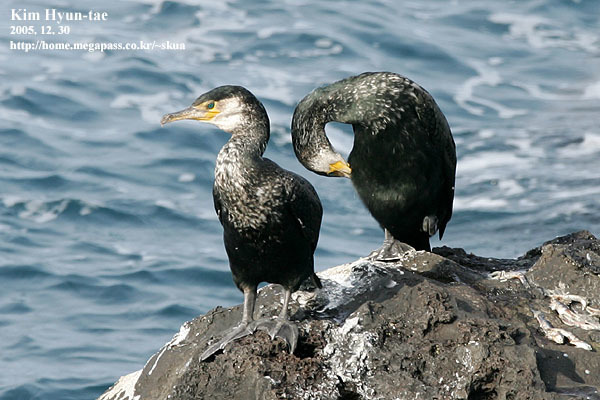
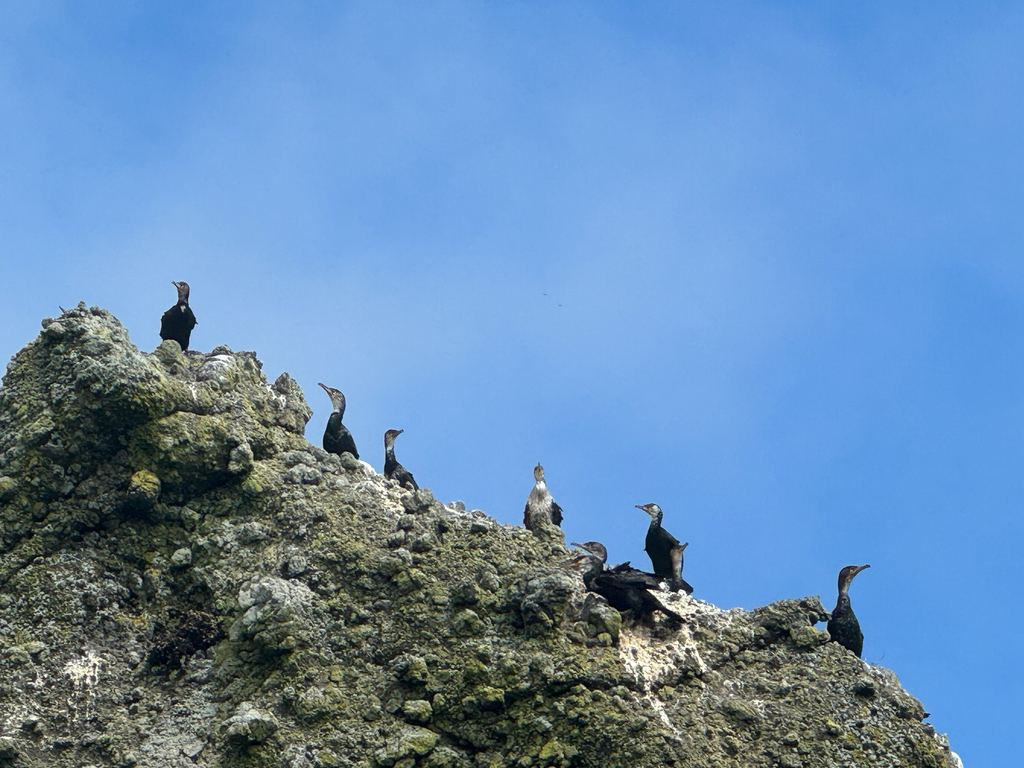
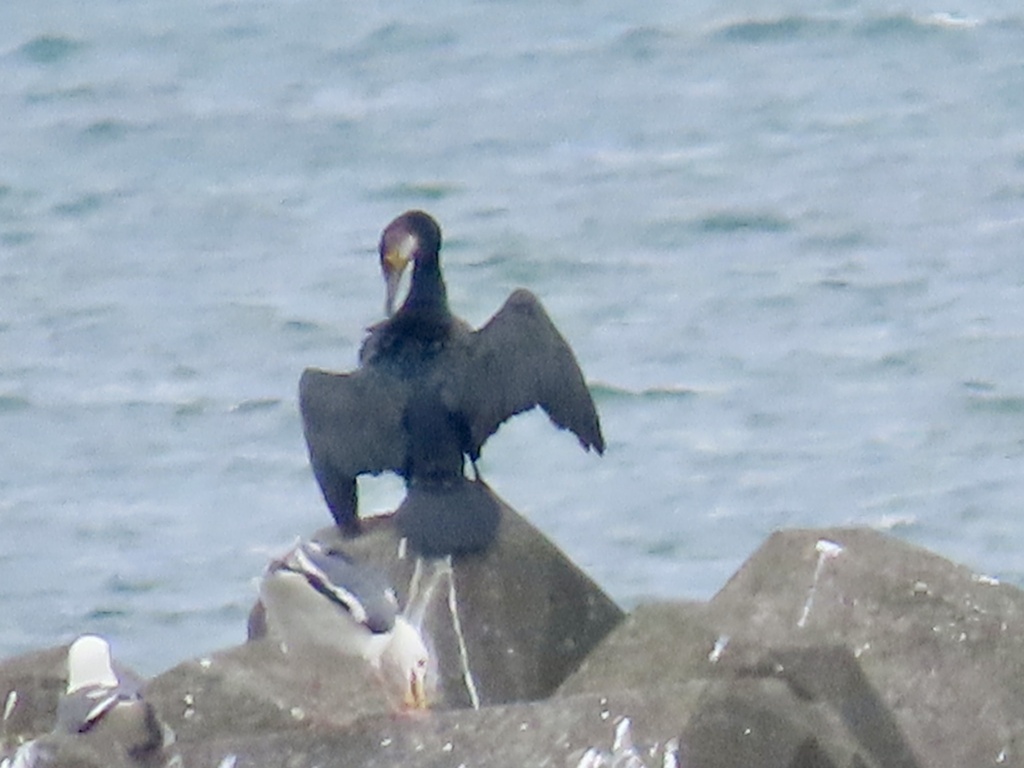
Photos show the species, not always the places on this page.
Length
About 81 to 92 cm (32 to 36 in) long, with a wingspan of about 152 cm (60 in).
Weight
About 2.3 to 3.55 kg (5.1 to 7.8 lb) according to Wikipedia. SeaLifeBase lists up to 3.1 kg (6.8 lb).
Next to a person
About as long as an adult's leg, with a wingspan a little less than a tall adult's height.
What it eats
Mainly fish, caught by diving underwater.
Around people
Calm, give space
How it lives
A coastal diving bird, called umiu ("sea cormorant") in Japan. Adults are black with a white throat and cheeks and a partly yellow bill. Young birds are plainer and browner. It nests in colonies on relatively wide cliff ledges, and also on port jetties and offshore rocks. Compared with the great cormorant, which breeds near lakes and rivers, it relies more on coastal and open-sea habitat. I did not find clutch size or lifespan in the sources I read.
Where it goes
Migratory in parts of its range. It breeds mainly on Hokkaido, Sakhalin and the southern Kuril Islands, with smaller groups on Honshu and the Korean Peninsula. The sources I read do not detail winter movements.
We only draw a journey on the map when scientists have tracked it or clearly documented it. For this animal we have not found one yet.
Populations
Least Concern (IUCN, 2018). BirdLife estimates, as quoted in a 2021 paper, are 10,000 to 100,000 birds in the breeding season and 25,000 to 100,000 in total. In Hokkaido about 1,900 breeding pairs were counted in the 1980s, and numbers there are believed to have risen since. It occurs along the coasts of China, Japan, North and South Korea, the Russian Far East and Taiwan. The sources I read name no specific threats.
Meet it respectfully
Watch from a distance with binoculars, or from a boat that keeps well back from nesting ledges and roosts. Never approach nests or flush resting birds, and never feed them. I did not read local rules for this species, so follow your guide and local regulations.
Fun fact
Tap the bulb to light it up.
It is one of the cormorants traditionally trained for ukai, the cormorant fishing of Japan.
Its Japanese name, umiu, means "sea cormorant".
Colonies use cliff ledges, but also port jetties and offshore rocks.
Japanese cormorant in the Ocean Atlas
Places we have researched where this animal is recorded. It is never guaranteed, and some places are for watching from the boat only.
Travel with usComing soonTrusted referralExploringOn pause, story onlyEthics pass
Country colour: pink where we travel, blue where we are exploring or refer, grey for story only.
 China
China Hong Kong
 Japan
Japan Russia
 South Korea
 Taiwan
Sources for this page
- Wikipedia, Japanese cormorant, 2026
- SeaLifeBase, Phalacrocorax capillatus, 2026
- bioRxiv preprint on cormorants in Hokkaido, 2021
- Wikipedia, Cormorant fishing, 2026
- GBIF, IUCN category lookup, 2026
Facts checked 5 October 2026. Photos: Unsplash licence, or Creative Commons as shown on each photo.
Work in ocean travel?
We are always happy to hear from exceptional local operators, accommodation, conservation organisations and destination experts. If your work fits responsible, small-group ocean travel, we would love to learn more.
Partner with Ocean CallingNew: tiger sharks in Fuvahmulah, January or March 2027
from CHF 2,900