
King penguin
Aptenodytes patagonicus
A tall penguin with an orange ear patch, standing quietly among brown downy chicks. No sighting is ever a promise.
Least Concern (IUCN) means it is not currently close to the thresholds for a threatened category. The sources I opened did not show the year of this assessment.
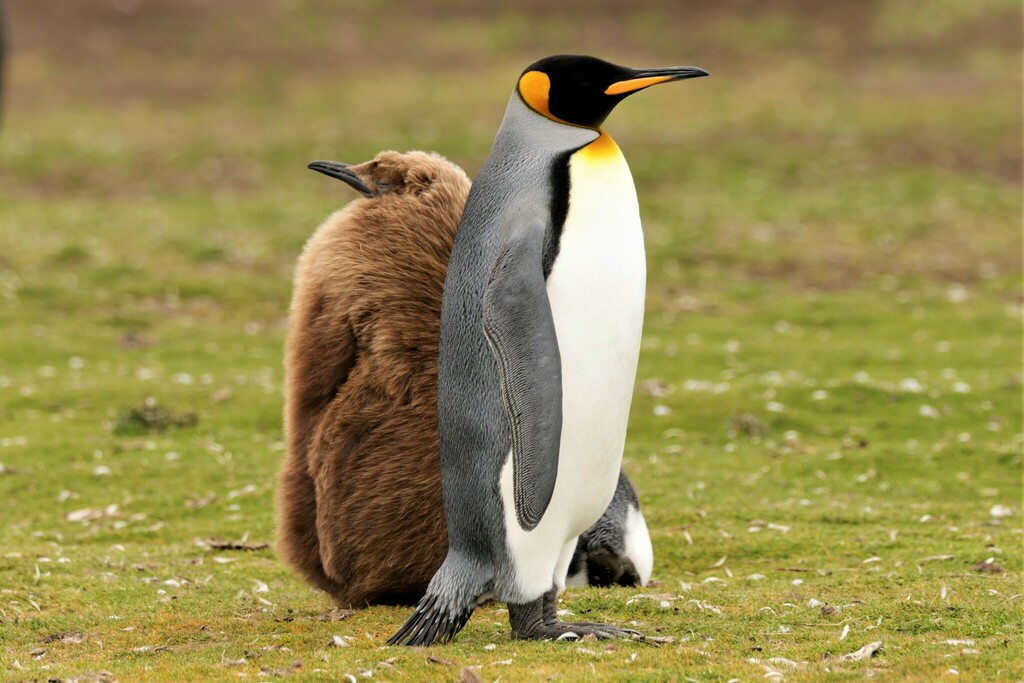
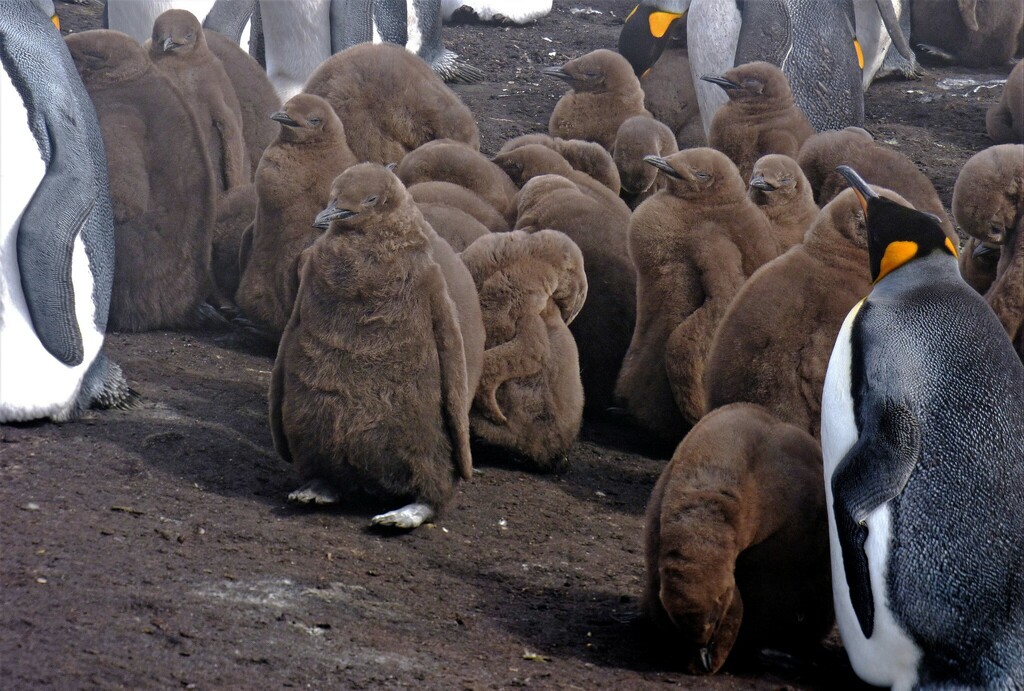
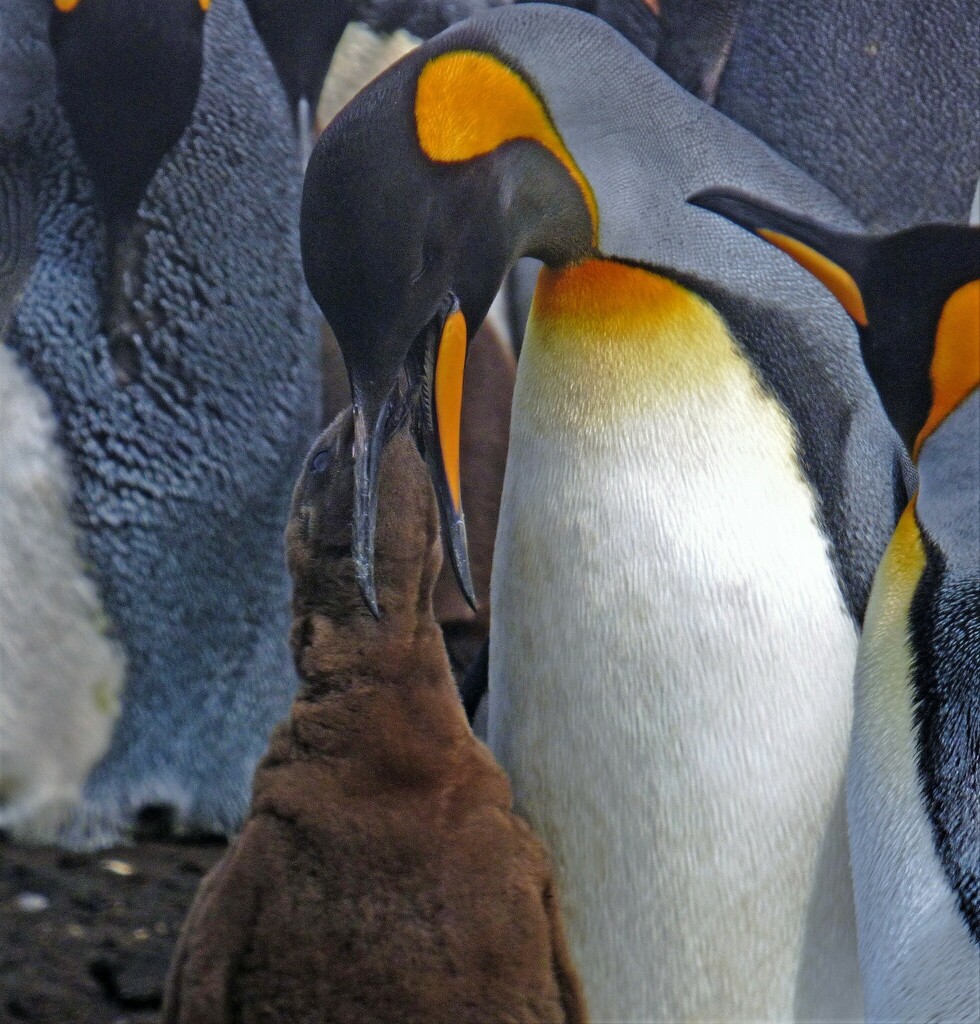
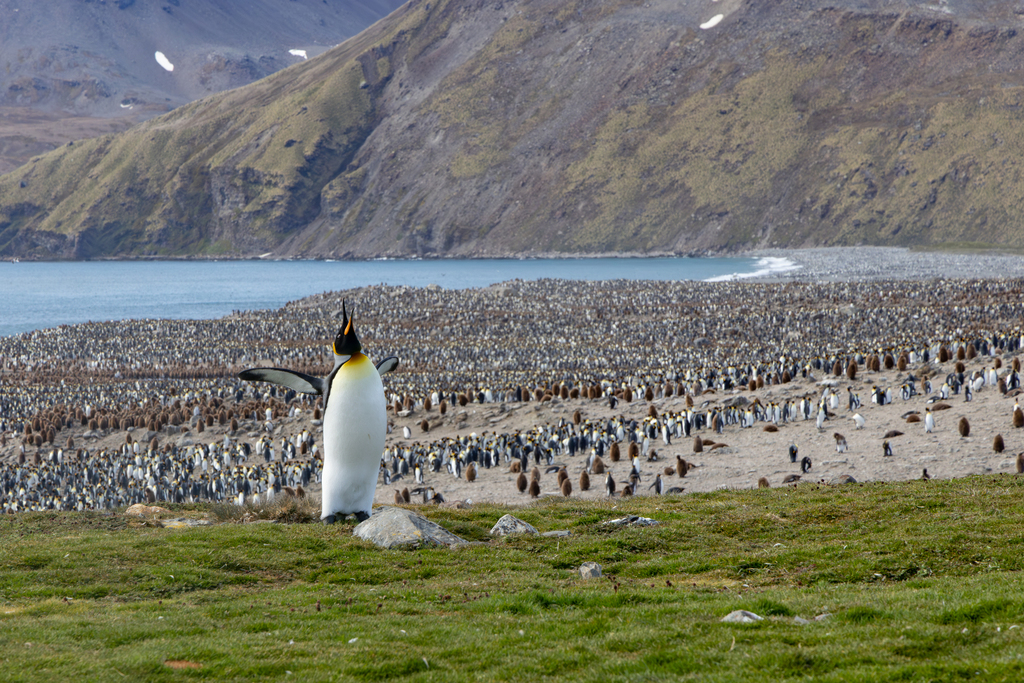
Photos show the species, not always the places on this page.
Length
About 70 to 100 cm (28 to 39 in) tall. Falklands Conservation gives 78 to 90 cm (31 to 35 in) in height and 85 to 95 cm (33 to 37 in) in length.
Weight
About 9.3 to 18 kg (20 to 40 lb). On Marion Island, males averaged 12.4 kg (27 lb) and females 11.1 kg (24 lb). Males are slightly larger.
Next to a person
Roughly waist to chest height on an adult, and about as heavy as a large dog. After the emperor penguin, it is the second-largest penguin.
What it eats
Mostly lanternfish (myctophids) and squid, with some krill. One study of the diet found fish made up about 80 percent for most of the year and about 30 percent in July and August. Dives are usually 100 to 300 m deep, and more than 340 m has been recorded near the Falklands.
Around people
Calm, give space
How it lives
A single egg is laid, around November to December in the Falklands, and incubated for about 55 days. The breeding cycle from laying to fledging takes about 14 to 16 months, so a pair can raise only two chicks in three years. Chicks gather in crèches from about March, and in winter they may lose up to half of their body weight while waiting for meals. Breeding starts at about 5 years old, and life expectancy in the wild is about 20 years (Falklands Conservation).
Where it goes
King penguins do not follow a fixed migration. Because the breeding cycle lasts more than a year, chicks are present at a colony all year round. Adults travel long distances to feed. In winter they can go hundreds of miles from the colony, and one source gives up to about 500 km.
We only draw a journey on the map when scientists have tracked it or clearly documented it. For this animal we have not found one yet.
Populations
Global: about 1.7 million breeding pairs (Falklands Conservation) or 2.23 million pairs (Wikipedia, citing recent estimates). Largest colonies are on the Crozet Islands (about 455,000 pairs), Kerguelen (240,000 to 280,000 pairs), the Prince Edward Islands (about 228,000 pairs) and South Georgia (over 100,000 pairs). Falkland Islands: about 1,500 breeding pairs, almost all at Volunteer Point on East Falkland, and the trend is increasing. About 500 to 700 chicks are produced each year there. One tour source gives about 1,000 pairs and 500 chicks, so numbers differ by source and year. Climate change is flagged as a long-term threat because it can shift the food supply. IUCN status: Least Concern.
Meet it respectfully
Watch quietly from a distance and let the penguins decide how close to come. Never chase, touch, feed or bait them, never walk into the colony and keep clear of chicks and nesting adults. At Volunteer Point and on the Falklands bird-watching page, the Falklands tourism site asks visitors to keep at least about 6 m (20 ft) from wildlife. Volunteer Point is reached by off-road track and guides and wardens work there, so go with a guide and follow their instructions. Landings by sea can be difficult or impossible in some weather, and nothing about a visit is guaranteed.
Fun fact
Tap the bulb to light it up.
The breeding cycle is the longest of any penguin, about 14 to 16 months from egg to fledged chick.
In winter, chicks wait for meals and may lose up to half of their body weight.
They dive routinely to 100 to 300 m, and more than 340 m has been recorded near the Falkland Islands.
King penguin in the Ocean Atlas
Places we have researched where this animal is recorded. It is never guaranteed, and some places are for watching from the boat only.
Travel with usComing soonTrusted referralExploringOn pause, story onlyEthics pass
Country colour: pink where we travel, blue where we are exploring or refer, grey for story only.
 Antarctica
 Argentina
 Australia
 Chile
Chile Falkland Islands
 Germany
 New Zealand
 South Africa
 United Kingdom
 United States
Sources for this page
- IUCN Red List category via GBIF, 2026
- Falklands Conservation, 2026
- Wikipedia, King penguin, 2026
- Animal Diversity Web, University of Michigan, 2026
- Falkland Islands Tourist Board, Volunteer Point, 2024
- Oceanwide Expeditions, Volunteer Point, 2026
- Falkland Islands Tourist Board, bird-watching, 2026
Facts checked 5 October 2026. Photos: Unsplash licence, or Creative Commons as shown on each photo.
Work in ocean travel?
We are always happy to hear from exceptional local operators, accommodation, conservation organisations and destination experts. If your work fits responsible, small-group ocean travel, we would love to learn more.
Partner with Ocean Calling