
Lion's mane jellyfish
Cyanea capillata
A cold-sea jelly with a trailing mane of hair-like tentacles. Beautiful from a distance, so give it wide space in the water and on the beach.
Not Evaluated means IUCN has never assessed the lion's mane jellyfish.
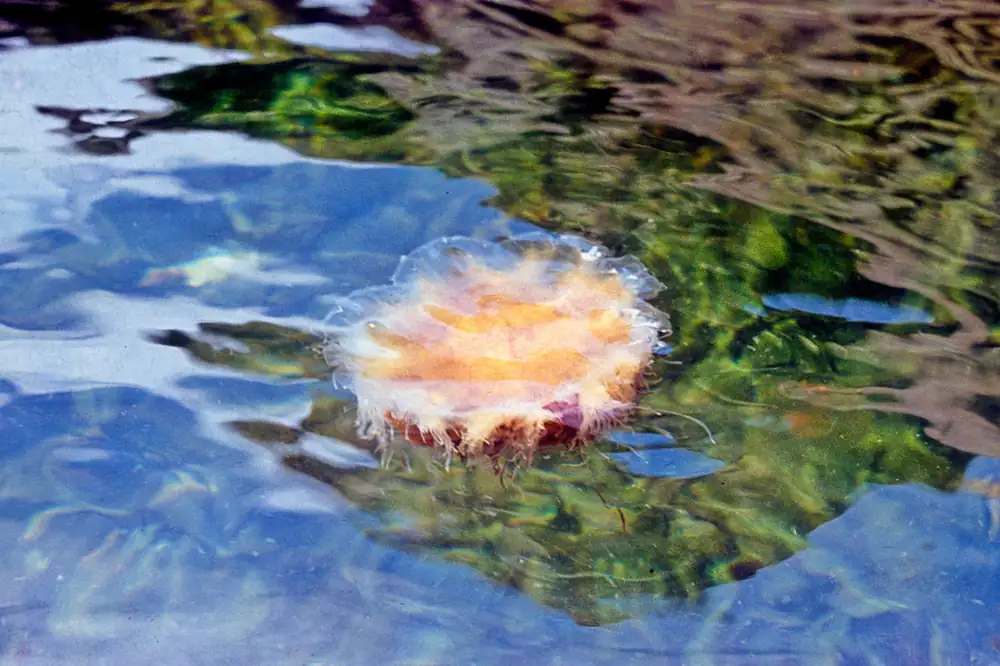
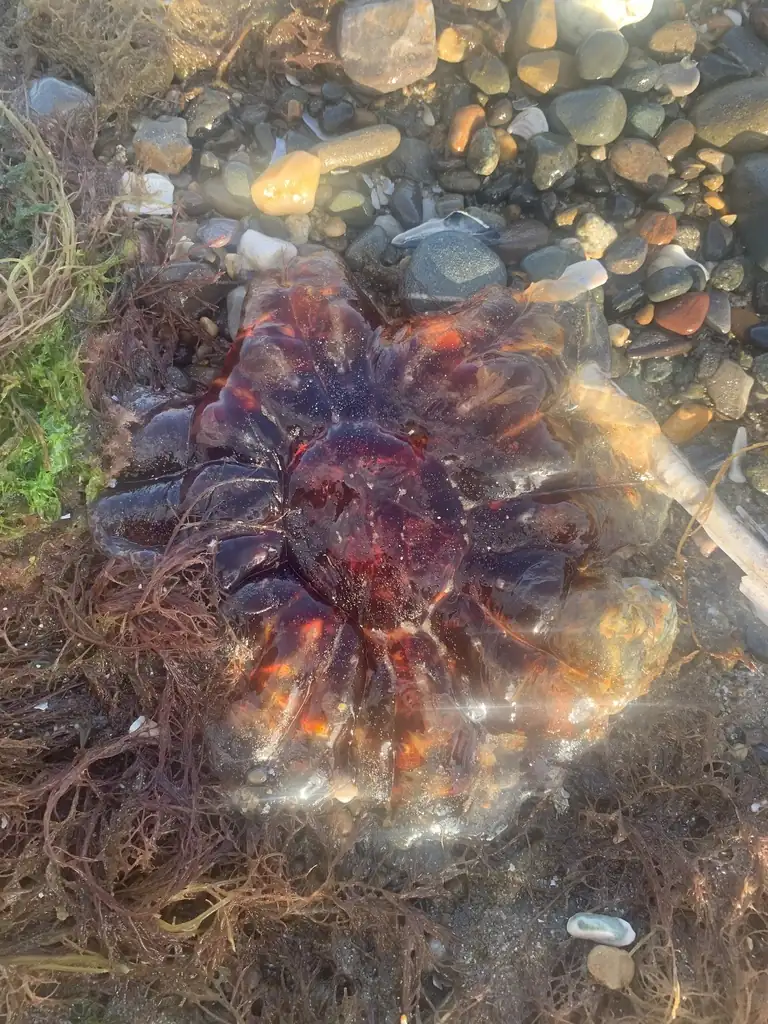
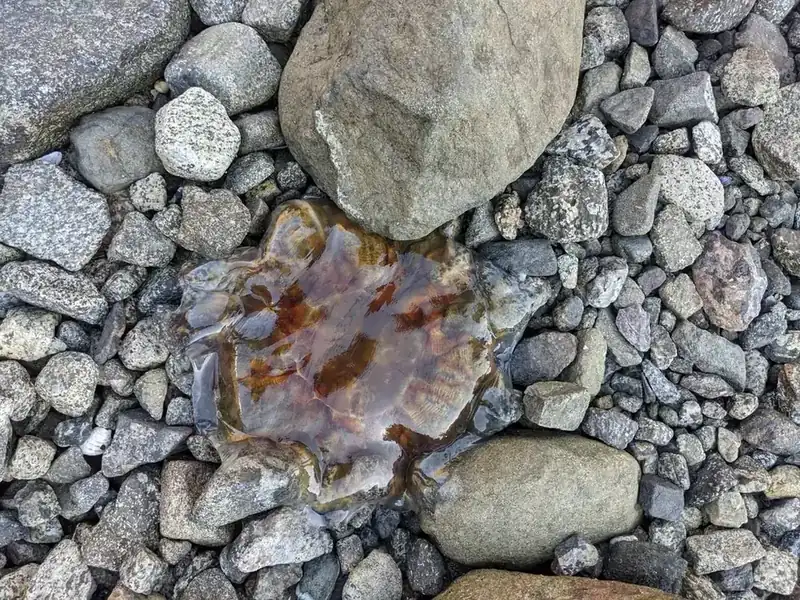
Photos show the species, not always the places on this page.
Length
Bell usually 30 to 50 cm (1 to 1.6 ft) across in British waters; rarely recorded up to about 2 m (6.6 ft)
Weight
Not reliably measured
Next to a person
Most bells are dinner plate to beach ball sized; rare giants can be almost as wide as a person is tall, and the tentacles trail much further
What it eats
Tiny drifting animals such as copepods, fish eggs and larvae, small fish, and other jellyfish, especially moon jellies.
Around people
Potentially dangerous, respect
How it lives
The lion's mane has a saucer-shaped bell, usually yellowish brown or red, and a thick mass of long, thin tentacles in eight groups, with 70 to 150 or more in each group. It belongs to the cold and temperate seas of the North Atlantic, Arctic and North Pacific. Around Britain and Ireland it is most often seen along the east coast of England and Scotland and in the Irish Sea. Similar giant jellies in Australia and some other places are different Cyanea species.
Where it goes
Not a migrant. It drifts with currents and tides. In British waters young ones appear from February, and larger ones are most common from June to September. Storms and tides can gather them into swarms.
We only draw a journey on the map when scientists have tracked it or clearly documented it. For this animal we have not found one yet.
Populations
Numbers vary with the season, and storms and tides sometimes gather many together. In the northeast Atlantic a smaller lookalike, the blue jellyfish, lives alongside it. Lion's manes tend to grow larger in colder, high-latitude seas.
Meet it respectfully
The sting is strong and can cause blisters, pain and muscle cramps, and more rarely problems with breathing and the heart. Keep your distance in the water, where the tentacles are hard to see, and never touch one on the beach, because stranded jellies can still sting long after they wash up. If stung, follow local lifeguard or medical advice, and get urgent help for breathing problems or chest pain.
Fun fact
Tap the bulb to light it up.
It is one of the largest jellyfish, with eight clusters of about 70 to 150 or more hair-like tentacles.
It feeds heavily on moon jellies and other jellyfish.
Headlines that call it larger than a blue whale are not supported; they compare long tentacles and old, unchecked measurements.
A lion's mane can still sting long after it has been stranded on the shore.
Source: MarLIN (Marine Biological Association), Lion's mane jellyfish, Cyanea capillata
In Orkney, five divers first thought to have decompression sickness were most likely suffering from lion's mane stings.
Source: Trevett et al., 2019, Diving and Hyperbaric Medicine
Lion's mane stings can cause severe pain and, in rare cases, an illness similar to Irukandji syndrome.
Source: Doyle et al., 2017, Toxins
Lion's mane jellyfish in the Ocean Atlas
Places we have researched where this animal is recorded. It is never guaranteed, and some places are for watching from the boat only.
Travel with usComing soonTrusted referralExploringOn pause, story onlyEthics pass
Country colour: pink where we travel, blue where we are exploring or refer, grey for story only.
 Canada
 Denmark
 France
 Germany
 Greenland
 Iceland
 Ireland
 Netherlands
 Norway
 Russia
 Sweden
 United Kingdom
 United States
Sources for this page
- MarLIN (Marine Biological Association), Lion's mane jellyfish, Cyanea capillata
- Doyle et al., 2017, Toxins
- Trevett et al., 2019, Diving and Hyperbaric Medicine
- WoRMS, Cyanea capillata
- Dawson, 2005, Invertebrate Systematics, Cyanea in southeast Australia
- Holst & Laakmann, 2014, Journal of Plankton Research, Cyanea capillata and C. lamarckii
- WHOI, 2020, Jellyfish on Massachusetts beaches
- Monterey Bay Aquarium, Lion's mane jelly
Facts checked 26 September 2026. Photos: Unsplash licence, or Creative Commons as shown on each photo.
Work in ocean travel?
We are always happy to hear from exceptional local operators, accommodation, conservation organisations and destination experts. If your work fits responsible, small-group ocean travel, we would love to learn more.
Partner with Ocean CallingShop with Ocean Calling
Visit the Ocean Calling storefront on Amazon.
As an Amazon Associate I earn from qualifying purchases. You are not only choosing products that respect the ocean, you are also helping us keep going: paying our local partners fairly and keeping our retreats ethical, sustainable and honestly priced for you. 💗