
Mimic octopus
Thaumoctopus mimicus
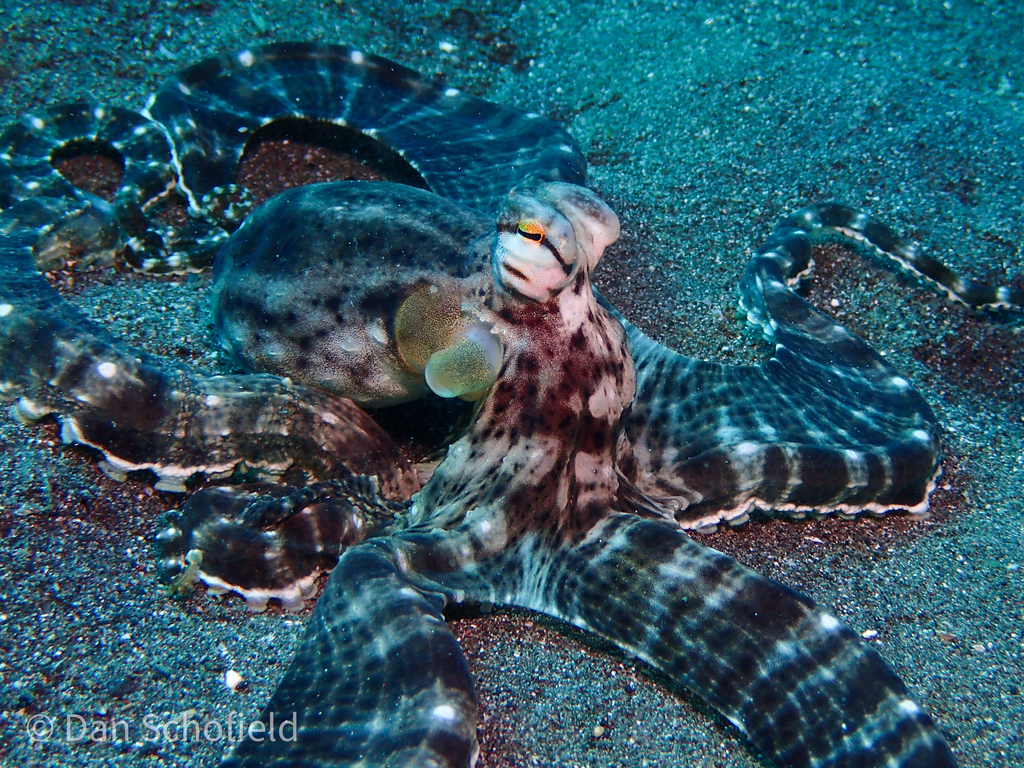
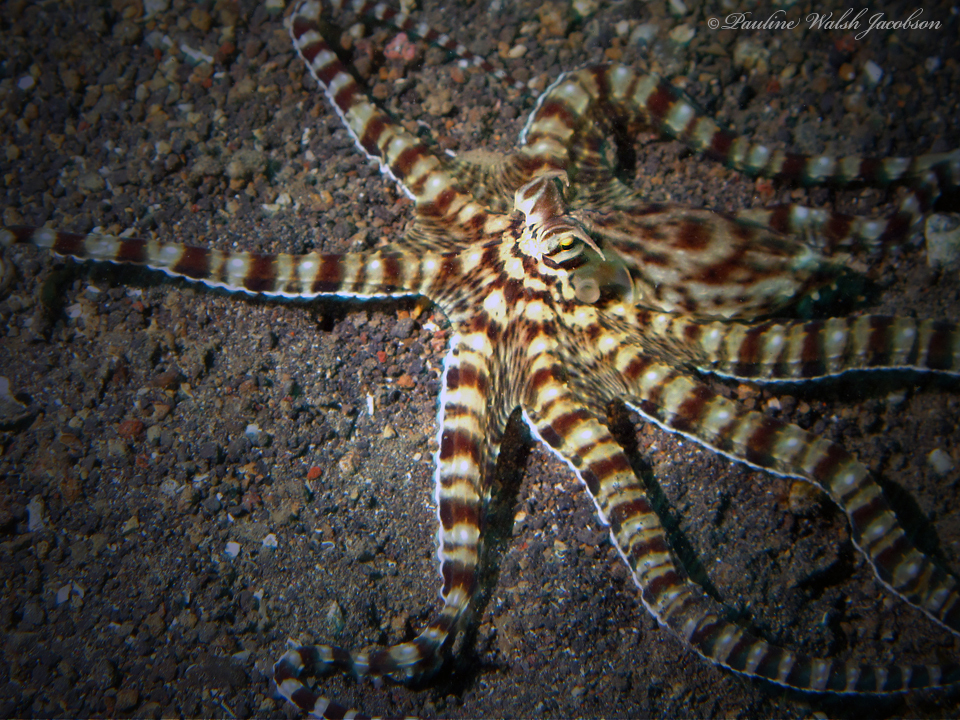
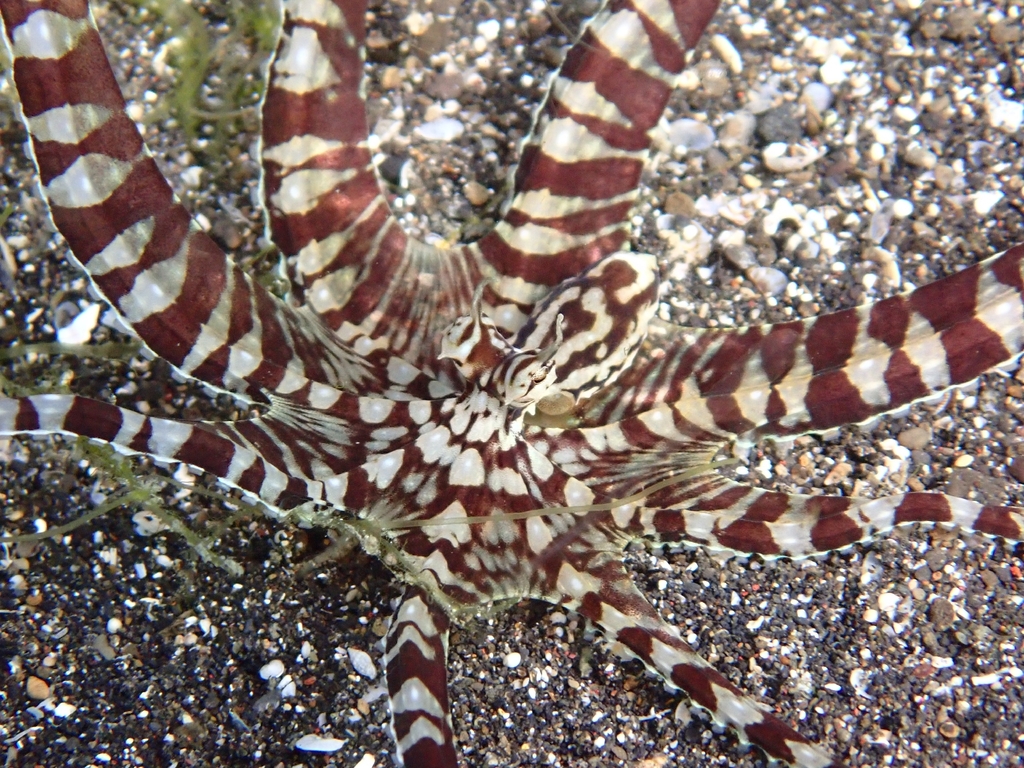
On quiet Indo-Malayan sand, a long-armed octopus may briefly look like a sole, lionfish or sea snake. Give it space and never herd it to perform.
Least Concern (IUCN, 2016) means it is not at high risk of extinction worldwide today.
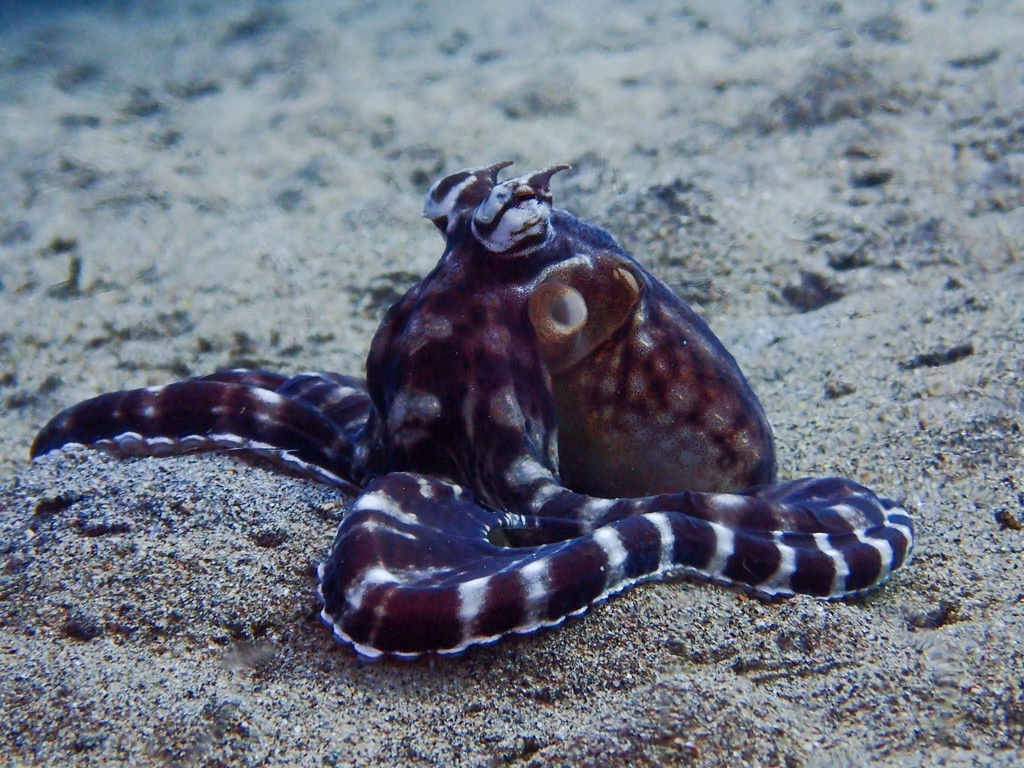
Photos show the species, not always the places on this page.
Length
Body (mantle) about 6 cm (2.3 in); with arms, largest recorded about 48 cm (19 in)
Weight
Not reliably measured
Next to a person
Arms included, large ones are about as long as an adult's forearm; the body is about the size of a thumb
What it eats
Small fish and crustaceans on open sand. It pokes its arms into burrows, and it can even enter a tunnel and come out of another hole up to about 1 m away.
Around people
Calm, give space
How it lives
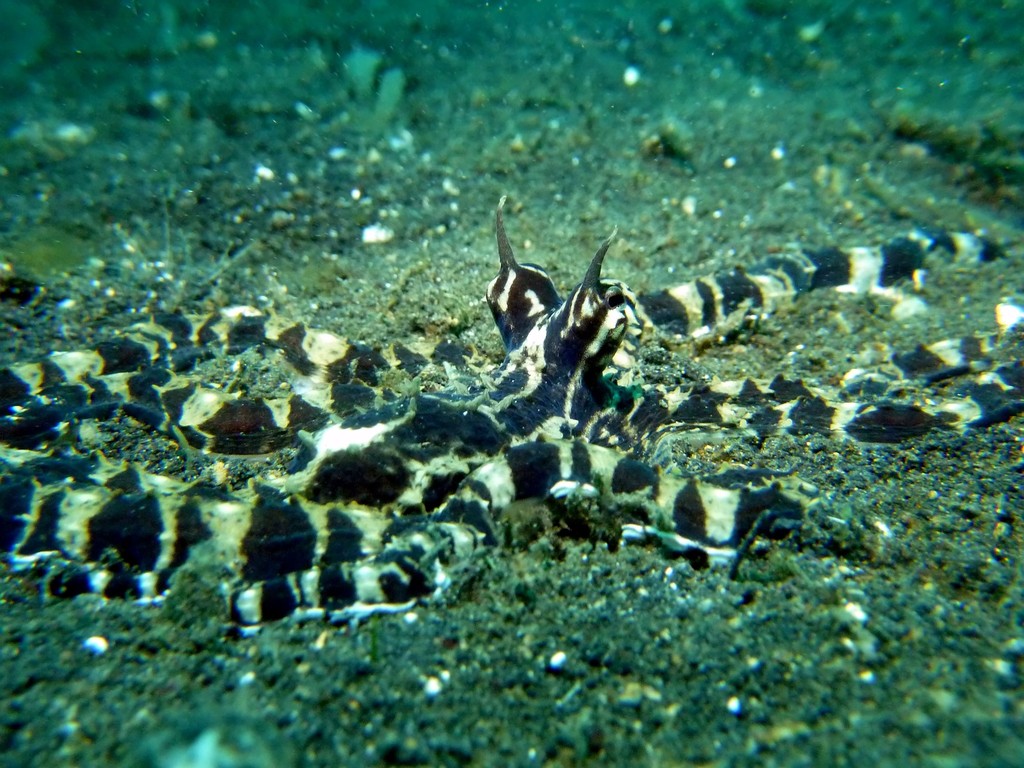
The mimic octopus lives on soft sand and mud in shallow tropical water, from 0.5 to 37 m. It hunts by day, poking its long arms into burrows for small fish and crustaceans. When a threat comes, it can change shape and colour to look like toxic animals that share its home. Scientists are confident about three of these: banded soles, lionfish and banded sea snakes.
Where it goes
The mimic octopus does not migrate. It uses empty burrows of other animals as short-term homes, staying in one hole for one to four days, maybe within a network of holes in its home range. Some left their hole at first light, foraged all day and spent the night in the last hole they entered.
We only draw a journey on the map when scientists have tracked it or clearly documented it. For this animal we have not found one yet.
Populations
First filmed in Indonesia and described in 2005, it is known mainly from the Indo-Malayan region, from Indonesia, Malaysia and the Philippines to New Caledonia. Rare photo records extend the range to the Red Sea, the Great Barrier Reef and, since sightings in 2020 and 2022, southern Mozambique. It is easy to confuse with the wonderpus, a look-alike banded octopus.
Meet it respectfully
Muck dives happen very close to the sand. Keep fins and hands off the bottom, never touch, handle, poke or herd the octopus to make it show its mimicry, and do not block its way back to its burrow. Use gentle lights and few photos.
Fun fact
Tap the bulb to light it up.
It was only given its scientific name in 2005.
In the first study, it copied a banded sea snake only when damselfish attacked it.
Viral lists say it copies many animals, but scientists are confident about only three.
Scientists first filmed the mimic octopus in Sulawesi and Bali, Indonesia. Nine octopuses showed poses that copy venomous animals, and they seemed to choose which animal to copy depending on the threat.
In May 2020 and May 2022, mimic octopuses were seen in less than 30 cm of water on a tidal flat in the Vilanculos Coastal Wildlife Sanctuary, Mozambique. These were the first records from Mozambique.
Source: Marshall et al., 2024, Journal of the Marine Biological Association of the UK
The wonderpus looks very similar but behaves differently. It prefers the half-light of dawn and dusk, and one wonderpus stayed in the same deep sand burrow for at least three weeks.
Mimic octopus in the Ocean Atlas
Places we have researched where this animal is recorded. It is never guaranteed, and some places are for watching from the boat only.
Travel with usComing soonTrusted referralExploringOn pause, story onlyEthics pass
Country colour: pink where we travel, blue where we are exploring or refer, grey for story only.
 Australia
 Egypt
Egypt Indonesia
 Malaysia
 Mozambique
 New Caledonia
 Philippines
Sources for this page
- Norman & Hochberg, 2005, Molluscan Research
- Norman, Finn & Tregenza, 2001, Proceedings of the Royal Society B
- SeaLifeBase, Thaumoctopus mimicus
- Marshall et al., 2024, Journal of the Marine Biological Association of the UK
- Coker, 2013, Marine Biodiversity Records
- SeaLifeBase, Wunderpus photogenicus
- Allcock, 2016, IUCN Red List
Facts checked 26 September 2026. Photos: Unsplash licence, or Creative Commons as shown on each photo.
Work in ocean travel?
We are always happy to hear from exceptional local operators, accommodation, conservation organisations and destination experts. If your work fits responsible, small-group ocean travel, we would love to learn more.
Partner with Ocean Calling7-day freediving course in Coron, Palawan
CHF 1,480