
Red coral
Corallium rubrum
A slow-growing red bush under dim rock ledges, and no sighting is ever a promise.
Not Evaluated means the global IUCN Red List has not assessed this species. It is cited as Endangered for the Mediterranean, where most colonies live.
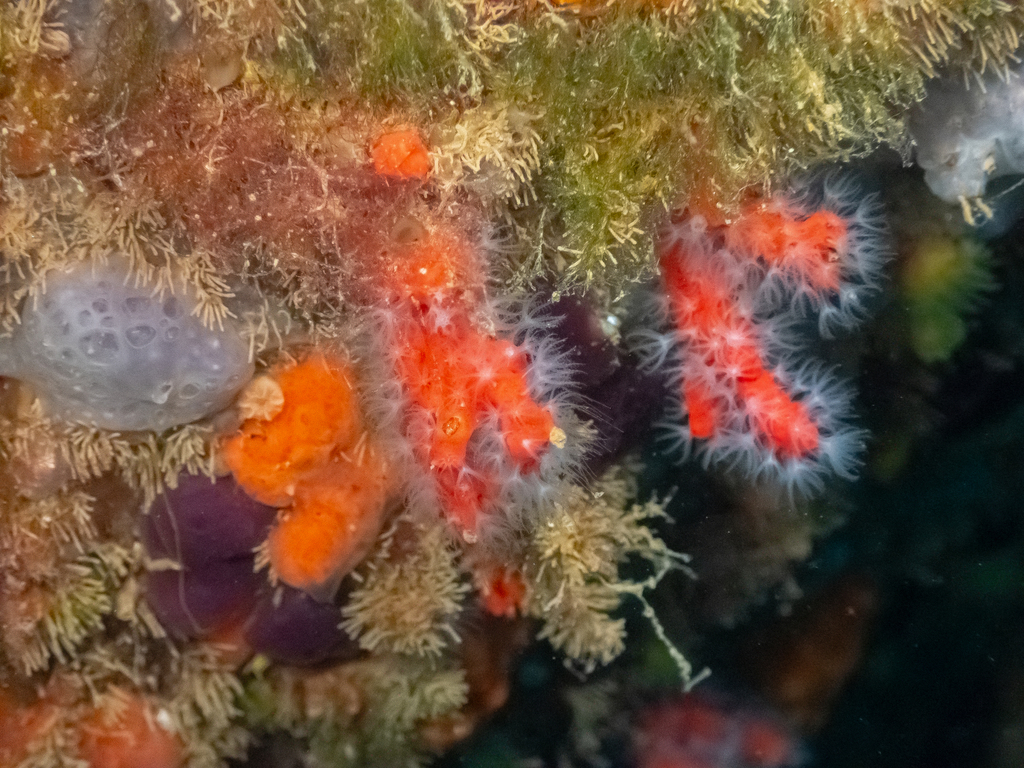
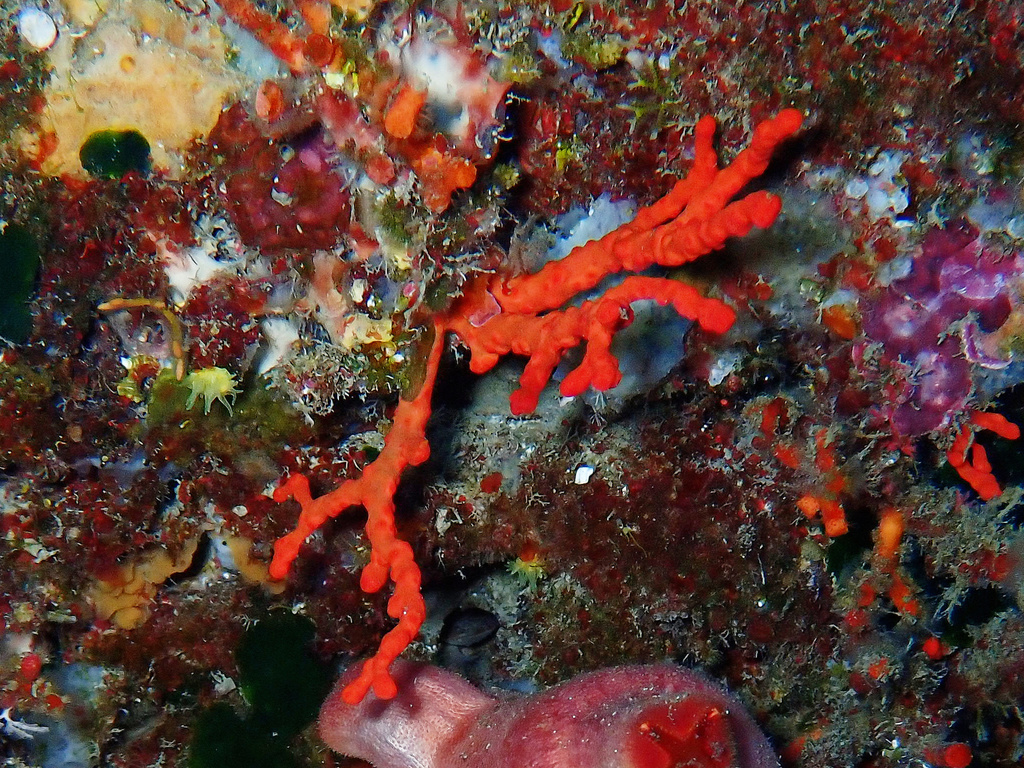
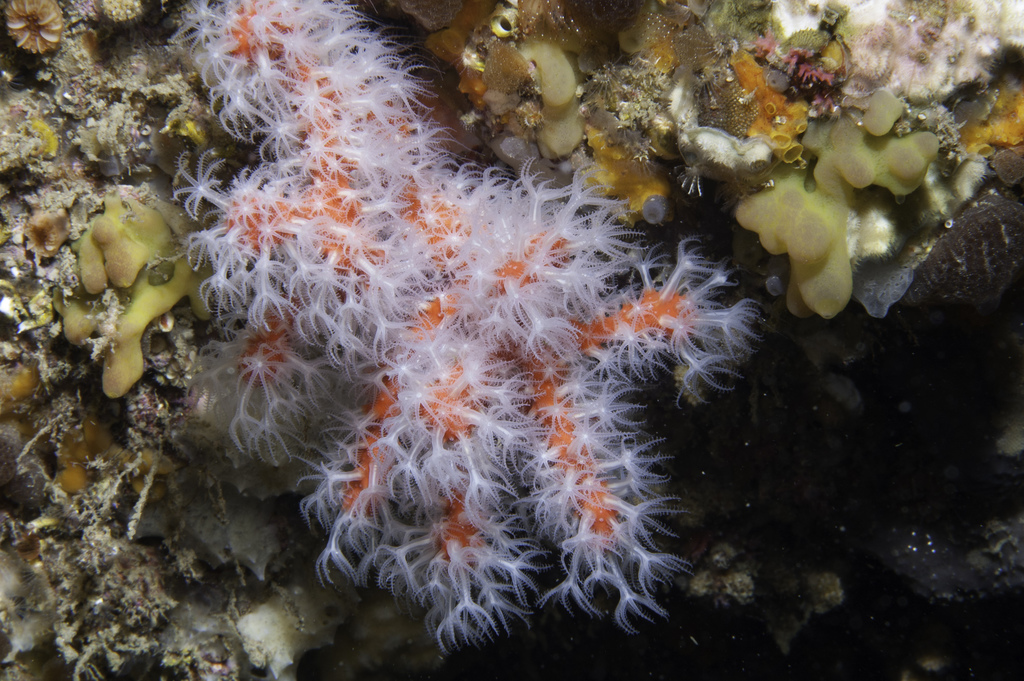
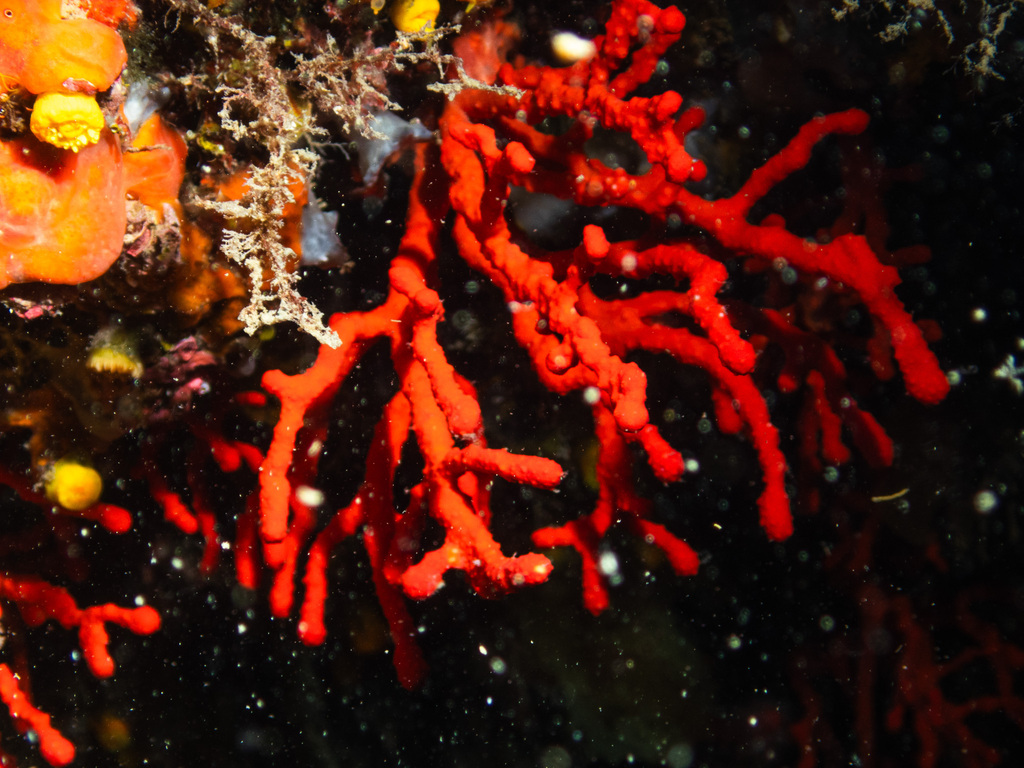
Photos show the species, not always the places on this page.
Length
Colonies are small leafless bushes. Wikipedia says they grow up to about 1 m (3.3 ft) tall and SeaLifeBase says over 50 cm (20 in). In the north-western Mediterranean, colonies were about 15 cm (6 in) tall in the 1960s and 1970s but only about 2 to 3 cm (0.8 to 1.2 in) in the 1990s
Weight
Not given in the sources I read
Next to a person
Most shallow colonies today are shorter than a finger
What it eats
The white polyps feed on plankton.
Around people
Look, never touch
How it lives
A colony is a fixed, branching skeleton of hard calcium carbonate coloured red by carotenoid pigments, with retractable white polyps. It grows very slowly: about 0.3 to 0.5 mm of basal diameter a year, or 0.293 mm a year in north-western Sardinian stocks. PLOS ONE says recovery after disturbance can take decades to centuries. It prefers dim places such as cave walls, cliffs and overhangs, and SeaLifeBase says water warmer than 24 C can cause critical mortality. It is reported from about 5 m to more than 1,000 m, mostly shallower than 100 m, and shallow groups have been heavily harvested.
Where it goes
Adult colonies are fixed to rock and do not move. As in its class, octocorals release gametes that develop into planktonic planula larvae, which settle on the seabed.
We only draw a journey on the map when scientists have tracked it or clearly documented it. For this animal we have not found one yet.
Populations
The species is Not Evaluated globally on the IUCN Red List (SeaLifeBase and GBIF). For the Mediterranean it is listed as Endangered, as stated in a genome paper. In some regions PLOS ONE says it is considered ecologically extinct. In Sardinia, a 2025 study found both stocks depleted, with biomass at 0.53 and 0.41 of the target level, and recommended raising the minimum harvest size from 7 mm to 13 to 15 mm basal diameter. In the Medes Islands reserve, one poaching event in 2002 removed about 60% of biomass. ScienceDaily reported in 2011 that it was not in CITES Appendix II. In Spain, the Menorca Nord marine reserve, declared in 1999 and covering 5,085 ha, lists red coral among its species of conservation interest, with about 628 benthic species recorded.
Meet it respectfully
Look, never touch. Colonies are slow-growing and easily damaged, and a study in the Medes Islands found that more dives went with smaller colonies, which suggests diver contact does harm. Keep fins, hands, gauges and tanks away from walls and overhangs, and never break off or collect coral. I read that the Menorca Nord reserve has special protection zones and recreational fishing bans in designated areas, but I did not read diving rules, so follow reserve and dive operator guidance. A sighting is never a promise.
Fun fact
Tap the bulb to light it up.
The red colour comes from carotenoid pigments in a hard calcium carbonate skeleton.
It adds only about 0.3 to 0.5 mm of basal diameter a year, so recovery after harvest can take decades to centuries.
The Menorca Nord marine reserve, declared in 1999, has about 628 recorded benthic species.
Red coral in the Ocean Atlas
Places we have researched where this animal is recorded. It is never guaranteed, and some places are for watching from the boat only.
Travel with usComing soonTrusted referralExploringOn pause, story onlyEthics pass
Country colour: pink where we travel, blue where we are exploring or refer, grey for story only.
 Croatia
 France
 Greece
 Italy
Italy Malta
Malta Spain
SpainSources for this page
- Wikipedia, Red coral, 2026
- SeaLifeBase, Corallium rubrum
- PLOS ONE, 2019, Historical record of Corallium rubrum
- ICES Journal of Marine Science, 2025, Sardinian stocks
- Linares et al., 2012, Marine reserves and red coral
- ScienceDaily, 2011
- Genome sequence of the Mediterranean red coral, PMC
- Govern de les Illes Balears, Reserva Marina Menorca Norte
Facts checked 5 October 2026. Photos: Unsplash licence, or Creative Commons as shown on each photo.
Work in ocean travel?
We are always happy to hear from exceptional local operators, accommodation, conservation organisations and destination experts. If your work fits responsible, small-group ocean travel, we would love to learn more.
Partner with Ocean CallingShop with Ocean Calling
Visit the Ocean Calling storefront on Amazon.
As an Amazon Associate I earn from qualifying purchases. You are not only choosing products that respect the ocean, you are also helping us keep going: paying our local partners fairly and keeping our retreats ethical, sustainable and honestly priced for you. 💗