
Sicklefin lemon shark
Negaprion acutidens
A calm, heavy-bodied shark that often rests on the sand at Moʻorea's deeper sites. We watch, never feed.
Endangered (IUCN, 2020) means it is at very high risk of extinction in the wild.


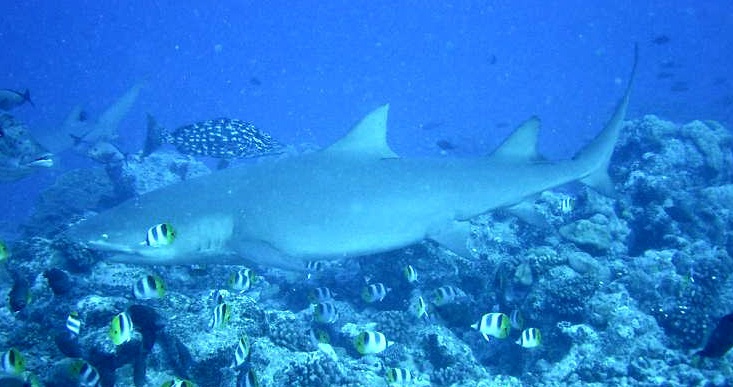

Photos show the species, not always the places on this page.
Length
Usually up to about 3.1 m (10 ft); the largest recorded was about 3.8 m (12.5 ft)
Weight
Not reliably measured
What it eats
Mostly fish that live near the seabed, which make up over 90% of its diet, and sometimes squid, octopus, crabs, prawns and rays.
Around people
Potentially dangerous, respect
How it lives
A slow, heavy shark that often cruises near the bottom or rests on the sand. Around Moʻorea, scientists have identified individual lemon sharks from photos for years. One study recorded 32 sharks in 2,589 sightings over 541 dives at a site in the north of the island.
Where it goes
It stays close to home: most sharks that were tagged were found again within about 2 km of where they were tagged. At Moʻorea, the same individuals are recognised at the same sites over many years.
We only draw a journey on the map when scientists have tracked it or clearly documented it. For this animal we have not found one yet.
Populations
Around Moʻorea, divers meet lemon sharks at northern sites such as Mamaru, Eden Park, The Twins and Tiki. In the past they were the main draw of shark-feeding dives. French Polynesia banned feeding sharks in October 2017, and we do not join dives that feed sharks.
Meet it respectfully
Usually shy with divers and moves away when approached, but it is a large shark with a few recorded unprovoked bites. Never feed, touch or follow it. Stay low and calm near the bottom and let it pass.
Fun fact
Tap the bulb to light it up.
In French Polynesia, sicklefin lemon shark pups are born in January.
Most tagged sicklefin lemon sharks were found again within about 2 km of where they were first tagged.
At one Moʻorea site, scientists logged 2,589 sightings of just 32 known sharks over 541 dives.
Sicklefin lemon shark in the Ocean Atlas
Places we have researched where this animal is recorded. It is never guaranteed, and some places are for watching from the boat only.
Travel with usComing soonTrusted referralExploringOn pause, story onlyEthics pass
Country colour: pink where we travel, blue where we are exploring or refer, grey for story only.
 Australia
 Fiji
Fiji French Polynesia
 Indonesia
 Japan
Japan Maldives
 New Caledonia
 Oman
Oman Papua New Guinea
 Seychelles
 Taiwan
Sources for this page
- FishBase, 2026, Negaprion acutidens
- Wikipedia, 2026, Sicklefin lemon shark (citing IUCN Red List 2021)
- Ultra Reef, 2024, What sharks can I see in Moorea?
Facts checked 25 September 2026. Photos: Unsplash licence, or Creative Commons as shown on each photo.
Work in ocean travel?
We are always happy to hear from exceptional local operators, accommodation, conservation organisations and destination experts. If your work fits responsible, small-group ocean travel, we would love to learn more.
Partner with Ocean CallingNot sure where to go? Get your Ocean Match
from CHF 19