
Southern rockhopper penguin
Eudyptes chrysocome
A small crested penguin hopping between ledges on a windy shore. Colonies come and go with the seasons, and no sighting is ever a promise.
Vulnerable (IUCN, 2018) means it faces a high risk of extinction in the wild. The listing cites rapid declines that have run for perhaps a century and appear to have worsened in recent years.
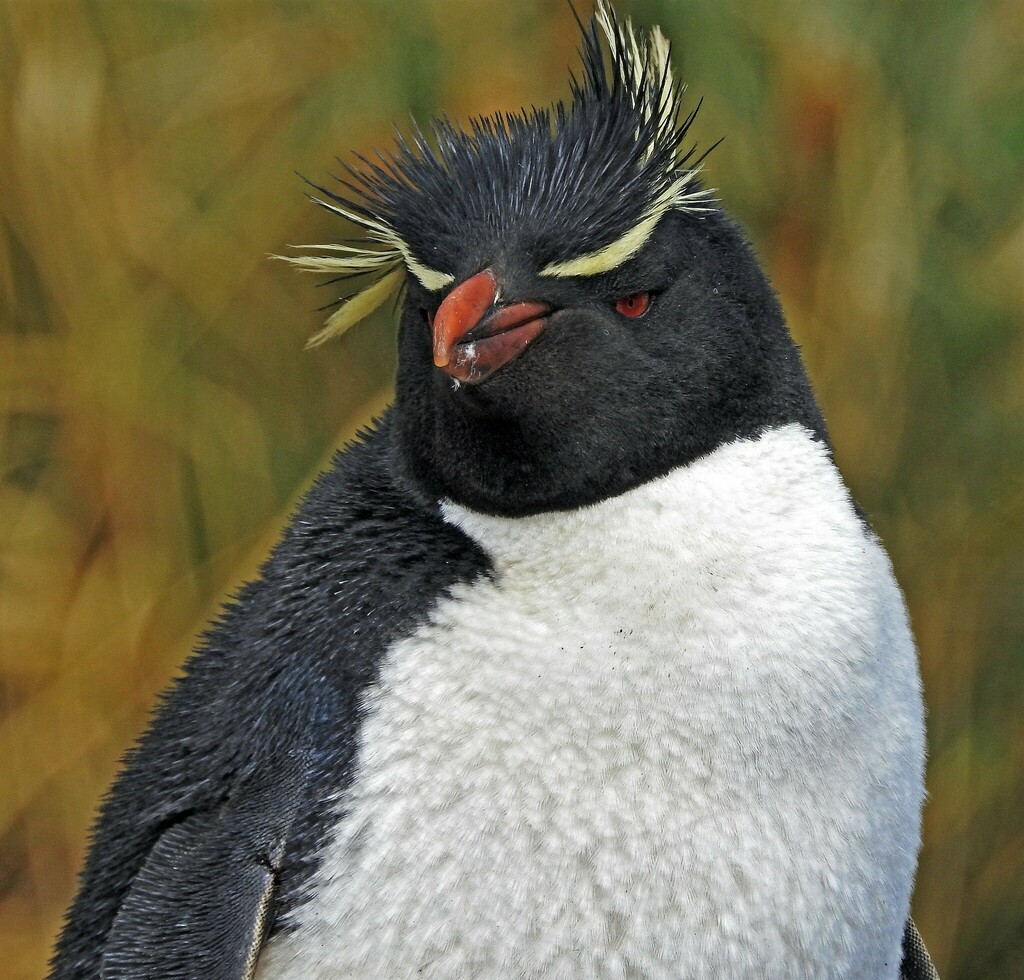
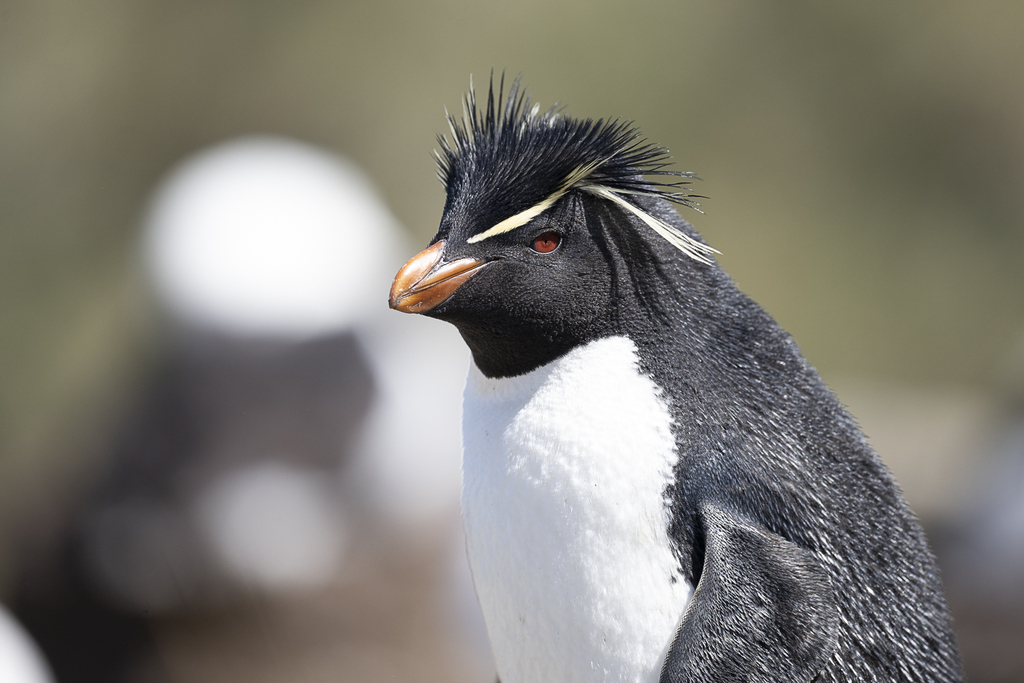
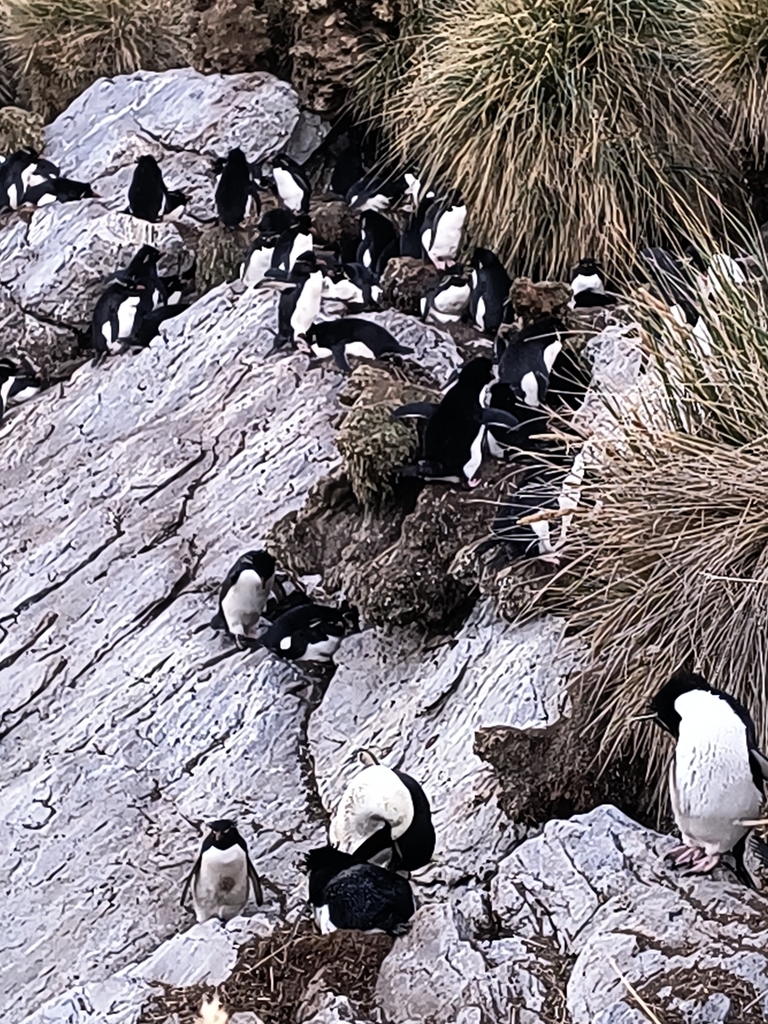
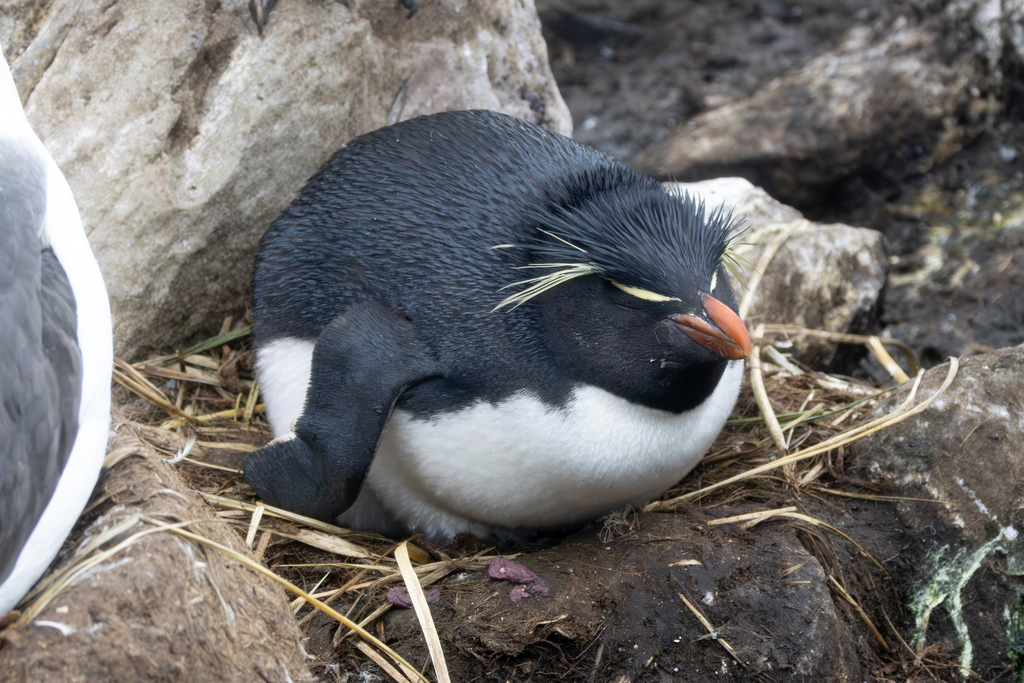
Photos show the species, not always the places on this page.
Length
About 45 to 58 cm (18 to 23 in) long. Sources differ a little; one gives about 42 cm in height.
Weight
Usually about 2 to 3.4 kg (4.4 to 7.5 lb), with an exceptional bird near 4.5 kg (10 lb). Falklands Conservation gives 3.5 to 4 kg (7.7 to 8.8 lb), with males heavier.
Next to a person
Roughly knee to hip height on an adult, and about the weight of a small dog.
What it eats
Mostly small crustaceans such as krill and squat lobsters (Munida gregaria), with some squid and fish. The mix changes with place and season. Dives are usually shallow, around 9 to 25 m (30 to 82 ft), but can reach about 100 m (330 ft).
Around people
Calm, give space
How it lives
Rockhoppers nest in dense colonies, often on rocky cliffs and slopes. In the Falklands, males arrive first in early October and females about a week later. Two eggs are laid in November, and chicks fledge by about February. Predators of eggs and chicks include skuas and caracaras, and sea lions take adults at sea. Wild birds live about 10 years on average, and the oldest recorded bird, in an aquarium, reached 29 years.
Where it goes
In the Falklands, rockhoppers come ashore to breed from about October to April. After breeding they head to sea, with a migration reported between about May and October. Falkland birds are reported to travel east of South America. While breeding, they forage within roughly 100 miles (160 km) of the colony.
We only draw a journey on the map when scientists have tracked it or clearly documented it. For this animal we have not found one yet.
Populations
Global: about 1 to 1.2 million breeding pairs on sub-Antarctic and temperate islands between 46 and 54 degrees south. Falkland Islands: about 320,000 pairs in 2010, around 36 percent of the world total, after severe declines since the 1930s. A starvation event in 1986, an algal bloom in 2002/03 and another starvation event in 2015 are all recorded, and numbers fell by 88,000 pairs between 2000 and 2005. Falklands Conservation says a 2010 census showed modest recovery, but the population is unlikely to return to the 1 million or more pairs estimated before the 1930s. About 70 percent of Falklands birds breed at three colonies: Steeple Jason, Beauchene Island and Grand Jason. The species has fallen by about one third over three decades. IUCN status: Vulnerable (2018).
Meet it respectfully
Watch from a distance and let the birds come and go on their own terms. Never chase, touch, feed or bait penguins, and never walk through a colony or between a bird and its nest. Skuas and caracaras take eggs and chicks, so a parent that is disturbed off its nest leaves them exposed. Stay back and move slowly. At Volunteer Point and on the Falklands bird-watching page, the Falklands tourism site asks visitors to keep at least about 6 m (20 ft) from wildlife. Follow local rules and your guide. Sightings depend on season, weather and the colony, and are never guaranteed.
Fun fact
Tap the bulb to light it up.
The name comes from the way they jump over boulders and across cracks instead of sliding on their bellies.
A rockhopper has a spiky black crest, a thin yellow plume above each eye, red eyes and an orange-red bill.
Southern rockhoppers are the smallest of the crested penguins, and the Falklands hold about a third of all breeding pairs.
Southern rockhopper penguin in the Ocean Atlas
Places we have researched where this animal is recorded. It is never guaranteed, and some places are for watching from the boat only.
Travel with usComing soonTrusted referralExploringOn pause, story onlyEthics pass
Country colour: pink where we travel, blue where we are exploring or refer, grey for story only.
 Antarctica
 Argentina
 Australia
 Chile
Chile Falkland Islands
 Germany
 New Zealand
 South Africa
 United Kingdom
Sources for this page
- IUCN Red List category via GBIF, 2026
- Falklands Conservation, 2026
- Global Penguin Society, 2026
- IUCN Penguin Specialist Group, 2026
- Antarctic and Southern Ocean Coalition, 2026
- Wikipedia, Southern rockhopper penguin, 2026
- Animal Diversity Web, University of Michigan, 2026
- Falkland Islands Tourist Board, bird-watching, 2026
Facts checked 5 October 2026. Photos: Unsplash licence, or Creative Commons as shown on each photo.
Work in ocean travel?
We are always happy to hear from exceptional local operators, accommodation, conservation organisations and destination experts. If your work fits responsible, small-group ocean travel, we would love to learn more.
Partner with Ocean CallingGili Trawangan in 5 days
from CHF 790