
Starry ray (thorny skate)
Amblyraja radiata
A skate of cold northern seabeds, seldom seen by visitors, and no sighting is ever a promise.
Vulnerable (IUCN, 2020) means it is at high risk of extinction in the wild.
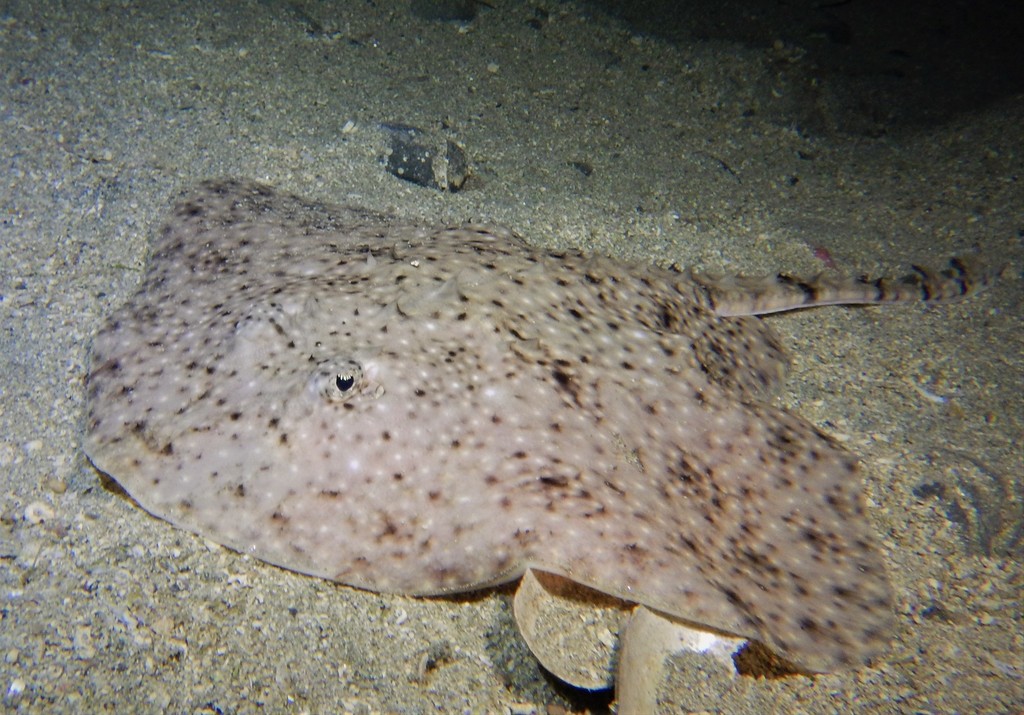
Photos show the species, not always the places on this page.
Length
Up to about 1.05 m (41 in) in total length
Weight
Up to about 11.4 kg (25 lb)
Next to a person
Up to about hip height on an adult, and about as heavy as a large suitcase
What it eats
Mainly fish and crustaceans, plus worms, hydroids, molluscs, squid and starfish relatives. It also scavenges.
Around people
Cold water, seldom seen
How it lives
The starry ray lives on sandy and muddy seabeds in cold water, from about 5 to 1,540 m but usually at 25 to 440 m, in water from about -1 to 14 degrees C. It lays eggs in tough cases, and a female can produce 10 to 45 egg cases a year. In the North Sea development takes about four months, and hatchlings are 8 to 12 cm (3 to 5 in) long. Maturity comes at about 87.5 cm (34 in), and the oldest age reported is 28 years.
Where it goes
In a Gulf of Maine tagging study, tagged skates moved at least 0.4 to 46.8 km over periods of 22 to 3,435 days, in random directions with no seasonal pattern. About 94 percent stayed in the same depth zone between tagging and recapture.
We only draw a journey on the map when scientists have tracked it or clearly documented it. For this animal we have not found one yet.
Populations
Worldwide: Vulnerable (IUCN, 2020). It lives across the North Atlantic and adjacent Arctic waters. In the Gulf of Maine, a 2020 study reports its abundance has declined by 80 to 95 percent since the 1960s. It has been a prohibited species in US waters since 2003, and bycatch in the Gulf of Maine trawl fishery is estimated at about 79 tonnes a year, around 1 percent of the biomass. It is of minor commercial value, and landings have been turned into fishmeal. I did not read regional assessments for other areas.
Meet it respectfully
The starry ray lives on cold, deep seabeds and is seldom met by visitors. If you ever see one, keep your distance. Never chase, touch, feed or bait it. Rules differ by place, so follow local rules and your guide.
Fun fact
Tap the bulb to light it up.
A female can lay 10 to 45 egg cases in a year.
In the Gulf of Maine, about 94 percent of tagged skates stayed in the same depth zone.
It lives in water as cold as about -1 degrees C.
Starry ray (thorny skate) in the Ocean Atlas
Places we have researched where this animal is recorded. It is never guaranteed, and some places are for watching from the boat only.
Travel with usComing soonTrusted referralExploringOn pause, story onlyEthics pass
Country colour: pink where we travel, blue where we are exploring or refer, grey for story only.
 Belgium
 Canada
 Denmark
 Germany
 Greenland
 Iceland
 Netherlands
 Norway
 Russia
 Sweden
 United Kingdom
 United States
Sources for this page
- GBIF (IUCN Red List category), 2026
- FishBase, 2026
- Wikipedia, 2026
- ICES Journal of Marine Science, 2020
Facts checked 5 October 2026. Photos: Unsplash licence, or Creative Commons as shown on each photo.
Work in ocean travel?
We are always happy to hear from exceptional local operators, accommodation, conservation organisations and destination experts. If your work fits responsible, small-group ocean travel, we would love to learn more.
Partner with Ocean CallingNot sure where to go? Get your Ocean Match
from CHF 19