
Blacktip Reef Sharks in Moʻorea: Mothers Who Cross 50 km
You are floating in the clear, shallow lagoon of Moʻorea, and a small shark with a black tip on its fin glides past, almost shy. For many snorkellers, this is the first shark they ever meet. What few people guess is the journey its mother may have made so it could be born here.
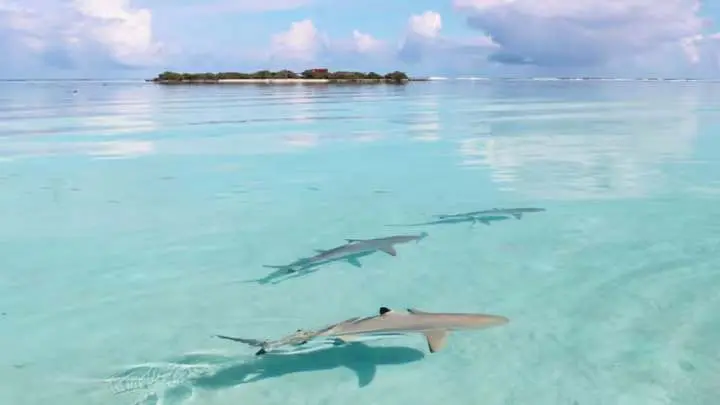
Some blacktip reef shark mothers in Moʻorea leave their home reef, swim across deep open ocean, and give birth on another island, up to 50 km away. Then they come back, and next time they return to the same nursery to give birth again.
How do we know this? And what does it mean for the way we swim in those shallows? Here is the story.
A shark of the shallows
The blacktip reef shark is one of the most common reef sharks of the Indian and Pacific Oceans. Common does not mean safe. It is listed as Vulnerable on the IUCN Red List.
At Moʻorea, researchers surveyed 268 blacktips and found something interesting. Females preferred the lagoons, while males used the outer reef slopes. The sharks grew about 6 cm a year, and males reached maturity at 111 cm.
So the calm lagoon, where most visitors swim, is largely a female world. When you float there, you are often a guest in the home of the mothers.
Do blacktip mothers really cross the open ocean?
Some do. To find out where females give birth, scientists took a tiny fin sample from young sharks and used DNA to match each pup to its parents. It is a bit like a family tree built from the water.
Most females gave birth at their home island. But some travelled to specific nursery areas outside the place where they usually live, sometimes to another island 50 km away, across deep ocean. And each of these females went back to the same nursery for every birth the researchers recorded.
This matters because blacktips around French Polynesia are not one big mixed population. A genetic study of five islands, 50 to 1,500 km apart, found strong differences between them, and the authors suggest that genes move between islands only a little. The researchers add a curious thought: if the females are this faithful to their places, the males may be the ones carrying genes from one island to another.
Loyal, but not rigid
A later team sampled 230 young sharks, all born that same year, at 10 nursery sites around Moʻorea over two pupping seasons.
Some full siblings born in different seasons were found at the same site, so their mother had come back. But other full siblings were found in nurseries on opposite sides of the island. The scientists call this "plastic reproductive philopatry", which simply means that mothers are loyal to birth places, but not always to the same one.
They suggest that human pressure on the coast could be one reason a mother changes nursery. They present this as a possibility, not a proven cause. They also found siblings caught together, at the same place on the same day, which supports the idea that very young brothers and sisters may stay close in their first weeks. More research is needed.
The first weeks of life
Those first weeks are fragile. The pup's body condition starts to fall as early as twelve days after birth, as it uses the energy stored in its liver. Only after about five weeks does it begin to explore and hunt for food.
Think about that for a moment. A small shark in the shallows may be living on its reserves, and every burst of speed costs it something.
There is good news too. Nine years in a row of monitoring at 10 Moʻorea nurseries found that the number of young blacktips was stable, and two nurseries even showed higher densities over time. Moʻorea is also inside French Polynesia's shark sanctuary.
But genetic work also found signs of a recent population bottleneck at Moʻorea, the most human-impacted lagoon in that study. A bottleneck is a moment in the past when numbers dropped, leaving less genetic variety. So the picture is hopeful, not careless.
How to share the shallows kindly
Blacktip nurseries are shallow coastal places, and the young sharks there face coastal building, tourism and pollution. That is exactly where people like us swim.
Between September and February, when pups are born and live their first weeks, give small sharks in shallow water extra space. Float calmly and keep your fins off the bottom. Never chase, corner, touch or feed them. A pup that swims away from you is using energy it needs.
Choose operators who do not use food to bring sharks close. A shark that comes near should come because it chooses to, not because it was called with fish. Wildlife encounters are unpredictable. Snorkelling near blacktip reef sharks should always follow local regulations and experienced professional guidance.
A few small habits help too. I wear a long-sleeve rash guard in the lagoon, so I need less sunscreen in the water, and when I do use some, it is a mineral one from our favourite sunscreens list.
The Moʻorea lagoon is also where our small Moʻorea group in September 2027 will spend its quiet hours, right at the start of pupping season. Knowing these mothers' story changes how you float there.
Questions people ask
Can I see baby sharks in Moʻorea?
Young blacktips live in shallow nurseries, and most are born in October and November. You may see small sharks in shallow water, but sightings are never guaranteed, and the kind thing is to watch from a distance.
How do scientists know who the mother is?
They take a tiny fin clip from each pup and compare DNA markers. Pups that share both parents are full siblings. In the Moʻorea study, each shark was tagged, sampled and released in less than ten minutes.
Are Moʻorea's blacktips doing well?
Numbers of young sharks were stable over nine years of monitoring. Genetic work, however, found signs of a recent population bottleneck at Moʻorea, the most human-impacted lagoon in that study.
Wildlife encounters are never guaranteed and never forced. Ocean Calling works only with vetted, ethical local operators, and every animal is free to approach, or not, entirely on its own terms.
Sources & further reading
- Mourier, J. & Planes, S., 2013. Direct genetic evidence for reproductive philopatry and associated fine-scale migrations in female blacktip reef sharks in French Polynesia. Molecular Ecology 22: 201-214.
- Eustache, K.B. et al., 2023. Genetic evidence for plastic reproductive philopatry and matrotrophy in blacktip reef sharks of Moorea. Scientific Reports 13: 14913.
- Eustache, K.B. et al., 2024. Spatial and temporal analysis of juvenile blacktip reef shark demographies identifies critical habitats. Journal of Fish Biology 104: 92-103.
- Debaere, S.F. et al., 2023. Quantifying changes in umbilicus size to estimate the relative age of neonatal blacktip reef sharks. Conservation Physiology 11: coad028.
- Mourier, J., Mills, S.C. & Planes, S., 2013. Population structure, spatial distribution and life-history traits of blacktip reef sharks. Journal of Fish Biology 82: 979-993.
- Vignaud, T. et al., 2013. Microsatellite analyses of blacktip reef sharks in a fragmented environment show structured clusters. PLoS ONE 8: e61067.
- Vignaud, T.M. et al., 2014. Blacktip reef sharks have high genetic structure and varying demographic histories in their Indo-Pacific range. Molecular Ecology 23: 5193-5207.
- Séguigne, C. et al., 2023. Citizen science provides valuable data to evaluate elasmobranch diversity and trends throughout French Polynesia's shark sanctuary. PLoS ONE 18: e0282837.
Further reading on Ocean Calling: French Polynesia in the Ocean Atlas · Does feeding sharks change their behaviour · Why sharks are essential to the ecosystem
Swim with humpback whales in Moʻorea: an ethical whale retreat
Whale encounter retreat · Moʻorea, French Polynesia
Time in the blue, on the whales’ terms. This story is about French Polynesia, where we run our whale trip.
Explore in the Ocean Atlas
Places in this article
Animals in this article
