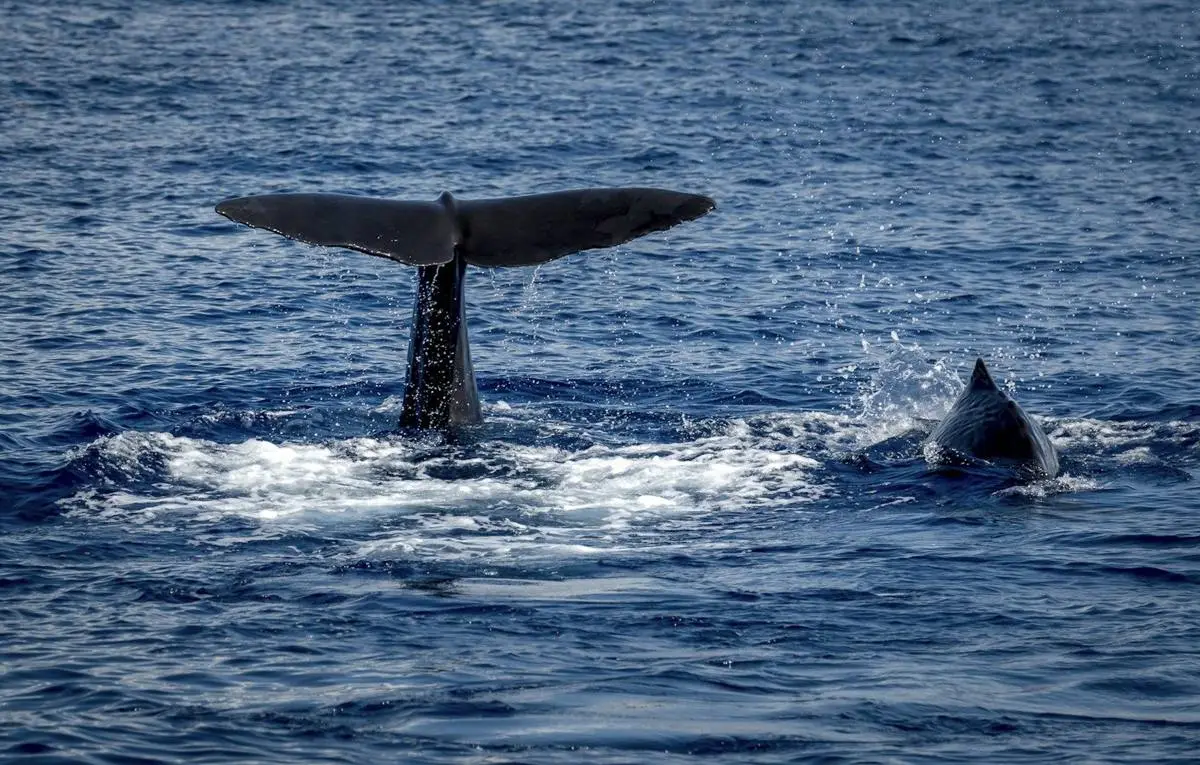
Do Sperm Whales Really Poop to Escape Orcas?
Someone once asked me a wonderful question: why do sperm whales poop on orcas to scare them away? The story travels fast online, and there is a real moment behind it. The true version is stranger, gentler and much more interesting than the headline.

So do sperm whales really poop to escape orcas? The short answer: nobody knows. A dark cloud, believed to be poop, was seen once during an orca encounter off Western Australia, and the orcas left. Whether the whales did it on purpose has never been tested. What science has recorded many times is something else: sperm whales defend each other by staying close. To see both stories, we need to go to a canyon off Western Australia, and then back in time to a few rare days when scientists watched the two giants meet.
A dark cloud off Bremer Bay
Picture blue water about 50 km off the south coast of Western Australia, between Albany and Hopetoun. This is Bremer Canyon, and every summer it draws many dozens of killer whales, the other name for orcas. The same surveys also met 81 sperm whales in 37 groups, so the two species really do share this water.
On 19 March 2024, a marine biologist was on a whale watching boat there when orcas moved in on a group of sperm whales. The sperm whales pulled together, heads in the middle and tails fanned outwards.
Then a big dark cloud spread through the water. At first some watchers thought it was blood. Later it was believed to be faeces. Sperm whales eat mostly squid, and the biologist explained that this gives their poo a reddish colour. The orcas moved off, and the sperm whales seemed to survive.
It is a magical picture: giants in a circle like the petals of a flower, disappearing behind a cloud of their own making. But one moment seen from a boat is an observation. The reason behind it is a different question, and a harder one.
How sperm whales really defend each other
Attacks on sperm whales are rarely seen, so every careful account matters.
In October 1997, researchers watched about 35 killer whales attack nine sperm whales for four hours, more than 130 km off central California. The sperm whales formed a rosette, also called a “marguerite” after the flower: heads together, tails out. When one whale was pulled away from the circle, one or two others left the safety of the group, swam beside it and led it back. One sperm whale was killed and the others were badly hurt. It is a hard story to read, and a deeply moving one.
The same paper describes another day, when a single killer whale harassed a small group of sperm whales. Every sperm whale within at least 7 km charged towards them at full speed, until about 50 were gathered in a tight formation.
In the Galápagos in April 1985, at least 20 sperm whales packed together, kept turning to face the killer whales and held a calf in the middle. Then they left in a long, silent, fast flight. Off southern Brazil in 2012, twelve sperm whales with a calf lay side by side at the surface, some rolling to show their tails.
So the defences science has recorded again and again are closeness, shape and teamwork. No cloud is needed for that. You can meet these families on our sperm whale page in the Ocean Atlas.
The poop question: what we know and what we guess
Now the honest part. The idea itself is old. In 1966, researchers suggested that sperm whales often poop in stressful situations.
But the Galápagos team noticed something important. On a normal day they saw sperm whales poop several times. Yet during the killer whale attack, although they were well placed to see it, they saw none at all. And the detailed California account describes slicks of blood and oil, but no cloud of faeces.
After Bremer Bay, the biologist was careful too. She said this has been seen before in sperm whales in distress, but that nobody knows if it is a stress response or a way to put off predators. There could also be other reasons why the orcas left that day.
So what was observed is a dark cloud during one orca encounter. The idea that sperm whales poop to escape orcas, as a smokescreen or a way to scare them, is a hypothesis, a guess still waiting to be tested. We found no peer-reviewed study that tests it, and nothing shows the whales aim at the orcas.
The little cousins with real ink
There is a true ink story, but it belongs to much smaller animals: the pygmy sperm whale and its close relative, the dwarf sperm whale. They belong to a different group, the genus Kogia. The pygmy sperm whale grows to about 11.5 feet, so roughly the length of a small car.
NOAA explains that each pygmy sperm whale has a sac of dark liquid in its intestine. It can release more than 3 gallons of dark, reddish brown “ink”, which makes a dark cloud that helps protect the whale when it feels threatened or is trying to escape predators. Maybe that is where part of the online story comes from.
How to meet sperm whales with respect
Sperm whales are best met from a boat, with a patient crew. Each place has its own rules. In the Azores, swimming with whales is forbidden, and boats may not come within 100 m of whales with small calves. In Sri Lanka, boats must switch off their engines at 100 m and never come closer, and watchers may not enter the sea. NOAA advises staying at least 100 yards away.
Of the places in this story, only Dominica has a legal swim framework. Its Sperm Whale Reserve law allows swim-with-the-whales activities only inside the Reserve, with a permit from the Chief Whale Officer, never with nursing or birthing whales, and with no chasing, touching or feeding. Wildlife encounters are unpredictable. Whale watching should always follow local regulations and experienced professional guidance.
If orcas are near, give everyone even more space. On a long day on the water, I keep my phone and a spare layer in a small roll-top dry bag, so I can simply sit, watch and let the whales decide. And if you are still looking for the ocean that fits you, our Ocean Match is a gentle place to start.
If this made you curious about experiencing the ocean this way, you can explore our upcoming retreats.
Questions people ask
Do sperm whales poop on orcas on purpose?
Nobody knows yet. A dark cloud, believed to be faeces, was seen during one orca encounter off Western Australia, and the orcas left. Whether it was deliberate, a stress reaction or a coincidence has not been tested.
Can orcas really hunt adult sperm whales?
Yes, although it is rarely seen. Off California, researchers watched killer whales kill one sperm whale and badly wound the others.
Is the sperm whale “ink” real?
The ink cloud is real in the small pygmy sperm whale, which releases a dark liquid from a sac in its intestine. NOAA describes it for this small whale, a different animal from the great sperm whale.
Wildlife encounters are never guaranteed and never forced. Ocean Calling works only with vetted, ethical local operators, and every animal is free to approach, or not, entirely on its own terms.
Sources & further reading
- Pitman, R.L., Ballance, L.T., Mesnick, S.I. and Chivers, S.J., 2001. Killer whale predation on sperm whales: observations and implications. Marine Mammal Science 17(3).
- Arnbom, T., Papastavrou, V., Weilgart, L.S. and Whitehead, H., 1987. Sperm whales react to an attack by killer whales. Journal of Mammalogy 68(2).
- Sucunza, F. et al., 2022. Sperm whale harassment by killer whales in the western South Atlantic Ocean. Latin American Journal of Aquatic Mammals 17(2).
- Salgado Kent, C. et al., 2021. Seasonal productivity drives aggregations of killer whales and other cetaceans over submarine canyons of the Bremer Sub-Basin. Australian Mammalogy 43(2).
- ABC News, 2024. Sperm whales drop “bubble of poo” off WA to prevent orca attack.
- BBC Discover Wildlife, 2024. Sperm whales seen pooing on orcas in possible “defensive defecation”.
- Lavery, T.J. et al., 2010. Iron defecation by sperm whales stimulates carbon export in the Southern Ocean. Proceedings of the Royal Society B.
- NOAA Fisheries. Pygmy sperm whale.
- NOAA Fisheries. Sperm whale.
- Azores Regional Legislative Decree 9/99/A (FAOLEX).
- International Whaling Commission. Whale Watching Handbook: Sri Lanka.
- Commonwealth of Dominica. Sperm Whale Reserve Bill 2025.
Further reading on Ocean Calling: Meeting Azores sperm whales without getting wet · Dominica’s sperm whale reserve · Orca in the Ocean Atlas
Swim with humpback whales in Moʻorea: an ethical whale retreat
Whale encounter retreat · Moʻorea, French Polynesia
Time in the blue, on the whales’ terms. If you love whales, this is our whale trip: small group, slow pace, on the animals’ terms.
Explore in the Ocean Atlas
Animals in this article