Azores Sperm Whales: Meeting Them Without Getting Wet
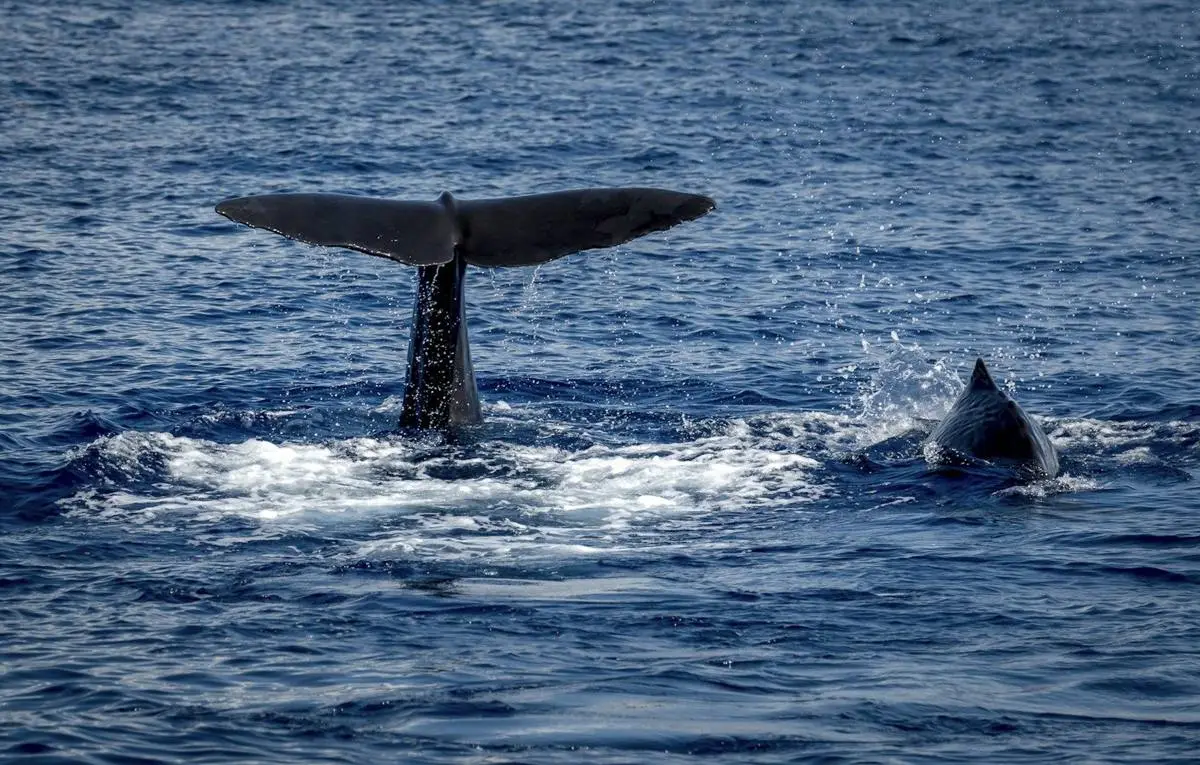
A flat grey sea, a boat with the engine off, and a long dark back that slides away without a sound. A sperm whale hunting squid in deep water does not need you in the sea to feel enormous.
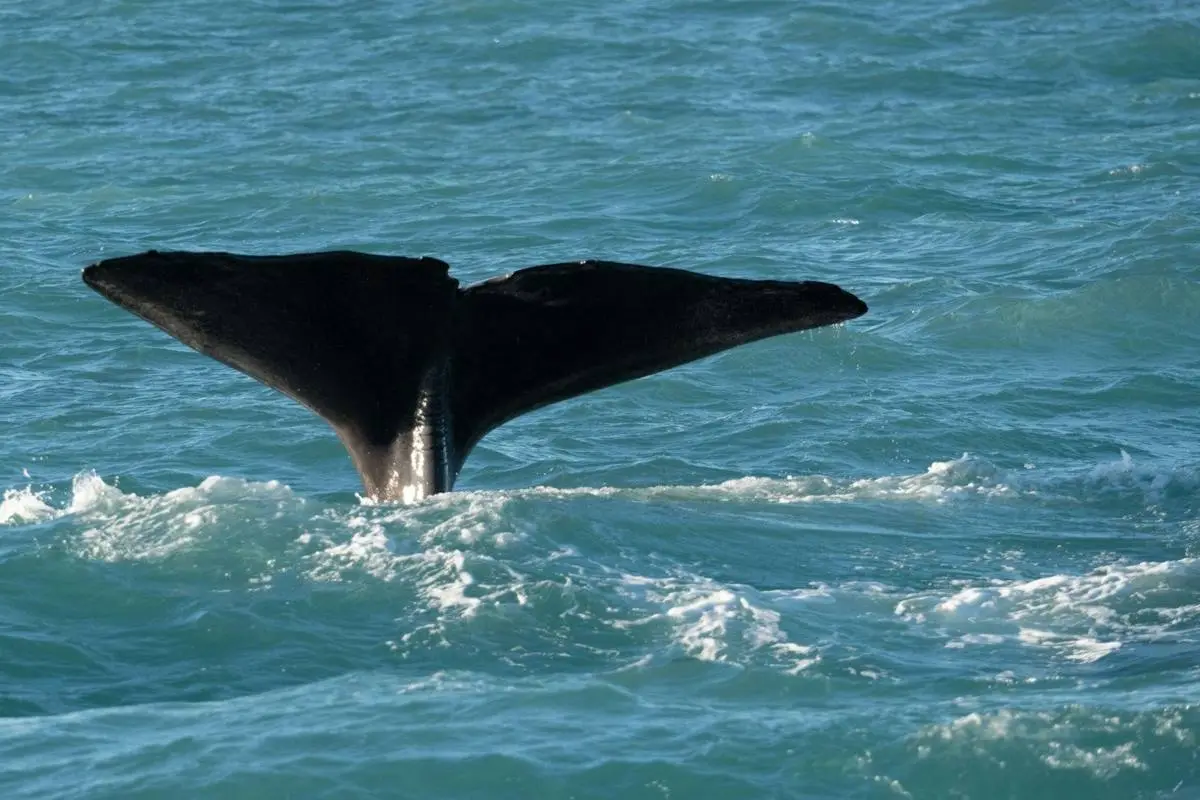
First you see a puff of breath on the horizon. Then a long dark back, lying still like a floating log. If the whale is ready, the tail lifts slowly and slides under. After that, the boat waits, and nothing happens for a very long time. That waiting is part of the experience, not a gap in it.
If you are planning Azores sperm whale watching, here is the short answer. Choose a licensed boat, bring a warm layer, stay on deck and give the whales time. Swimming with whales is forbidden in the Azores, and Ocean Calling would never sell it. Many people wonder if watching from a boat is really "enough". I think the boat is exactly the right place to be, and it can still be one of the best mornings of your life.
What are you watching when a sperm whale blows?
Sperm whales are the largest of the toothed whales. NOAA Fisheries gives males about 52 feet (around 16 metres) and females up to 35 feet. They hunt squid in deep water. According to the International Whaling Commission (IWC) whale watching handbook, females and their young live in stable groups built around related females, while young males leave and mature males mostly stay apart. NOAA describes these social groups as about 12 animals on average. So a group at the surface is usually a family of females with calves, and that matters for how we behave near them.
Think about what you are really seeing. The whale spends most of its life far below your boat. At the surface it breathes, rests and recovers before the next dive. You are watching the short, necessary pause between two long hunts. It is a bit like meeting someone on their coffee break. You would not want to take it from them.
In the Azores, the IWC lists sperm whales as present all year. Fin, blue and sei whales pass mainly in spring, and several dolphin species live here too, including common, bottlenose, Risso’s, striped and Atlantic spotted dolphins. Our sperm whale page in the Ocean Atlas has more about the species.
How long does a sperm whale stay underwater?
These whales are among the great divers of the ocean. Sources agree they can reach roughly 3,000 metres at the deepest, but a typical dive is much shallower. NOAA describes dives that often reach around 2,000 feet (about 600 metres) and can last 45 minutes, while another scientific profile gives about 400 metres and 35 minutes as a common pattern. An Azores operator reports average feeding dives of 40 to 45 minutes. Numbers differ between sources and between animals, so read them as a feel for the scale, not a rule.
This is the question every boat hears. A dive can run longer, and a whale may come up far from where it went down. That is why, as one local guide describes, skippers around Pico use a hydrophone, a waterproof microphone, to listen for the clicks before they approach.
It also means the honest forecast is never a promise. You may spend forty minutes watching an empty sea and then see a fluke. You may see nothing from one whale and a great deal from another. I would rather say that plainly than sell a certain thing.
What the Azores rules say
Whale and dolphin watching in the Azores is governed by a regional decree from 1999, Regional Legislative Decree 9/99/A, which has been changed several times since. The IWC handbook mentions amendments in 2003 and 2004, plus several ordinances, including a mandatory code of conduct and a limited number of licensed boats. In simple words: this is a licensed activity, and the number of boats is capped.
The decree was amended and published again in full in 2003 (Regional Legislative Decree 10/2003/A). In that text, the approach area starts 500 metres from the nearest animal. Inside it, boats travel parallel to the animals and slightly behind them, leaving their path ahead clear, and never go more than 2 knots faster than the animals. No boat may come closer than 50 metres to any whale or dolphin, and the total time in the approach area is limited to 30 minutes. With whales, no more than three boats may stay within 500 metres of the same animal or group, and each boat may stay there for 15 minutes at most. The decree forbids chasing, including repeated approaches when the animals keep avoiding the boat. It forbids splitting a group or isolating a calf, feeding, and coming closer than 100 metres to whales with small calves.
And then there is article 21, short and clear: “É proibida a natação com baleias”. Swimming with whales is forbidden. The IWC confirms this is still the case today, for safety reasons and for the welfare of the animals. Operators describe snorkelling with some dolphin species as allowed under conditions, never with scuba.
Some operators publish their own summaries of the rules with slightly different numbers, for example a 50-metre minimum approach. Those are operator summaries, not the legal text, and details have changed since 1999. Please check the current rule, and the operator’s permit, before you travel. If anyone offers you a sperm whale swim in the Azores, ask to see the permit. I have not found a rule that supports it.
Do the rules really help the whales?
Yes, and there is evidence. In a study of 80 sperm whales in 40 encounters around the Azores in 1998, whales changed swimming speed on 3 occasions when boats followed the rules, compared with 19 when they did not. They showed aerial displays, like jumps, twice when boats followed the rules, compared with 20 times when they did not.
Rules only help if they are followed. That is why the choice of operator matters so much.
Why staying dry protects the animals
Sperm whale calves cannot dive deep, so they stay near the surface while the adults hunt. An Azores operator describes groups where the adults take turns with their dives, so some of them are always at the surface with the calves. A boat that arrives fast, or a swimmer who slips in, breaks that careful arrangement. The whale cannot leave a calf, and it cannot easily tell us it is uncomfortable.
There is also the question of noise and numbers. The Azores system tries to limit both, by licensing boats and keeping them at a distance. Our job as visitors is to make that system easier for the whales, not to look for the corner where it is weakest. If you want to understand why in-water encounters need written rules, our piece on how to read guaranteed swim ads goes through the small print. And to see what a system with written in-water rules looks like, read about dwarf minke whales and the rope on the Great Barrier Reef, instead of imagining the same thing for the mid-Atlantic.
How to choose a boat and what to bring
Ask a few plain questions. Does the operator hold a current licence, and how do they apply the watching rules? How many boats may be near one animal, and how are sightings shared between boats? What is the minimum distance, and what changes when a calf is there? Will the skipper turn away if the whales look disturbed, and how do they decide when it is time to leave? Do they cancel when the sea is not safe, and what happens if there are no sightings? A good operator answers without hurry and does not promise a fluke.
Group size matters too. A smaller, quieter boat changes the feeling of the whole morning. On board, stay seated when the skipper asks, keep your voice low and your hands out of the water. Watch for the signs of a dive: a series of breaths, a slightly arched back, then the fluke. When the whale goes down, I would rather wait calmly than race to where it might come up. If you fly a drone, know that the decree forbids using aircraft to watch whales and dolphins, except for science or for filming with prior authorisation.
The deck can be cold and wet even in summer, so bring a windproof layer and something warm for your hands. A roll-top dry bag keeps a phone and a spare jumper dry when spray comes over the side, and leaves both hands free to hold on. A reusable water bottle and a few packing cubes help you leave no plastic behind. If you tend to feel sick on boats, ask a pharmacist before the trip, because I am not a doctor.
An honest word about getting there
The Azores are far from most of us, and the flight is usually the biggest part of this trip’s footprint. I do not have a number I could verify, so I will not invent one. What I can say is that a longer stay is kinder than a quick visit, and that choosing a small, licensed boat and moving around less help a little. Our Portugal notes in the Ocean Atlas treat the Azores as a watching destination.
Wildlife encounters are unpredictable. Sperm whale watching should always follow local regulations and experienced professional guidance.
If this quiet way of meeting the ocean feels right to you, our Ocean Match can help you find the place that fits you best, or you can explore our upcoming retreats. We would never sell a swim with sperm whales in the Azores.
Questions people ask
Can you swim with sperm whales in the Azores?
No. Article 21 of the regional decree says swimming with whales is forbidden, and the IWC confirms this still applies. Swimming with some dolphins is allowed, but regulated. If anyone offers a whale swim, ask to see the permit.
When is the season for Azores sperm whale watching?
The IWC lists sperm whales as present all year. Weather and sea state decide which days you can go out, so ask a local operator what the last few days looked like instead of trusting a brochure. A sighting is never guaranteed.
How close do boats get?
The decree, as republished in 2003, sets a minimum of 50 metres from any whale or dolphin and 100 metres from whales with small calves, with limits on speed, number of boats and time. Ask your operator how they apply the current rules.
Are there other whales and dolphins?
Yes. Fin, blue and sei whales pass mainly in spring, and common, bottlenose, Risso’s, striped and Atlantic spotted dolphins are listed for the Azores. Nothing is promised, and which species you meet depends on the day.
How long will I wait for a sighting?
Sperm whales often spend around 35 to 50 minutes underwater on a feeding dive, so waiting is normal. Some trips find a whale quickly, and some find none. A good skipper will tell you that honestly at the start.
Will I get seasick?
Open Atlantic water can be rough, even in summer. Choose a calm day if you can, eat lightly and sit in the middle of the boat where it moves least. Ask a pharmacist or doctor about remedies, because I cannot advise on medicines.
Is whale watching bad for the whales?
It can be, if boats are too close, too many or too noisy. Studies in the Azores found more changes in whale behaviour when boats broke the rules, and small energy costs even near boats that followed them. Pick an operator that follows the rules and accept fewer minutes with the animal.
Wildlife encounters are never guaranteed and never forced. Ocean Calling works only with vetted, ethical local operators, and every animal is free to approach, or not, entirely on its own terms.
Sources & further reading
- Região Autónoma dos Açores, 1999. Decreto Legislativo Regional n.º 9/99/A (cetacean watching). FAOLEX copy.
- International Whaling Commission, Whale Watching Handbook: Portugal country profile (Azores and Madeira)
- International Whaling Commission, Whale Watching Handbook: sperm whale species page
- NOAA Fisheries. Sperm whale species profile.
- Oliveira et al., 2022. Exposure to whale watching vessels affects dive ascents and resting behavior in sperm whales. Frontiers in Marine Science.
- Magalhães et al., 2002. Short-term reactions of sperm whales (Physeter macrocephalus) to whale-watching vessels in the Azores. Aquatic Mammals. Summary via Conservation Evidence.
- Whale Watching Azores, whale watching guidelines (operator summary of the regional rules)
- Espaço Talassa, Responsible whale watching in the Azores (operator code of ethics)
- Azores Whale Watch, sperm whale sighting pages (operator)
- Duke University OBIS-SEAMAP, Sperm whale species profile
- Aquarium of the Pacific, Sperm whale
- Cetacean Watching Azores, Baby sitting in sperm whales (operator blog)
- Assembleia Legislativa Regional dos Açores. Decreto Legislativo Regional n.º 10/2003/A, de 22 de março, amending and republishing Decreto Legislativo Regional n.º 9/99/A (observação de cetáceos), articles 9 and 19 to 22. Jornal Oficial dos Açores.
Further reading on Ocean Calling: Sperm whales are not humpbacks · Guaranteed swim ads · Madeira: sperm whales and pilot whales · Sperm whales in Dominica · Portugal in the Ocean Atlas
Swim with humpback whales in Moʻorea: an ethical whale retreat
Whale encounter retreat · Moʻorea, French Polynesia
Time in the blue, on the whales’ terms. If you love whales, this is our whale trip: small group, slow pace, on the animals’ terms.
Explore in the Ocean Atlas
Places in this article
Animals in this article