
Madeira Whale Watching: Sperm Whales, Pilot Whales, Stay Dry
A morning off Madeira. The island rises green and steep behind you, the Atlantic is deep blue in front, and a family of pilot whales rests at the surface, breathing slowly. Nobody on the boat puts on a mask. That is not a missed chance. It is exactly how Madeira whale watching is meant to be.

What can you see on a Madeira whale watching trip? Most often short-finned pilot whales and bottlenose dolphins, which live here all year, and sometimes sperm whales and other visitors. And you watch them from the boat: free swimming with whales and dolphins is not allowed here. Madeira is one of the Atlantic's most reliable year-round places to watch whales and dolphins from a boat. Many visitors still arrive expecting a swim, and they are surprised. To understand why the whole encounter is designed from the deck, it helps to meet the animals first.
Who lives around Madeira?
The islands sit on deep Atlantic slopes, very close to Funchal and the other harbours of the south coast. That deep water, so near the land, suits animals that feed far below the surface and rest closer to the calm side of the island.
The most constant neighbours are short-finned pilot whales and bottlenose dolphins, which live here as residents. Pilot whales feed mainly on squid, and also on fish and octopus.
Further offshore, sperm whales appear when the conditions and the food line up. They are deep-water hunters of squid. Then there are the seasonal or less frequent visitors: Atlantic spotted and common dolphins, fin whales, Bryde's whales and, now and then, sei whales. They add variety from roughly April to October. Humpbacks are rare here.
What a good day looks like
A good day is a quiet day. The animals rest at the surface, which people call logging, or they travel, or they dive, while the boat holds its position at a respectful distance. A quieter day with fewer animals is still a day on the Atlantic.
The weather decides more than any advert. Operators often cancel when the swell is more than about two metres, and the south coast is usually more sheltered than the north.
The water stays roughly between the high teens and the mid-twenties Celsius all year, about 64 to 75 °F. This is cooler Atlantic water, not a tropical lagoon. Dress for wind, spray and a long time sitting. I keep my spare layer and my phone in a small roll-top dry bag, so I am not searching for things when the whales come up.
Why you stay dry
Madeira regulates the watching of marine animals through Regional Legislative Decree 15/2013/M, managed by the IFCN, Madeira's institute for forests and nature conservation. Commercial whale watching needs IFCN authorisation, and the number of boats is limited by a carrying capacity.
The International Whaling Commission summarises Madeira's rules in plain words. Free swimming with whales and dolphins is not allowed. Common and Atlantic spotted dolphins may be observed underwater only if swimmers stay connected to the boat by a rope.
The same summary gives a minimum distance of 50 metres and about 10 minutes for each boat with a group. If several boats share the same group, they all leave after 40 minutes at most, and then that group gets a 2-hour rest before anyone approaches again. Each boat may make up to three trips a day. Some guides also keep a wider distance, often cited as about 100 metres, from large whales.
Some local fast boats still sell a short dolphin “add-on” with a rope. The marketing and the legal summary do not always match. We do not sell or recommend rope swims, and we explain why in Madeira's rope dolphin observation. For animal-first travel, the choice is simple: stay dry and choose a licensed operator.
Wildlife encounters are unpredictable. Whale watching should always follow local regulations and experienced professional guidance.
How to choose a kind Madeira boat
You do not need to be an expert, just curious. Is the boat authorised by the IFCN to watch marine animals? Will the guide explain distances and time limits before you leave the harbour? Is there a vigia passing information to the boat? What happens if the animals are resting, have calves, or are already surrounded by boats? And is a swim with whales or dolphins part of the ticket? If yes, walk away from that product.
On the water, the animal decides the quality of the hour. The boat moves parallel to the animals, never cuts across a group's path, keeps the engine calm, and leaves when the clock or the animals say so. These habits matter more than a perfect photo.
Currents, feeding depth and other boats change every day, so sightings cannot be promised. You came to learn how these animals use Madeira's slopes, not to force a swim. If this slow, watch-only way of meeting the ocean speaks to you, our Ocean Match can help you find the place that fits you.
And if you would like to share a slow ocean week with a small group, you can explore our upcoming retreats.
Questions people ask
Can you swim with whales in Madeira?
No. Free swimming with whales and dolphins is not allowed under Madeira's rules for watching marine animals, set in Regional Legislative Decree 15/2013/M.
Are there resident whales off Madeira?
Yes. Short-finned pilot whales and bottlenose dolphins are widely described as year-round residents. Sperm whales and other species come and go with food and season. Sightings are never guaranteed.
Are the whales dangerous on a boat trip?
For a licensed boat watch, the risk from the animals is low. Humans are not their prey. The practical risks are the Atlantic swell and the motion of the boat.
When is the best time for Madeira whale watching?
Resident species can be watched all year when the sea allows. Variety often grows from about April to October. Swell and wind can still cancel trips.
Wildlife encounters are never guaranteed and never forced. Ocean Calling works only with vetted, ethical local operators, and every animal is free to approach, or not, entirely on its own terms.
Sources & further reading
- IFCN Madeira, Observação de vertebrados marinhos / DLR 15/2013/M
- IWC Whale Watching Handbook, Portugal country profile
- NOAA Fisheries, short-finned pilot whale summary
Further reading on Ocean Calling: Sperm whale in the Ocean Atlas · Pilot whale facts and ethical encounters
Swim with humpback whales in Moʻorea: an ethical whale retreat
Whale encounter retreat · Moʻorea, French Polynesia
Time in the blue, on the whales’ terms. If you love whales, this is our whale trip: small group, slow pace, on the animals’ terms.
Explore in the Ocean Atlas
Places in this article
Animals in this article
 Short-finned pilot whaleGlobicephala macrorhynchus
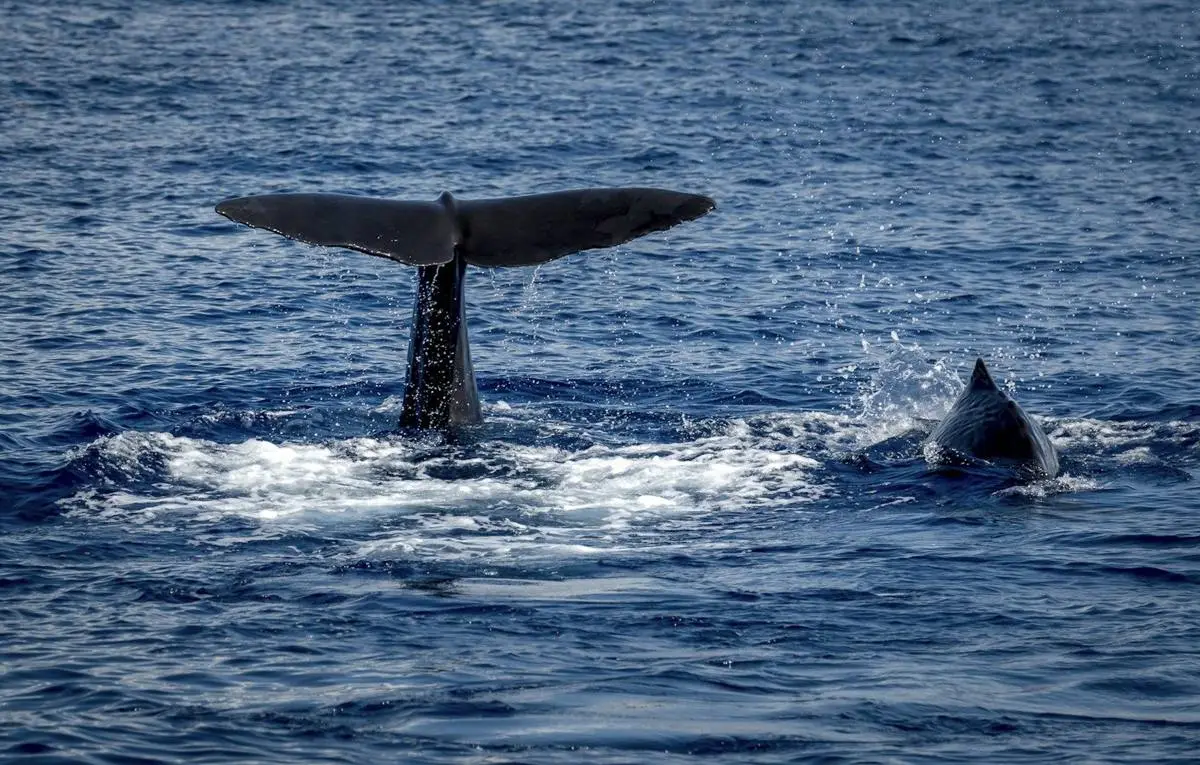 Sperm whalePhyseter macrocephalus
 Common bottlenose dolphinTursiops truncatus