Pilot Whale Facts and How to Meet Them Ethically
Pilot whales travel in tight family pods of dozens. What they really are, why they stay so close together, and what a kind, ethical encounter looks like.

What are pilot whales, and why do they travel in such tight pods?
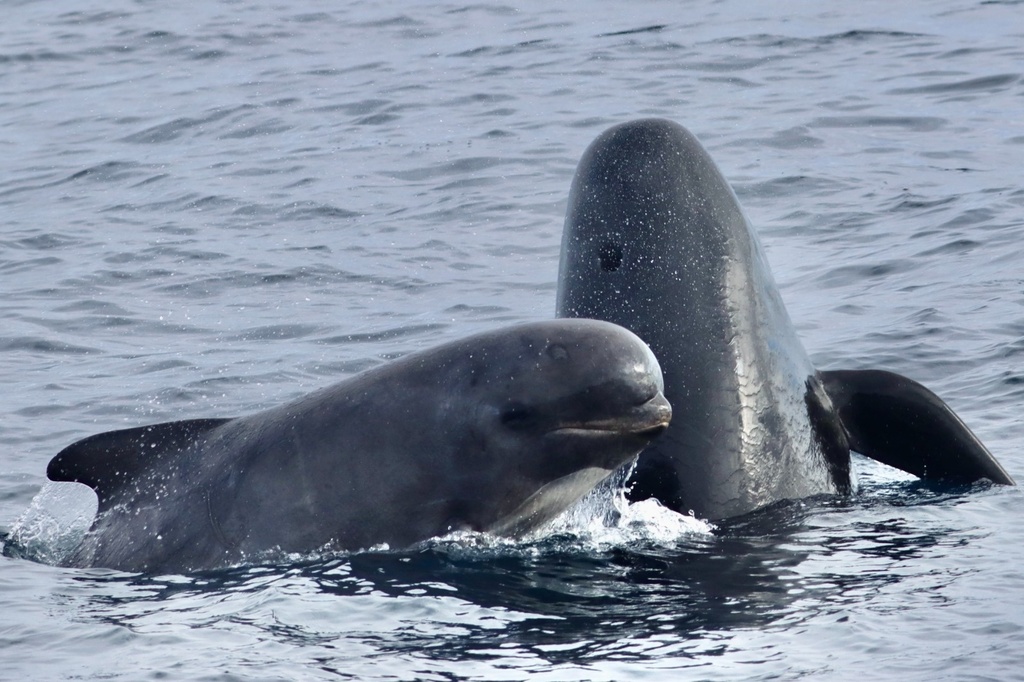
First you see one dark back. Then five. Then fifteen, and suddenly it looks like the whole ocean is breathing at once, close together, moving as one. A pod of about fifteen pilot whales is a big part of why Ocean Calling exists, so these animals are close to my heart. The short answer to the big question: pilot whales are large dolphins that live in stable family groups, and they stay close because the group is how they find food, raise their calves and survive. They are one of the animals we are asked about most, and one of the most misunderstood, so this page is a simple set of questions and answers.
Are pilot whales actually whales?
Not really, and this surprises almost everyone. Pilot whales belong to the dolphin family, Delphinidae, the same family as the orca, which is also a dolphin and not a "true" whale. There are two species. The long-finned pilot whale (Globicephala melas) lives in cooler temperate and subpolar waters of the North Atlantic and the Southern Hemisphere. The short-finned pilot whale (Globicephala macrorhynchus) prefers warmer tropical and subtropical seas around the world. From a boat they look very alike: a dark body, a round, bulbous head and a low, broad dorsal fin set quite far forward.
Why do pilot whales travel in such tight pods?
Because a pod really is a family. Researchers generally describe pilot whales as living in matrilineal societies. These are stable groups built around related females, where both sons and daughters tend to stay in the group they were born into, instead of leaving to breed somewhere else. That is unusual for mammals, and it is part of why the groups look so tightly bound at the surface.
How big a group is depends on where you look. The North Atlantic Marine Mammal Commission describes long-finned pilot whales as a social species found in groups of tens to hundreds of animals. The Sea Watch Foundation, which works around the British Isles, describes pods of roughly 20 to 100, usually split into smaller subgroups of about 10 to 20, mostly females with their calves. So when it looks like the whole ocean is surfacing, you may be watching several families travelling together for a while.
What do they eat, and how deep do they dive?
Mostly squid, and also fish and octopus. According to NOAA Fisheries, long-finned pilot whales can dive to around 2,000 feet (roughly 600 metres) for 10 to 16 minutes to feed. Much of their feeding happens at night in deep water, when their prey comes up closer to the surface. This is one reason a calm pod "logging" at the surface in daylight, lying still like floating logs, may simply be resting after a night of work. A good reason to let them rest.
Why do pilot whales strand in such large numbers?
This is the question people ask most, usually right after "are they dangerous?" We have no reason to think so, but they are wild animals and deserve space like any other. Pilot whales are well known for mass strandings. New Zealand's Te Ara encyclopedia describes the stranding of around 1,000 pilot whales at Long Beach in the Chatham Islands in 1918 as the country's, and the world's, worst recorded stranding. The Department of Conservation is a little more careful and calls it "perhaps a world record".
The classic explanation goes back to their social life: because the bonds in a pod are so strong, healthy animals may follow one lost or sick individual into shallow water. But this is not a settled, simple story. The 2013 study by Oremus and colleagues in the Journal of Heredity found several maternal lineages in most of the strandings it looked at, and family ties did not predict where the animals ended up on the beach. One of the authors suggested that family groups may be breaking apart in deep water before the stranding, not after. Researchers are still working on it, and no single cause has been proven. Our piece on why pilot whale strandings keep making headlines goes deeper into this.
Conservation status: why "Least Concern" is not the whole story
Globally, the long-finned pilot whale is listed as Least Concern on the IUCN Red List. That is good news, but it is a global label. It does not tell you how a local population is doing, and it does not mean the pressures on pilot whales are small. Like other deep-diving toothed whales, they share the ocean with fishing gear, ship traffic and underwater noise. In the Faroe Islands they are still hunted in the traditional drive hunt known as the grind. If you want the honest, uncomfortable picture of where whales are still hunted, our guide to who still hunts whales today covers it.
For a traveller, the conservation part is simpler than it sounds. Resting at the surface, nursing calves, travelling as a family: these are exactly the moments a careless boat can interrupt. Every time a pod is chased or split, it pays an energy cost. "Least Concern" is not a licence to get closer.
Where might you see them responsibly?
Pilot whales are a regular sighting in several places, though never a guaranteed one. The Canary Islands, especially the waters off Tenerife, are known for short-finned pilot whales, and Madeira and the Azores see them too. Our page on responsible pilot whale watching off Tenerife looks at one of these places in detail. Wherever you go, sightings depend on the season, the weather and the animals themselves, and an honest operator will tell you so before you board.
A long day on deck is part of the experience. A roll-top dry bag keeps your phone and a jumper dry when the spray comes over the bow, and a bottle from a simple tropical travel kit saves you buying plastic at the harbour.
What does an ethical pilot whale encounter actually look like?
The same as with any whale or dolphin: patience instead of pursuit. A responsible boat keeps a steady, slow course, does not cut across the direction the pod is travelling, and lets the whales decide how close they come, never the other way around. Because a pod travels as a family, a boat pushing into the middle of it does not just startle a few animals. It splits a group that depends on staying together. The best encounters are usually the quietest: engine down, distance kept, and the pod allowed to simply pass by. Local rules differ by country, so check the current rule before you travel and ask your operator which one they follow.
Wildlife encounters are unpredictable. Pilot whale watching should always follow local regulations and experienced professional guidance.
Our page on how we make ethical wildlife encounter decisions explains the same principles for every species we meet. If this made you curious about meeting the ocean this way, you can explore our upcoming retreats.
Questions people ask
Are pilot whales whales or dolphins?
They belong to the dolphin family, Delphinidae, like the orca. The name "whale" comes from their size, not their family tree.
How many pilot whales are in a pod?
It varies. Long-finned pilot whales are described in groups of tens to hundreds, and around the British Isles pods of about 20 to 100 are often made of smaller subgroups of 10 to 20 animals.
How deep can pilot whales dive?
NOAA Fisheries says long-finned pilot whales can dive to about 2,000 feet (around 600 metres) for 10 to 16 minutes to feed, mostly at night.
Why do pilot whales strand together?
Strong social bonds are part of the explanation, but genetic work from 2013 found several separate family lines in most of the strandings it studied. There is no single proven cause yet.
Are pilot whales endangered?
The long-finned pilot whale is listed globally as Least Concern by the IUCN. That global label does not describe every local population, and pilot whales are still hunted in the Faroe Islands.
Can I swim with pilot whales?
Rules depend on the country and change over time. Check the current local rule before you travel, and choose an operator who keeps a calm distance and lets the pod decide.
Wildlife encounters are never guaranteed and never forced. Ocean Calling works only with vetted, ethical local operators, and every animal is free to approach, or not, entirely on its own terms.
Sources & further reading
- NOAA Fisheries. Long-finned pilot whale (species profile), accessed 2026.
- North Atlantic Marine Mammal Commission (NAMMCO). Long-finned pilot whale.
- Sea Watch Foundation. Long-finned pilot whale species sheet, 2020.
- Oremus, Gales, Kettles & Baker. Genetic evidence of multiple matrilines and spatial disruption of kinship bonds in mass strandings of long-finned pilot whales. Journal of Heredity 104(3), 2013.
- ScienceDaily, 2013. Role of kinship in mass strandings of pilot whales questioned (news summary of Oremus et al.).
- Te Ara, the Encyclopedia of New Zealand. Whales: strandings.
- New Zealand Department of Conservation. Chatham Islands marine mammals.
- Mammal Diversity Database (American Society of Mammalogists). Globicephala melas, including IUCN status.
- Whale and Dolphin Conservation, 2025. Another hunt in the Faroes sees hundreds of pilot whales killed.
Further reading on Ocean Calling: More from the journal · Wildlife & the law · See the retreats · Ocean Atlas
Swim with humpback whales in Moʻorea: an ethical whale retreat
Whale encounter retreat · Moʻorea, French Polynesia
Time in the blue, on the whales’ terms. If you love whales, this is our whale trip: small group, slow pace, on the animals’ terms.
Explore in the Ocean Atlas
Animals in this article