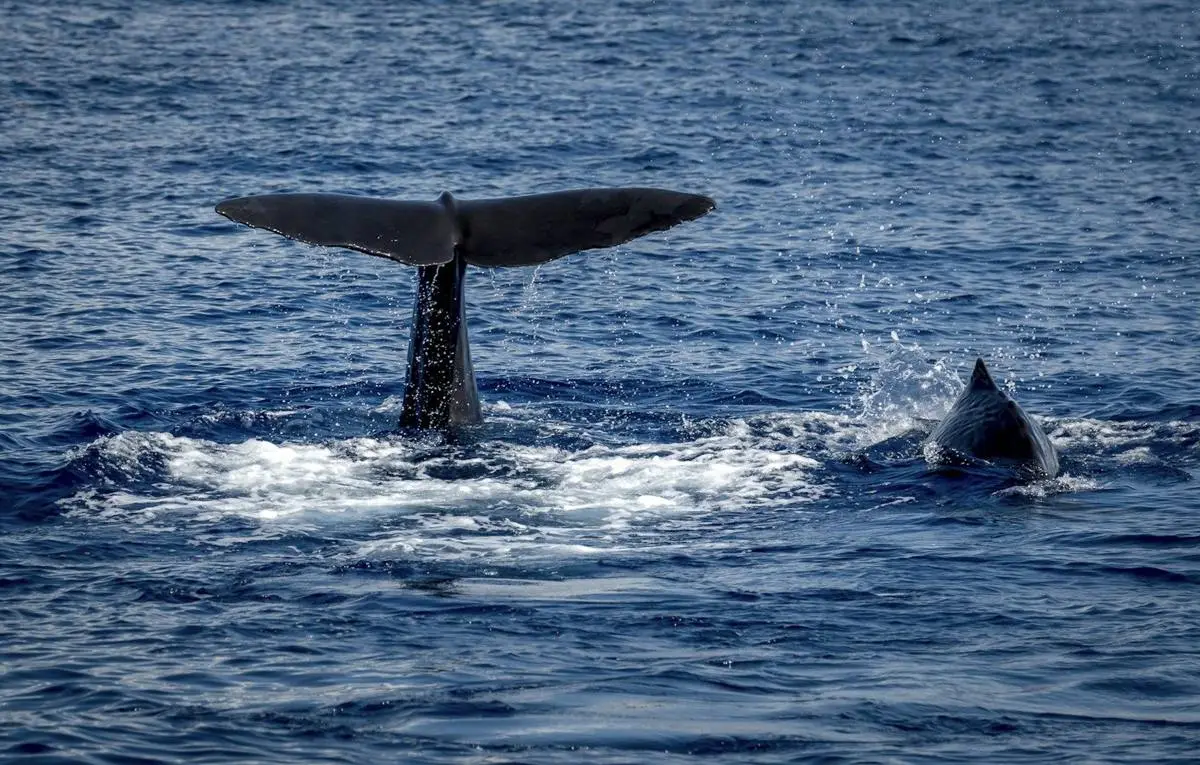
Whales Help Us Breathe: The Whale Pump, Explained
Giant whales do not make the air we breathe. But what they leave in the water can help feed the tiny plants that do, and that is a lovely reason to protect them.

For Rocío, who lives with bronchiectasis, breathing is never a small thing. It is one reason whales feel so close to her. So when she first read that “whales help us breathe”, she wanted to know if it was true. The honest answer: not directly. Whales do not make the oxygen in the air. But what they leave in the water can help feed the tiny plants that do, in some places. How much that matters for the whole planet is still being worked out.
Where does our oxygen come from?
Much of the ocean’s oxygen comes from phytoplankton, microscopic plants and algae that drift in the sunlit top layer of the sea. Like plants on land, they use sunlight to grow, and they release oxygen as they do. NOAA’s National Ocean Service says scientists estimate that roughly half of the oxygen produced on Earth comes from the ocean, and that about the same amount is used by marine life.
You will often hear this as “every second breath comes from the ocean”. It is a beautiful way to say it, and true in spirit. But marine life uses up a large share of that oxygen, so it is not a strict count of the breaths you take. The “half” is a production figure, not a gift of new oxygen each year.
What is the “whale pump”?
Baleen whales and many other whales feed at depth, then come back up and release their waste near the surface, where light reaches. That waste carries nutrients that phytoplankton need, such as nitrogen. It is a surprising idea, because we usually picture nutrients sinking down and getting lost in the dark. Scientists call this upward movement the whale pump.
In a 2010 study in PLOS ONE, Joe Roman and James McCarthy estimated that whales and seals may recycle about 23,000 metric tonnes of nitrogen a year into the sunlit layer of the Gulf of Maine. That is more than all the rivers flowing into that basin combined. The paper chooses its words carefully: it says “may”, and the figure comes from field measurements combined with population estimates. The authors also suggested that, before commercial whaling, the effect was probably much larger.
Iron from sperm whales
In the Southern Ocean, iron is scarce, and phytoplankton often run short of it. A 2010 study by Trish Lavery and colleagues, published in Proceedings of the Royal Society B, estimated that the region’s sperm whales, about 12,000 of them, release around 50 tonnes of iron a year into the sunlit layer. The team estimated that this helps move about 400,000 tonnes of carbon a year to the deep sea. The whales themselves breathe out about 200,000 tonnes, which leaves a net removal of around 200,000 tonnes. These are estimates for one region, not a measurement of the whole ocean.
It fits a longer story about sperm whales and the deep, which you can also read in our piece on sperm whales and their poop.
A puzzle: krill and the missing whales
There is an old puzzle in Antarctic science, sometimes called the krill paradox. When whaling removed most of the big baleen whales, scientists expected krill to boom, since fewer animals were eating them. Instead, reports describe a sharp fall in krill on former whaling grounds. One idea is that whales recycled iron that krill and phytoplankton needed. A 2025 University of Washington study found significant iron in whale faeces. But it analysed only five samples, from two humpbacks in the Southern Ocean and three blue whales off California, so it is an early result. Other researchers think climate change and other factors matter more, or that the timing is a coincidence. I would call this one unresolved.
How much does the whale pump really matter for the climate?
Here we have to be honest. A review by Heidi Pearson and colleagues, published in Trends in Ecology & Evolution (online December 2022), says that indirect pathways, such as whale waste feeding phytoplankton, have the greatest potential to capture carbon, but are poorly understood. The authors list open questions, such as how available whale nutrients really are to phytoplankton, and how much this changes by species and region. They also note that if whale populations recover, the global effect on carbon would be relatively small.
That is why you will not find a claim here that one whale equals a certain number of trees. Estimates like that vary widely and depend on assumptions. What we can say is that whales are part of a living system, and healthy whale populations are part of a healthy ocean. Whales are valuable without needing to be a climate tool.
Why we care at Ocean Calling
If whales matter to the ocean, then how we watch them matters too. We want to see them kindly: from a respectful distance, never chasing, touching or feeding, and only with local operators who follow the rules. Boats and noise are a real stress for whales, and travelling to see them has its own carbon cost. Choosing small boats, slow trips and fewer, longer visits is one way to carry that responsibility. Wildlife encounters are unpredictable. Whale watching should always follow local regulations and experienced professional guidance.
If you are heading out to look for whales, a small roll-top dry bag keeps a dry layer close, so staying on deck is a comfortable choice and not a cold one, and a rash guard is useful sun protection on a long boat day. You can read more about how we think about distance and sightings in why ethical whale encounters often mean fewer sightings, and about the story that made this topic personal in Rocío’s story. If this made you curious about experiencing it yourself, you can explore our retreats.
Questions people ask
Do whales make oxygen?
No. Phytoplankton make most of the ocean’s oxygen. Studies suggest that whale waste can help feed them in some places.
Does every second breath really come from the ocean?
NOAA says roughly half of the oxygen produced on Earth comes from the ocean. But marine life uses much of it, so “every second breath” is a popular simplification, not a strict count.
Does whale poo really matter for the planet?
In the places where it has been studied, such as the Gulf of Maine and the Southern Ocean, estimates say it adds nutrients that phytoplankton need. How much it matters for the whole ocean and for the climate is still being studied.
Can whales help fight climate change?
A 2022 to 2023 review says the potential is greatest through indirect routes such as feeding phytoplankton, but these are poorly understood, and the global effect of whale recovery would be relatively small. Whales are worth protecting for their own sake.
What is the krill paradox?
After whaling removed most large baleen whales, krill on former whaling grounds reportedly fell instead of rising. One idea links this to lost whale iron recycling. Other researchers disagree, so it is not settled.
Will I see whales on an Ocean Calling retreat?
Wildlife is never guaranteed and never forced. We work with vetted local operators, keep to local rules, take small groups of up to 6 on our hosted retreats and let the animals decide.
Wildlife encounters are never guaranteed and never forced. Ocean Calling works only with vetted, ethical local operators, and every animal is free to approach, or not, entirely on its own terms.
Sources & further reading
- How much oxygen comes from the ocean? NOAA National Ocean Service
- Roman, J. and McCarthy, J. J. (2010). The Whale Pump: Marine Mammals Enhance Primary Productivity in a Coastal Basin. PLOS ONE 5(10): e13255
- Lavery, T. J. et al. (2010). Iron defecation by sperm whales stimulates carbon export in the Southern Ocean. Proceedings of the Royal Society B 277: 3527-3531
- Pearson, H. C. et al. (2023). Whales in the carbon cycle: can recovery remove carbon dioxide? Trends in Ecology & Evolution (NSF Public Access Repository)
- Whale poop contains iron that may have helped fertilize past oceans. University of Washington, 2025
Further reading on Ocean Calling: Learning to freedive, living with bronchiectasis, and my uncle’s words · Why ethical whale encounters often mean fewer sightings · Do sperm whales poop to escape orcas? · Ocean Atlas
Swim with humpback whales in Moʻorea: an ethical whale retreat
Whale encounter retreat · Moʻorea, French Polynesia
Time in the blue, on the whales’ terms. If you love whales, this is our whale trip: small group, slow pace, on the animals’ terms.
Explore in the Ocean Atlas
Animals in this article