
Do Artificial Reefs Work for Conservation?
A stone face on the seabed, half covered in coral, a school of fish turning around its ear. It makes a beautiful photo. But is it saving the reef, or only gathering fish for the camera?
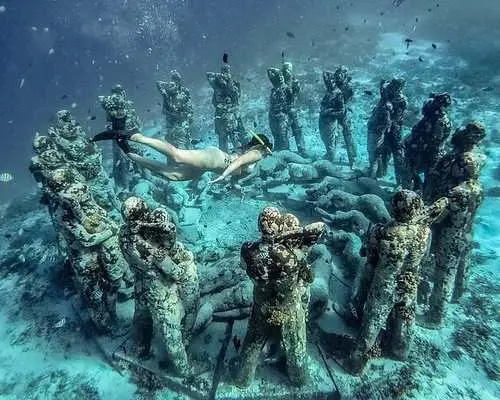
Imagine a sunken statue, a scuttled ship or a grid of concrete cubes on a sandy bottom. Give it a few years underwater and it is covered in life, circled by fish, and very photogenic. It is a satisfying picture, and it is one reason artificial reefs are such a favourite of conservation marketing.
So do artificial reefs work for conservation? Sometimes. They can work for narrow, well-measured goals, such as a nursery for young fish or a surface for coral to settle on. The evidence that they restore a whole reef is much weaker. Below is what I could verify, and where I simply do not know.
What an artificial reef is
An artificial reef is a structure placed by people that marine life then uses like a natural reef. It may be a wreck, a concrete module, an old platform or an underwater sculpture park. They are built for different reasons: to help fisheries, to give divers something to visit, and more recently to help corals recover.
Those reasons matter, because a structure built for divers and a structure built for coral are not judged by the same question. When someone says an artificial reef is “working”, the polite next question is: working for what?
The old question: attract or produce?
Scientists have argued for a long time about whether artificial reefs create new fish or simply gather fish from nearby places. The debate is not new. Pickering and Whitmarsh reviewed it in 1997 and pointed out that the design of a reef plays a key role in how well it works.
It matters because a structure that only moves fish from a natural reef to a new place is not really doing conservation work, even if it looks full of life. The review I describe next did not give me a clear answer on this point, so I will not pretend there is one.
What the 2022 review found
The most useful overview I found is a systematic review by Higgins, Metaxas and Scheibling, published in PLOS ONE in January 2022. It looked at artificial reefs placed in tropical and subtropical waters, 136 studies in total. Most were in the North Atlantic and the Central Indo-Pacific between the 1980s and the 2000s, and their use for restoration or for reducing stress on reefs grew as coral decline sped up.
Of those, 51 studies checked whether the reef met a conservation goal. The most common goals were more fish, more habitat and more coral cover. Success was reported for nursery habitat and for coral cover in about 71 per cent of the studies that tested them. Fish abundance was moderately successful, at around 60 to 64 per cent. Protecting a specific target species was the least successful, at 42 per cent.
Those numbers come from studies of different sizes and quality, so they are not a promise for any one project. The authors also noted that most artificial reefs were small, which limits what they can do against coral loss over a whole region. Failures were often blamed on poor design or on large bleaching events.
An evidence map from 2024
Another source, a 2024 systematic map by a team including USGS scientists, looked at built structures in shallow tropical coral ecosystems. They drew on more than 250 articles from 50 countries across five decades. Most structures were installed for coral restoration (61 per cent) or coastal protection (12 per cent), and the great majority (87 per cent) were artificial rather than hybrid or natural.
The evidence was strongest for purpose-built structures and for coral results such as growth, settlement and cover. The big gaps were long-term ecological effects and effects at the scale of a whole seascape. In plain words: we know some structures help corals settle, and we know much less about what happens after ten or twenty years.
Can an artificial reef restore a whole coral reef?
Reading all of this together, I would say it like this. A small cluster of modules placed to give young fish somewhere to hide, or a frame seeded with coral fragments, has real evidence behind it. A large wreck or sculpture park marketed as “restoring the reef” for a whole coastline makes a claim that current science generally cannot support.
That is not a reason to dismiss these projects. Some of the most interesting conservation work today sits where art, design and marine science meet. It is a reason to ask three questions of any claim: what exactly was measured, for how long, and compared with what? If a project cannot answer them, I treat it as a nice idea, not as proof.
I also looked for solid evidence about pollution from sunken ships and wrecks, and about independent studies of one popular concrete module brand. I did not find a reliable answer, so I leave those questions open. If you see a confident claim about them, ask for the source.
What this means when you visit a reef
No built structure replaces an intact natural reef. The kindest thing we can do around any reef, artificial or not, is move slowly and never touch, stand on or crowd the life trying to settle there. Our guide to snorkelling without damaging coral explains how, and our article on coral reef resilience shows what a natural reef needs to recover.
A few practical things help. A well-fitting low-volume mask and snorkel lets you float calmly instead of fighting a leak, and a long-sleeved rash guard means you need less sunscreen in the water. Neither saves a reef, but both make it easier to behave well.
If this made you curious about experiencing the ocean this way yourself, you can explore our retreats. Our groups are small, six guests at most, so there is room to go slowly and to skip any activity that does not feel right. Our wildlife encounter guidelines explain how we decide what we will and will not do.
Questions people ask
What is an artificial reef?
A structure placed by people, such as a wreck, a concrete module or a sculpture, that marine life then uses like a natural reef. It can be built for fisheries, diving or coral restoration.
Do artificial reefs create new fish or just attract them?
Scientists have debated this since at least the 1990s. A 1997 review stressed that reef design is key. I did not find a clear, general answer, so it depends on the design and the place.
Can artificial reefs restore a whole coral reef?
The 2022 PLOS ONE review found that most artificial reefs are small, which limits their ability to address coral loss across a region. Local, narrow goals such as nursery habitat have better evidence.
How often do artificial reefs meet their goals?
In the 51 studies that assessed a goal, success was reported in about 71 per cent for nursery habitat and coral cover, around 60 to 64 per cent for fish abundance, and 42 per cent for protecting target species. Treat these as rough guides.
Is an artificial reef a form of greenwashing?
It can be, if big claims are made without monitoring. A 2025 Conservation Letters paper argues that funding is moving faster than the science and asks for more oversight. Many projects are honest and well monitored, so ask for the evidence.
Is it fine to snorkel or dive on an artificial reef?
Nothing in the sources I checked says it is wrong. The same care applies as anywhere: no touching, no standing, no feeding, and follow the local rules. I did not find evidence on whether visiting them protects natural reefs.
Wildlife encounters are never guaranteed and never forced. Ocean Calling works only with vetted, ethical local operators, and every animal is free to approach, or not, entirely on its own terms.
Sources & further reading
- Higgins E., Metaxas A., Scheibling R.E., 2022. A systematic review of artificial reefs as platforms for coral reef research and conservation. PLOS ONE (via PubMed Central).
- Evidence on the ecological and physical effects of built structures in shallow, tropical coral reefs: a systematic map. Environmental Evidence, 2024 (via PubMed Central).
- U.S. Geological Survey, 2024. New study highlights benefits and challenges of using built structures on coral reefs.
- Allgeier J.E. and Griffith M., 2025. Greenwashing marine conservation: the use of artificial reefs for fisheries and coral restoration needs oversight. Conservation Letters 18(5), abstract.
Further reading on Ocean Calling: Snorkelling without damaging coral · Coral reef resilience · Ethical wildlife encounter decisions · More from the journal · Ocean Atlas
Find the retreat that fits you
Small groups of up to six guests, unhurried days and local experts. Tell us how you feel in the water and we will point you to the right trip.