
Can Scientists Recognise a Sea Turtle by Its Face? Balicasag’s Photo-ID Research
Sea turtles don’t carry passports. They carry something better: a face. The scales on the side of a turtle’s head form a pattern that researchers can photograph and recognise again, years later.
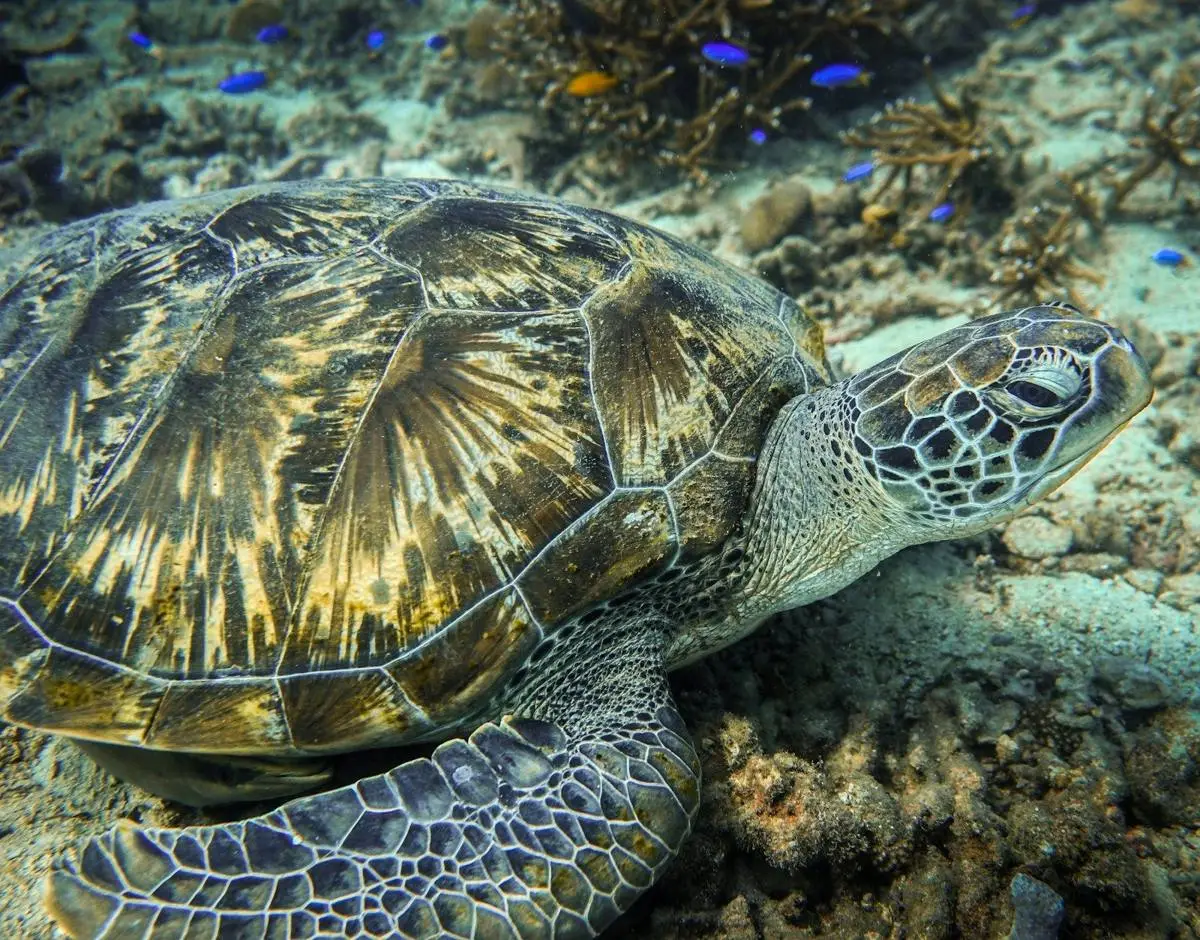
Look closely at the side of a turtle’s head and you will see a small mosaic of scales. That mosaic is the answer to the question in the title: yes, researchers can tell individual turtles apart by their faces. Around Panglao and Balicasag, LAMAVE’s Panglao Turtle Research and Conservation Project uses this photo-identification to build a catalogue of the turtles using local waters. The project works with Panglao’s local government, coastal resource managers, sea wardens, dive operators and the Balicasag Island Snorkel Guide Association.
How does turtle photo-ID work?
A researcher takes a clear photo of a turtle’s facial scales. Then they compare the pattern with the images already in the catalogue. A match means the same turtle has been seen again.
It is a non-invasive method. The identification comes from the animal’s own natural markings, not from a tag that a person attaches.
And it opens good questions. Do the same turtles come back to a site? How do individuals use their feeding areas? How might turtle populations connect across a wider region?
Can a holiday photo help?
Possibly. LAMAVE runs citizen-science work that invites people to send photos of marine turtles and other large marine animals. A useful image has to be sharp enough to identify the turtle, and it needs the location and the date.
Follow the project’s current instructions for sending images and sharing location data responsibly. Instructions can change, so check with LAMAVE first.
Please don’t chase, touch or corner a turtle to get the shot.
Why focus on Panglao and Balicasag?
Turtles use the waters around these islands as habitat, and the research team is studying the population and its movements.
That local context matters. A turtle at Balicasag is part of a living ecosystem, not a character that appears on cue for each boat.
I love science that turns a moment into something useful. A calm photo from a respectful distance can help researchers answer questions over many years. A closer photo taken by disturbing the animal gives a worse record of the encounter, and maybe a worse day for the turtle. Wildlife encounters are unpredictable. Snorkelling with sea turtles should always follow local regulations and experienced professional guidance.
For the bigger picture, see our Panglao and Balicasag overview in the Ocean Atlas.
Questions people ask
Can scientists really tell sea turtles apart by their faces?
Yes. The scales on the side of a turtle’s head form a pattern. Researchers photograph it and compare it with images already in a catalogue.
Does photo-ID harm the turtle?
No. It is a non-invasive method. The identification comes from the animal’s natural markings, not a tag attached by a person.
Can I send my holiday turtle photos to researchers?
Possibly. LAMAVE runs citizen-science work that invites photo submissions. A useful image is sharp and comes with the location and date. Follow the project’s current instructions.
Should I get closer for a better photo?
No. Please don’t chase, touch or corner a turtle. A calm photo from a respectful distance is the useful kind.
Wildlife encounters are never guaranteed and never forced. Ocean Calling works only with vetted, ethical local operators, and every animal is free to approach, or not, entirely on its own terms.
Sources & further reading
- LAMAVE: Panglao Turtle Research and Conservation Project
- LAMAVE: how scientists study turtles with photographs
- LAMAVE citizen-science programme
Further reading on Ocean Calling: Balicasag marine sanctuary · Responsible turtle snorkelling · Turtle photo-ID in Gili Air · Philippines in the Ocean Atlas
Gili Trawangan: turtles, statues and a reef that grows back
Snorkelling retreat · Gili Trawangan, Lombok, Indonesia
Turtle reefs and reef restoration, 8–14 June 2027. If you love turtles, this retreat is on reefs where they live.