
Beginner Freediving Guide: Calm, Breath Control and Safety
One breath at the surface, a slow fold of the body, and then silence. A beginner freediving guide to the calm, the science of slow breathing, and the safety rules every beginner needs.
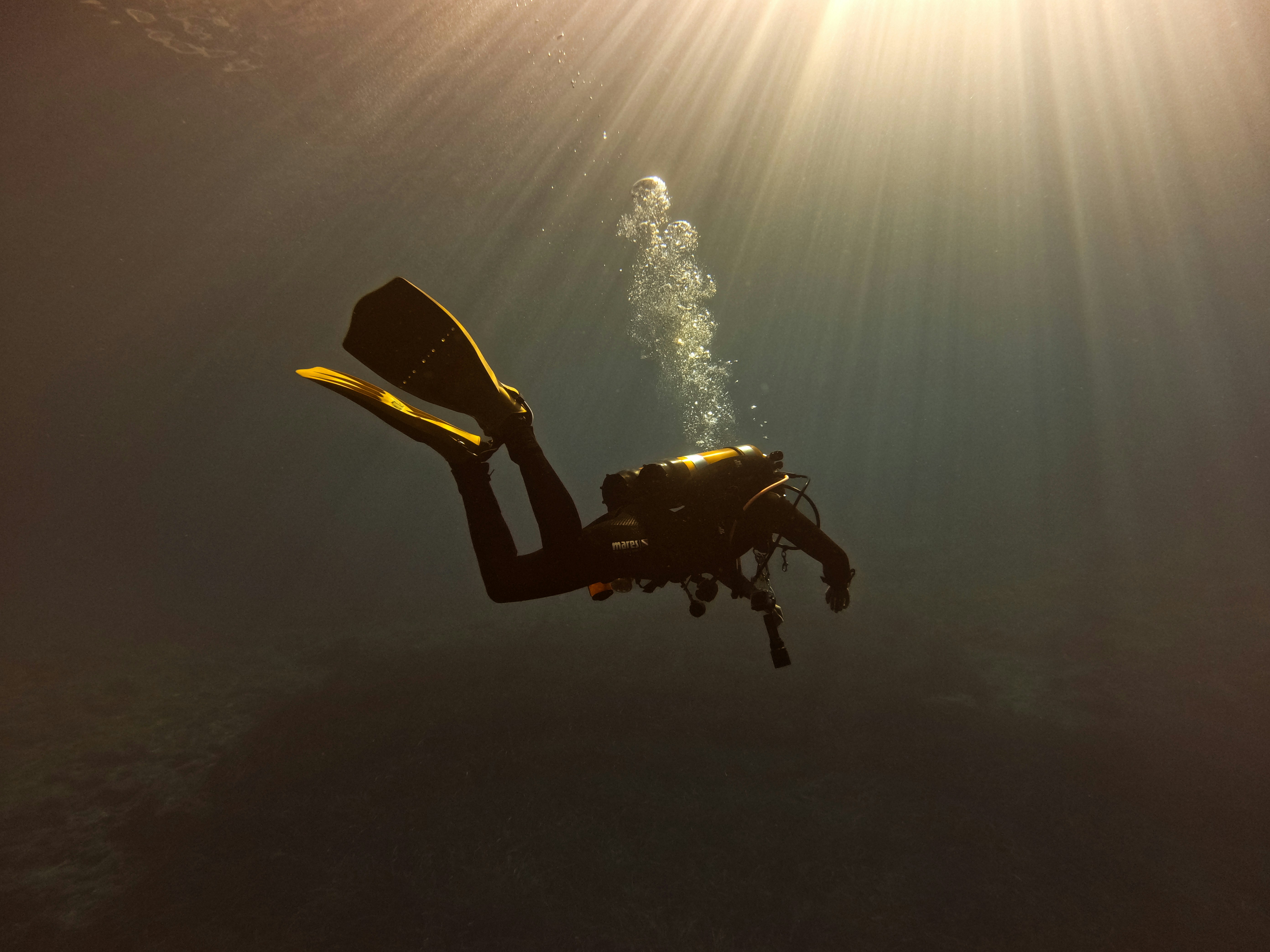
Picture your first freedive: one calm breath at the surface, a slow fold of the body, and then silence. No bubbles, no hiss of a regulator. Just you, the blue, and a small voice saying "come back up." So what are the mental benefits of freediving for a beginner? Mostly attention. You learn to notice your body's signals early, to stay calm with mild discomfort, and to slow your breathing on purpose. This guide explains why, in plain science, and where the honest limits are.
Why freediving is more mental than physical
People often assume freediving is about lung capacity. In practice it is much more about attention. How calmly you hold your breath depends less on the size of your lungs and more on how you respond to what your body is telling you.
Without a tank, a regulator or the sound of your own mechanical breathing, there is very little left to distract you. Going deeper stops being the point; staying composed becomes the point. It is one of the few places where being still is not just allowed, it is required.
For many people, this is exactly what they come for: the quiet. With nothing pulling attention outward, it settles inward, on the present moment, in a way that can be harder to find on land. If that idea speaks to you, we explore it further in what a mindful ocean experience actually feels like.
Where does the urge to breathe come from?
For most beginners, the hardest part is not the depth. It is the last stretch before the surface, when the urge to breathe feels loud and impossible to ignore. It helps to know where that urge comes from: mainly your body reacting to rising carbon dioxide in the blood, not to a sudden lack of oxygen. The discomfort is an early signal, not proof that something is wrong.
That knowledge has a safety side too, and it matters. Because the urge is driven by carbon dioxide, breathing fast and deep before a dive (hyperventilating) washes carbon dioxide out and delays the urge, while oxygen keeps dropping. That is how a diver can black out with no warning, often in the last metres near the surface. So the urge is a friend. Never try to silence it, and never practise breath-holds alone.
Once beginners understand this, with proper instruction and a buddy watching, the fear around it usually softens. Tension uses more oxygen; relaxation saves it. That one relationship, between how you feel and how your body performs, is one of the first things freediving teaches, and it tends to stay with people long after they leave the water.
The freefall: when the water does the work
As you go deeper, pressure squeezes the air in your lungs and wetsuit into a smaller space, and your buoyancy changes. Past a certain depth you no longer need to swim down at all: your body simply keeps sinking on its own. Freedivers call this the freefall. It is real physics, not a metaphor, and the depth where it begins is different for every person and every wetsuit.
During freefall there is almost no movement, just descending, suspended in the water. Many freedivers describe it as the calmest moment of the dive, because for a few seconds there is nothing to do but be present and equalise gently. The pressure is felt evenly around the body, more like being held than being squeezed.
For many beginners, this is the turning point: depth stops being about effort and becomes about trusting technique. Trusting it, instead of fighting it, is usually what makes the rest of the dive feel easier. Depth itself should come slowly, over many sessions. Good fins help on the way down; our guide on how to choose freediving fins explains the different blade types, and you can see a selection of freediving fins in our storefront.
What slow breathing does for calm
The skills people learn in the water often follow them home. A large 2022 systematic review and meta-analysis by Laborde and colleagues, in Neuroscience & Biobehavioral Reviews, pooled 223 studies and found that voluntary slow breathing increases vagally mediated heart rate variability. In plain words: slow breathing moves the nervous system toward its "rest" side, during the practice, right after one session, and after weeks of training. That is not unique to freediving, but freediving is one of the most direct ways to practise it, because your breath is literally the only tool you have.
Many freedivers describe a few things that carry over into daily life:
- More awareness of their own breathing in stressful moments
- More ability to stay steady when a situation feels uncertain
- Noticing tension building in the body earlier
- More trust in their own physical adaptability
These are reports, not measured results, and none of it makes hard things disappear. It can slowly change how those moments feel, and that alone can make a real difference. Freediving is also not therapy: if you live with anxiety or panic, talk to a doctor before a course and tell your instructor.
Trust, partnership and shared safety
Freediving is never a solo activity. Every dive is done with a trained buddy or instructor watching closely, and a good school keeps the number of students per instructor small, so that attention is real, not theoretical. Divers learn to read each other's signals and respond to them, which builds trust slowly, dive by dive.
Knowing someone is watching out for you does something for your nervous system too: feeling prepared lets you relax, and relaxing is what makes a dive comfortable instead of effortful. Our page on freediving safety basics covers the buddy system in more detail.
The ethical layer: quiet bodies, quiet reefs
Freediving has a gentle side for the ocean, too. There are no bubbles and no engine noise underwater, and a relaxed freediver moves slowly. That makes it easier to keep distance from animals and to stay off the reef. But the rules are the same as for any ocean visitor: never touch coral, never chase a turtle or a fish for a better look, and keep your fins high near the bottom. A calm mind and good buoyancy protect the reef as much as they protect you.
Small practical choices help as well. A rash guard covers your back during the long breathe-up at the surface, so you need less sunscreen in the water. And travel itself has a footprint, so fewer, longer trips are kinder than many short ones.
Coming back up, changed
Surfacing after a breath-hold dive tends to sharpen your senses for a moment. The air feels cooler, sounds seem clearer, and your own breathing feels more deliberate than it did an hour before.
Many people say this awareness does not stay underwater. It follows them onto the boat, and sometimes home. Freediving rarely removes what is difficult in someone's life. What it can change is how that difficulty is met: discomfort becomes something you can sit with for a moment, not something you must escape right away.
That, more than any depth number, is usually what people remember. If you are wondering whether this could suit you with no experience at all, our list of questions to ask before booking a freediving retreat is a good next read.
Questions people ask
Do I need big lungs to start freediving?
No. For beginners, relaxation and technique matter much more than lung size. A calm body uses less oxygen, which is why training focuses on breathing slowly and moving gently.
Why do I feel the urge to breathe so strongly?
Mainly because carbon dioxide builds up in the blood. The urge is an early signal, not a sign that oxygen has run out, and it should never be silenced by hyperventilating.
What is the freefall in freediving?
It is the part of the descent where pressure has compressed the air in your body and wetsuit enough that you sink without swimming. The depth where it starts varies between people and equipment.
Is there science behind the calm feeling?
A 2022 meta-analysis of 223 studies found that voluntary slow breathing increases vagally mediated heart rate variability, a marker linked to the body's "rest" system. Freediving uses this kind of breathing, but it is not a medical treatment.
Can I practise breath-holds alone?
No, never in water. Blackout can happen without warning, usually near the surface, so a trained buddy watching you is the basic safety rule of freediving.
If this made you curious about meeting the ocean this way, you can explore our upcoming retreats.
Wildlife encounters are never guaranteed and never forced. Ocean Calling works only with vetted, ethical local operators, and every animal is free to approach, or not, entirely on its own terms.
Sources & further reading
- Capps, A. (Divers Alert Network), 2023. Shallow-Water Blackout. Alert Diver.
- Laborde, S. et al., 2022. Effects of voluntary slow breathing on heart rate and heart rate variability: A systematic review and a meta-analysis. Neuroscience & Biobehavioral Reviews.
- Study of hyperventilation before serial breath-holds in 18 low-experience volunteers, 2023. European Journal of Applied Physiology.
- Review of deep breath-hold diving physiology and accidents, 2021. Frontiers in Physiology.
- Physiological challenges and adaptations in competitive freediving, 2024. German Journal of Sports Medicine.
- StatPearls (NCBI Bookshelf). Physiology, Diving Reflex.
Further reading on Ocean Calling: More from the journal · Wildlife & the law · See the retreats · Ocean Atlas
Freediving certification in Bali: Amed, USAT Liberty wreck and Ubud
Freediving certification · Amed & Ubud, Bali, Indonesia
Ocean breath first, sacred water after. If this made you want to learn to freedive, this is our beginner-friendly course.