
What Makes an Ethical Freediving Retreat?
You float at the surface of warm, blue water, about to try your first real breath-hold dive. Your heart beats a little faster. In that moment only one question matters: who is watching you? An ethical freediving retreat starts right there, and here are the questions to ask before you book one.
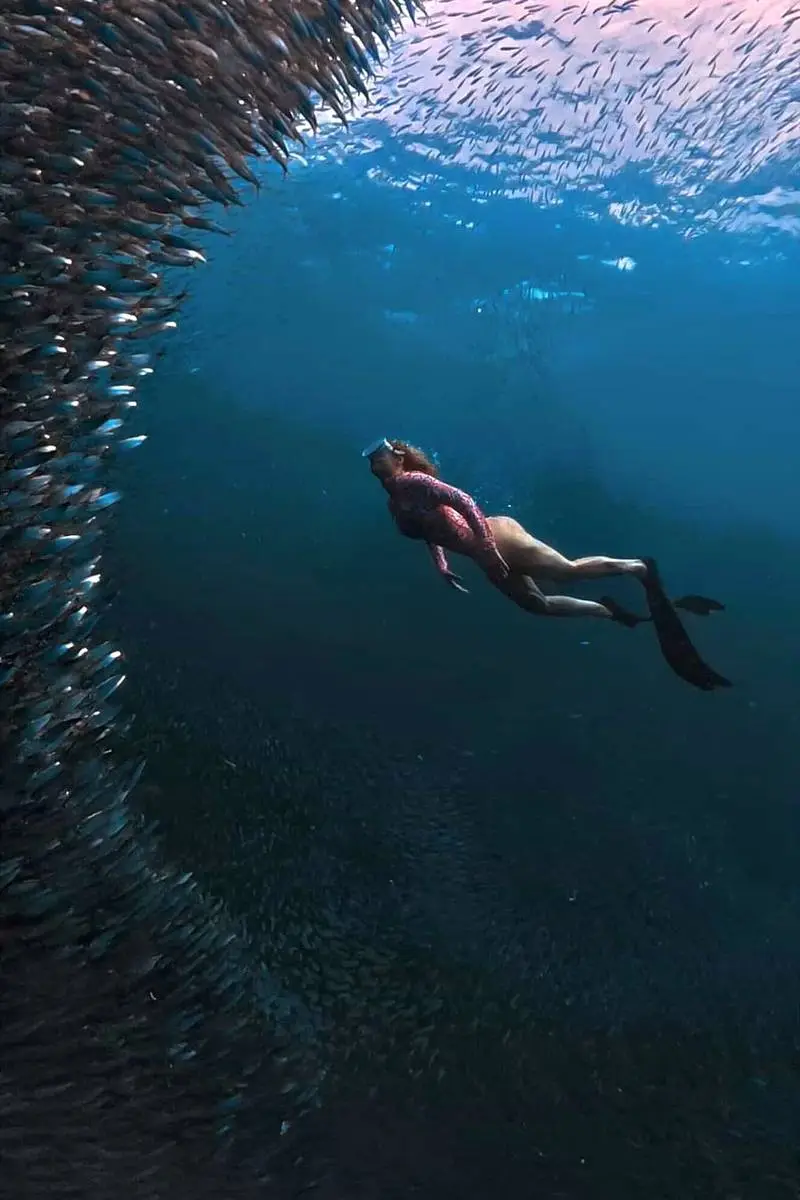
Many retreats call themselves ethical. I understand why, it is a lovely word. But when you are about to hold your breath in the open ocean, “ethical” has to mean something you can check.
Let me be honest from the start. Travel has an environmental cost, flights included. Ocean Calling is built on continuous learning, not a claim of perfection. So when I say ethical, I mean a list of small, concrete choices: for you, for the ocean, and for the place that welcomes you. If a retreat cannot explain those choices in simple words, it is fair to ask why.
What an ethical freediving retreat does for you
Freediving is calm, but it is not casual. The main risk is blackout: the brain does not get enough oxygen, and the diver loses consciousness in the water.
Divers Alert Network explains that a blackout can happen at any time, in any body of water, if a diver pushes their limits. Recreational divers who have serious incidents are usually overexerted, overweighted and under-supervised. Its advice is clear: always dive with a trained buddy.
That is the reason behind every rule. On an ethical freediving retreat, the buddy system is not a suggestion. One person dives, and one person watches from the surface for the whole dive and after they come up. Nobody dives alone, not even in relaxed “fun” sessions. We explain how it works in Buddy Systems, Explained.
The second part is who teaches, and how many people each teacher looks after. Teaching should come from certified professionals of a recognised agency. As one example of a published standard, AIDA International allows at most 4 students per instructor in open water on its first two courses, or 6 with a certified assistant.
At Ocean Calling, diving and freediving sessions are for a maximum of 4 guests, and other activities for a maximum of 6. Local certified professionals do the teaching. My part is the coordination, the design of the days, and looking after you before and during the trip.
The freedom to say “not today”
Depth is not the goal. A retreat that pushes you toward a number is caring for a result, not for you.
With us, you can pause, rest or skip any session, and you never need to explain why. You do not have to be “brave” for the group. Some days the body says yes, some days it says no, and both are normal. In my experience, the people who feel allowed to stop are the ones who relax, and a relaxed diver usually makes calmer choices.
Small things matter too. No competitions between guests, and no filming anyone who did not ask for it.
Room for different kinds of people
An ethical retreat is not only for confident swimmers who already love depth. It should have space for beginners, for highly sensitive people, for neurodivergent guests, for women who want to learn somewhere gentle, and for people travelling alone.
In practice, that means clear information before the trip, so you know what happens each day. You can ask questions privately, not only in front of the group. There is quiet time in the day, not only activities. And if something is hard for you, like cold water, a tight wetsuit, boat noise or a crowded site, you can say so and we plan around it.
Kind to the reef, kind to the place
Freediving is quiet, with no bubbles and no tanks. But a freediver can still hurt a reef with a fin kick, by standing on coral to rest, or by grabbing a rock that turns out to be alive.
The UN Environment Programme is very clear: do not chase, touch or feed any marine life, do not stand on corals, and keep good buoyancy so you do not crash into the reef or stir up sediment. It explains that feeding fish can make them depend on handouts or fall sick. It also suggests choosing operators that can explain how they avoid damaging corals, such as those following the Green Fins standard.
So we do not follow a green turtle to the surface for a photo, we do not touch rays or corals, and we never use food to attract fish. If an animal swims away, we let it go. Calm finning and correct weighting keep you off the reef, so learning well is already a way of protecting it. A good pair of freediving fins and a low-volume mask that fits your face are the two things I always pack, because I would rather spend a session relaxing than fighting my gear.
The place matters as much as the water. The Global Sustainable Tourism Council asks tour operators to give local residents equal opportunity for jobs, including management positions, and to buy local services and goods.
This is one reason local certified professionals do the teaching on our retreats. They know the currents, the rules and the community far better than any visitor, and more of the money from your trip stays with people who live there all year.
Which questions should you ask before booking a freediving retreat?
A good retreat will be happy to answer these. If the answers are vague, that is information too.
Start with safety. Who teaches the freediving, and which agency certifies them? How many guests are in the water per instructor? Is there always a buddy watching every dive, in every session? What is the emergency plan, what safety equipment is on the boat, and where is the nearest medical help?
Then ask about pressure and care. What happens if I want to skip a session? Are there depth goals, or a “guaranteed” certification? How do you support anxiety, sensory needs or health conditions, and is there a medical form?
Finally, ask about the ocean and the place. What are your rules about touching, feeding and chasing marine life, and about photos? Do you promise animal encounters? The honest answer is no. And are the instructors local?
In the water, the rules stay simple: never chase, touch, bait or feed wildlife, stay off the coral, and follow local regulations and your instructor’s guidance. If this is the kind of freediving you are looking for, take a quiet moment with our Ocean Match to find the trip that fits you.
If this made you curious to meet the ocean this way, you can explore our upcoming retreats.
Questions people ask
Is freediving safe for beginners?
With good training and a trained buddy watching every dive, beginners learn step by step. Divers Alert Network notes that blackouts can happen in any body of water when a diver pushes their limits, which is why supervision matters so much.
How many students should one freediving instructor have?
Agencies set their own limits. AIDA International allows up to 4 students per instructor in open water on its first two courses, or 6 with a certified assistant. On Ocean Calling retreats, freediving sessions are for a maximum of 4 guests.
Will we see turtles or rays?
Maybe, but nobody can promise it. Wildlife encounters are a gift, never a guarantee, and we let every animal choose whether to stay or go.
Wildlife encounters are never guaranteed and never forced. Ocean Calling works only with vetted, ethical local operators, and every animal is free to approach, or not, entirely on its own terms.
Sources & further reading
- Capps, A. (Divers Alert Network), 2023. Shallow-Water Blackout. Alert Diver.
- Divers Alert Network, 2021. DAN Annual Diving Report 2021 Edition: Breath-hold diving (2019 data). NCBI Bookshelf.
- AIDA International. AIDA Freediving Courses (student to instructor ratios).
- UN Environment Programme, 2026. Five ways you can help protect coral reefs on your next holiday.
- Global Sustainable Tourism Council. GSTC Industry Criteria for Tour Operators.
- Global Sustainable Tourism Council, 2013. GSTC Criteria for Hotels and Tour Operators with suggested performance indicators (criteria B2 and B3).
Further reading on Ocean Calling: What small-group freediving retreats can offer · Green turtle in the Ocean Atlas · Responsible wildlife tourism checklist
Freediving certification in Bali: Amed, USAT Liberty wreck and Ubud
Freediving certification · Amed & Ubud, Bali, Indonesia
Ocean breath first, sacred water after. If this made you want to learn to freedive, this is our beginner-friendly course.
Explore in the Ocean Atlas
Animals in this article
