
Panda Dolphin: Why Commerson’s Dolphin Looks Like an Orca
People keep asking if this little black-and-white dolphin is a baby orca. It is not. Meet the panda dolphin, properly called Commerson’s dolphin, a small dolphin of the far south that only borrows an orca’s colours.
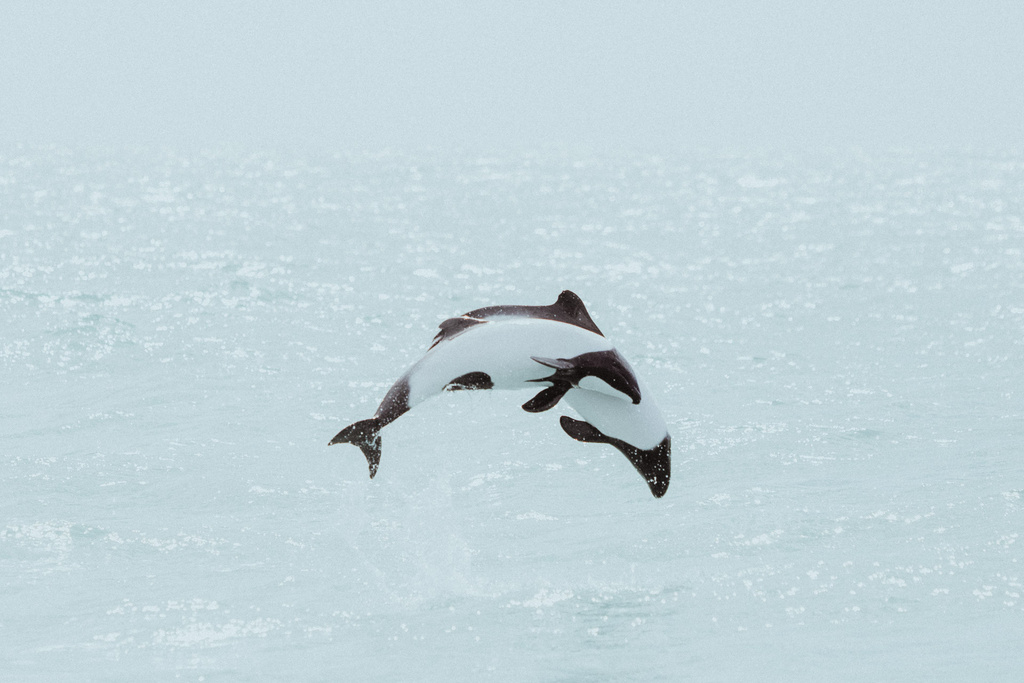
A photo of a panda dolphin does something funny to people. They stop scrolling, they squint, and they type the same question: is that a baby killer whale?
The short answer is no. Commerson’s dolphin, Cephalorhynchus commersonii, is a different animal altogether, and its real story is more interesting than the nickname.
To meet the panda dolphin the right way, it helps to know three things first: what it really is, why its babies look so different from their parents, and why a small dolphin living close to shore needs a little extra care from visitors. You can also find it on its page in our Ocean Atlas.
Is the panda dolphin a baby orca?
No, it just dresses like one. In Spanish it is often called tonina. It has a rounded body, a black head and flippers, and a bright white middle. There is no pointed beak, and the fin on its back is low and rounded. From a distance it can look like a tiny orca, or a very small porpoise.
Size is the best clue. Several sources give the adult length off South America as about 1.5 metres (Animal Diversity Web and the FAO account both say so, and others give a range of roughly 1.2 to 1.7 metres). An orca is many times longer. Newborns are small too: the FAO and Naturalis accounts say about 65 to 75 centimetres at birth, while SeaWorld gives 55 to 65. The numbers differ a little between sources, which is normal for animals that are hard to measure in the wild.
So when someone says “baby orca”, the honest answer is this. A full-grown panda dolphin is shorter than many humans are tall, and it belongs to the genus Cephalorhynchus, a small group of coastal dolphins of the southern hemisphere.
The twist: the babies are not black and white
Here is the part that surprises most people. Commerson’s dolphin calves do not start life in that bold outfit. Whale and Dolphin Conservation describes calves as grey, brown or black, and the contrasting pattern appears as they grow. The Animal Diversity Web account says the grey fades to white over the first months of life, and gives a period of about four to six months. I could not find a precise timeline in a research paper, so please read that as an approximate figure.
It is a lovely detail, and a useful one. A dull, dark young dolphin swimming beside a black-and-white adult is not a different species. It is simply a calf, probably still staying very close to its mother.
How panda dolphins live: spinning, surfing and two far-apart homes
These are energetic swimmers. Wildlife guides and species accounts describe them riding bow waves, leaping, spinning and twisting as they swim, and surfing breaking waves close to the shore. Swimming upside down is reported again and again. One guide suggests it may help the dolphins spot fish and squid, but that is an idea I could not confirm, so I leave it as a guess.
They eat fish, squid and crustaceans, according to the sources I read, and the South American animals seem to be opportunistic, taking a range of prey. Group size is another point where sources disagree. Some say small groups of fewer than ten are normal, and Falklands-focused sources describe even smaller groups of one to three, though gatherings of a hundred or more have been reported. The honest summary: usually small, sometimes not.
Two homes, thousands of kilometres apart
The main population lives in cold coastal waters around southern South America and the Falkland Islands (Islas Malvinas). Travel and wildlife guides name the coast of Santa Cruz in Argentina, Tierra del Fuego and the Strait of Magellan among the common places to see them.
A second population lives around the remote Kerguelen Islands in the southern Indian Ocean, roughly 8,500 kilometres away. The Kerguelen animals are larger, reaching about 1.75 metres, and their pattern is greyer and less sharply drawn, with a white band underneath. Because of those differences and the distance, some scientists treat them as two subspecies, C. c. commersonii in South America and C. c. kerguelenensis at Kerguelen. According to the Marine Mammal Protected Areas Task Force factsheet for the area, the Kerguelen dolphins are most often seen in the Golfe du Morbihan.
Conservation: what we know and what we do not
This is the ethical layer, and it is mostly a story about nets. A study of Commerson’s dolphins in Tierra del Fuego and southern Patagonia notes that the species is caught by accident in small-scale gillnet fisheries, especially along shallow coasts. The same authors warn that this bycatch may be underestimated where the borders between local groups are not well known. In the 1970s and 1980s some fishermen in Argentina and Chile also killed these dolphins for crab bait. Reports say that has been curtailed, though accidental catches continue.
How many are there? I could not find a reliable global number, and I would not trust anyone who gives one. One often-quoted survey from 1984 estimated about 3,400 in the Strait of Magellan, which is old and covers one area only. The species is generally listed as Least Concern by the IUCN, but sources disagree about the Kerguelen animals. One fact sheet says they are Endangered on a regional list for the French Southern Territories, while another says both subspecies are Least Concern with a lack of data. I did not manage to read the assessment itself, so I cannot settle that.
The Falklands are a special case. A research project there, “Dolphins of the Kelp”, notes that the islands have no history of inshore fishing, so there is no fishing bycatch of the kind seen elsewhere. It also notes that monitoring of dolphins in Falklands waters has been limited, which leaves a gap in what we know.
How to watch panda dolphins kindly
Whale watching of Commerson’s dolphins is a fairly new activity in Santa Cruz, according to the IWC country profile for Argentina, and I could not find published approach distances for that province. So please do not assume every boat follows the same rule. Check the current local rule before you travel, and choose a guide who tells you plainly what they do.
A good trip looks like this. The boat approaches slowly, stays parallel to the animals, keeps its distance, and does not follow if the dolphins leave. Nobody chases, nobody touches, and nobody gets into the water to swim with a wild group. If the dolphins decide to ride the bow wave, that is their choice. The boat holds a steady, slow speed and never steers towards them. Our piece on when ethical tours become chases lists the warning signs, and Dolphins are not smiling explains why a leaping dolphin is not always a happy one.
Wildlife encounters are unpredictable. Dolphin watching should always follow local regulations and experienced professional guidance.
Cool, windy boat days in the south call for sun and wind cover, so a long-sleeve rash guard under a jacket is a sensible layer. A roll-top dry bag keeps a phone and a spare jumper dry when the spray comes over the side.
Where Ocean Calling stands
We do not run any trip in Patagonia or the Falklands, and we would not sell a dolphin swim where the rules and the evidence are unclear. Our rule is simple: small groups of up to six, vetted local operators, no chasing, no touching, no bait, and every guest free to skip any activity. Travel to the far south also has a real carbon cost, so I would rather you go rarely and slowly than often and fast.
If this made you curious about experiencing it yourself, you can explore our upcoming retreats. And if you are not sure which ocean animal you would love to meet first, our Ocean Match can help.
Questions people ask
Is the panda dolphin a baby orca?
No. Commerson’s dolphin is a small dolphin of the genus Cephalorhynchus. Adults off South America are about 1.5 metres long, far smaller than an orca. It only looks a little like one because of its black-and-white pattern.
Why do the calves look different?
Calves are described as grey, brown or black, and the black-and-white pattern develops as they grow. One species account suggests the change takes roughly four to six months, but I could not confirm that in a research paper.
Where can you see Commerson’s dolphins?
In cold coastal waters of southern South America, including Argentina’s Santa Cruz coast, Tierra del Fuego and the Strait of Magellan, and around the Falkland Islands (Islas Malvinas). A separate population lives at the Kerguelen Islands.
Is the Commerson’s dolphin endangered?
The species is generally listed as Least Concern by the IUCN, but accidental capture in gillnets is a known threat and population numbers are poorly known. Sources disagree on the status of the Kerguelen animals, so check the current IUCN listing.
Can you swim with panda dolphins?
Ocean Calling does not offer it. These are small coastal dolphins in cold water, and I found no clear published rules for in-water encounters. Watching from a boat that keeps its distance is the kinder choice.
Why do they swim upside down?
Nobody knows for sure. One wildlife guide suggests it helps them spot prey such as fish and squid, but that is an idea, not a proven reason.
Wildlife encounters are never guaranteed and never forced. Ocean Calling works only with vetted, ethical local operators, and every animal is free to approach, or not, entirely on its own terms.
Sources & further reading
- Whale and Dolphin Conservation. Commerson’s dolphin species guide, WDC
- Animal Diversity Web, University of Michigan Museum of Zoology. Cephalorhynchus commersonii
- FAO. Species account: Commerson’s dolphin, Marine mammals of the world
- Naturalis Biodiversity Center. Cephalorhynchus commersonii, Marine mammals of the world
- SeaWorld. Commerson’s dolphin facts, SeaWorld Parks & Entertainment
- Duke University OBIS-SEAMAP. Commerson’s dolphin, Cephalorhynchus commersonii
- Marine Mammal Protected Areas Task Force. Heard Island, Kerguelen and Surrounding Waters IMMA factsheet
- Pimper, L. et al. Population structure of Commerson’s dolphins in Tierra del Fuego and southern Patagonia, Conservation Genetics, 2010
- Rufford Foundation. Assessment of the population structure and conservation management of Commerson’s dolphins on the coasts of southern South America
- South Atlantic Environmental Research Institute. Dolphins of the Kelp (Darwin Initiative project), 2016 to 2018
- International Whaling Commission. Whale Watching Handbook, country profile: Argentina
Further reading on Ocean Calling: Falkland Islands in the Ocean Atlas · Commerson’s dolphin in the Ocean Atlas · Dolphins are not smiling · Ethical swimming with dolphins
Swim with humpback whales in Moʻorea: an ethical whale retreat
Whale encounter retreat · Moʻorea, French Polynesia
Time in the blue, on the whales’ terms. September 2027. If you love whales, this is our whale retreat: small group, slow pace, on the animals’ terms.