
Gili Air Conservation Course: How Our Matching Works
You are a certified diver with a few free weeks, and you do not want to only dive past the reef. You want to do something useful for it. A Gili Air conservation course can be a beautiful way to give something back, if you find the right one.
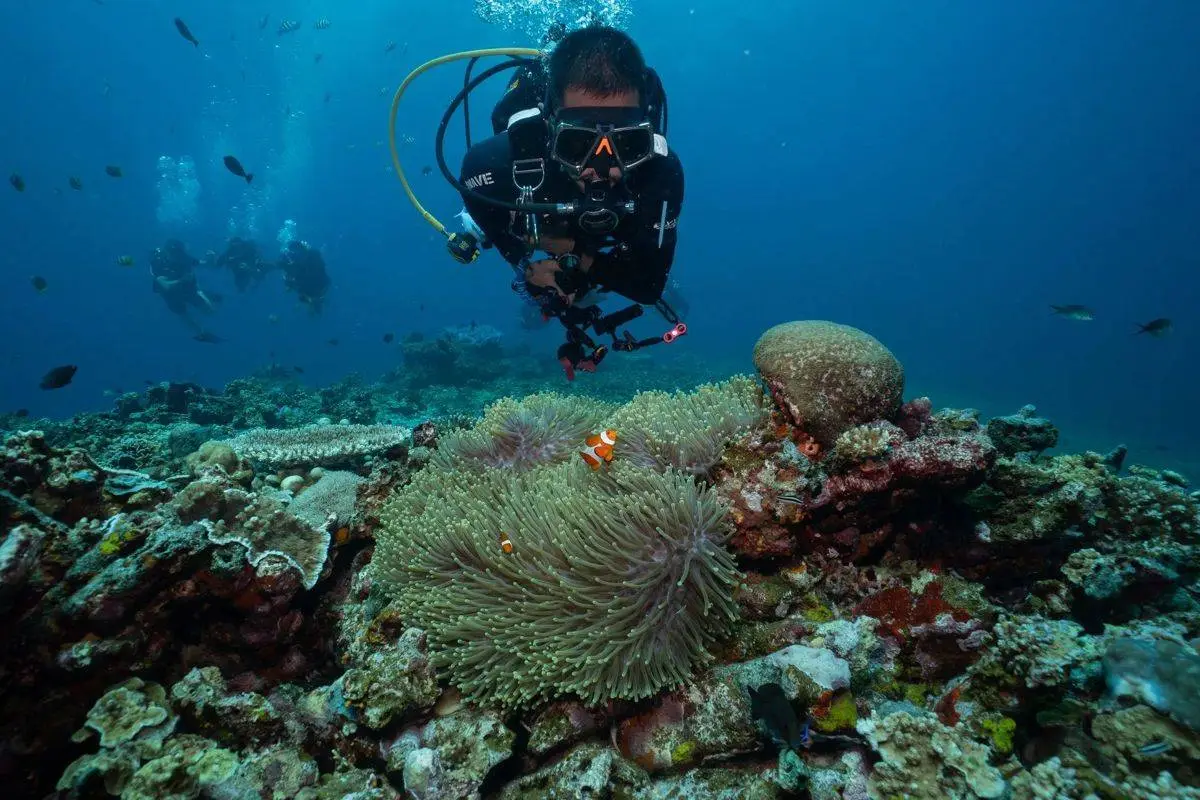
How do you find the right one? That is where we help. A PADI dive centre runs the courses, and we match you to the programme that fits your level and dates, for one flat fee. Many people write to us with exactly this wish. There are several programmes across the islands, and from far away it is hard to know which one fits your diving level, your dates and your values.
But first, let us look at what the work really is, and what it can and cannot do.
What a Gili Air conservation course usually involves
Gili Air, Gili Meno and Gili Trawangan sit together inside the Gili Matra marine park, off north-west Lombok. The park covers 2,273.56 hectares, including about 95 hectares of no-take zones where nothing may be taken. It was first created in 1993 and moved to Indonesia's Ministry of Marine Affairs and Fisheries in 2009. The reefs are shared, so boats from Gili Air often visit sites around all three islands.
On a course, the work usually has three parts. The first is reef surveys. Many programmes use methods similar to Reef Check, where divers follow a 100 m line in four 20 m segments and record the seabed every half metre. Reef Check only accepts data into its global database from certified EcoDivers. That tells you something important: good data needs training.
The second is coral restoration: growing coral fragments in nurseries, cleaning the structures and recording which fragments survive.
The third is turtle monitoring. Divers photograph the left and right side of a turtle's face, because the scales there are unique and stay the same over time. So each turtle can be recognised without anyone touching it.
The courses we match you with are PADI-based and run by a PADI dive centre, on Gili Air and on Gili Trawangan. They go from one-day workshops, on topics like turtle ecology or coral restoration, to programmes of one to four weeks. For the in-water days you need Open Water certification or higher. You can see the full overview on our Gili conservation courses page.
Does coral restoration actually work?
We think every guest should ask this before joining. The largest review so far looked at restoration projects around the world. Coral survival was often between 60 and 70%. But the median restored area was only about 100 square metres, and 60% of projects were followed for less than 18 months. The authors point to a lack of clear goals and of standard monitoring.
Biorock, the electrified reef method you will hear about on the Gilis, needs even more care. Its co-developer reports faster coral growth and better survival, including observations from Gili Trawangan. But a controlled study in Kenya found the opposite during a heat event. Bleaching was worse on the electrified structures, and after 14 months the normal structures held 34 new young corals while the electrified ones held none.
So we see restoration as a small, careful tool, not a cure. It cannot replace clean water, good moorings and less heat stress. The quiet value of a good course is often the data, the training and the understanding you take home.
When volunteering goes wrong
Paying to volunteer is not always good for the place. A researcher described the risks back in 2009: projects shaped more by what volunteers want than by what the place needs, unskilled work, and free labour that can replace local jobs.
So before you choose any course, on the Gilis or anywhere, it is worth asking a few questions. Where does the data go, and who uses it? Are Indonesian staff and scientists part of the team? How many divers are there per instructor, and is buoyancy checked before any work near coral? Does the programme say clearly that sightings are never guaranteed? Is the price clear?
These are the same questions we ask when we look for a match for you.
How our matching works
Ocean Calling does not run the courses. A PADI dive centre teaches them, and we help you find the right one.
You tell us your diving level, your dates and how much time you have. Before we charge anything, we check that the dive centre has space for your dates. Then you pay one flat matching fee: CHF 19 for a recommendation of a 1 to 3 day course, or CHF 99 for an itinerary of 1 week to 1 month.
After payment you receive the dive centre's name and contact, the right programme for your level, a suggestion for a calm place to stay, and a pre-trip checklist. You pay the course directly to the dive centre, at their own published price. We take no commission from them.
If we cannot find a place for your dates, we refund the fee in full. Once we have sent your information pack, the fee is not refundable.
Why a fee, and why no name here?
Good matching takes time. The fee is the same whichever course you choose, so we never have a reason to push you towards the longer or more expensive option.
You may also wonder why we do not name the dive centre here. The name is part of what the fee pays for. And we will not call any programme "the best". We simply tell you why we think it fits you.
Being a good guest on a science dive
Green turtles and hawksbill turtles are the ones you are most likely to meet on a course. In October 2025 the IUCN moved the green turtle globally from Endangered to Least Concern, thanks to decades of steady conservation work. The hawksbill, which feeds mainly on reef sponges, is still Critically Endangered.
On a science dive the rules are simple. Keep at least 3 m from turtles, and never touch, chase or block one for a better photo. Leave resting whitetip reef sharks alone in their ledges. Keep your buoyancy good, so fins and hands stay off the coral. For long days in the water I pack a long-sleeve rash guard, so I think less about the sun and more about my position.
A turtle that swims away is not a failed survey. It is the animal showing you what it needs.
Wildlife encounters are unpredictable. Diving near sea turtles should always follow local regulations and experienced professional guidance.
And if you would rather simply dive or freedive these reefs, our Gili Trawangan trip works through Ocean Match too: we match you with a trusted local team, and you book with them directly.
Questions people ask
Do I need to be a certified diver?
For the in-water days you need Open Water certification or higher.
What exactly does the matching fee pay for?
It pays for our research and our personal answer: checking space, choosing the right programme for your level, a suggestion for a place to stay and a pre-trip checklist. It is CHF 19 for a 1 to 3 day course and CHF 99 for a 1 week to 1 month itinerary. The course price is paid separately, directly to the dive centre.
Is coral restoration on the Gilis worth doing?
It can help in small areas, but reviews show most projects are small and short-term. The lasting value is often the training, the data and the care you bring home.
Wildlife encounters are never guaranteed and never forced. Ocean Calling works only with vetted, ethical local operators, and every animal is free to approach, or not, entirely on its own terms.
Sources & further reading
- Konservasi Laut. Gili Matra MPA profile.
- Reef Check Foundation. Tropical Monitoring Instruction.
- Olive Ridley Project. Sea Turtle Photo-ID.
- Boström-Einarsson, L. et al., 2020. Coral restoration: A systematic review of current methods, successes, failures and future directions. PLOS ONE 15(1): e0226631.
- Goreau, T.J.F., 2022. Coral Reef Electrotherapy: Field Observations. Frontiers in Marine Science 9: 805113.
- Knoester, E.G. et al., 2024. Negative effects by mineral accretion technique on the heat resilience, growth and recruitment of corals. PLOS ONE.
- Saputra, R.A. et al., 2020. Gili Shark Conservation Technical Report 2019 (NGO report, not peer-reviewed), hosted by Reef Check.
- Guttentag, D.A., 2009. The possible negative impacts of volunteer tourism. International Journal of Tourism Research 11(6).
- IUCN, 2025. Red List update press release (green turtle moved from Endangered to Least Concern).
- WWF. Hawksbill turtle species page.
- NOAA Fisheries. Hawksbill turtle species page.
Further reading on Ocean Calling: Ocean Match · How Gili Air turtles are photo-identified · Gili Trawangan’s water in peak season · Indonesia in the Ocean Atlas · Green turtle in the Ocean Atlas · Hawksbill turtle in the Ocean Atlas · Whitetip reef shark in the Ocean Atlas
Scuba diving certification on Gili Trawangan: turtles, calm days and no cars
Scuba certification · Gili Trawangan, Lombok, Indonesia
Turquoise water, no cars, no stress. This story is about the Gili Islands, where we run a trip.
Explore in the Ocean Atlas
Places in this article
Animals in this article
 Green turtleChelonia mydas
 Hawksbill turtleEretmochelys imbricata
 Whitetip reef sharkTriaenodon obesus