
Surprising Ocean Animal Facts, From Glass Meals to Iron Teeth
A turtle that eats glass, a fish that makes beaches, and a tooth that keeps a diary. They sound like fairy tales, but they are some of the most surprising ocean animal facts scientists have found, through patient, quiet work. Here is a slow walk through a few of them, and the places where you might meet these animals.

What are the most surprising ocean animal facts? Our favourites: hawksbill turtles live on glass-filled sponges, one bumphead parrotfish can turn tonnes of reef into sand in a year, a dugong’s tusk records its age like tree rings, and Komodo dragons have iron on their teeth. None of these came from a single lucky day. They came from counting rings, measuring sand and watching one bay for months.
And knowing a little more about an animal usually makes us gentler with it.
A turtle that eats glass
Watch a hawksbill turtle for a while and you may see it pushing its narrow beak into a crack in the reef. It is usually looking for sponges.
In a study with a beautiful title, “Spongivory in hawksbill turtles: a diet of glass”, the researcher Anne Meylan showed that Caribbean hawksbills feed mainly on sponges. Many of those sponges are full of tiny glass spicules, little needles the sponge uses to defend itself from being eaten. The turtles eat them anyway. NOAA describes the hawksbill as the only sea turtle that can survive on a diet made mainly of sponges.
That study was done in the Caribbean, so we keep the detail honest. In our part of the world, hawksbills are recorded around the Gili Islands and Amed in Indonesia, and around Moalboal and Apo Island in the Philippines.
A nest that decides
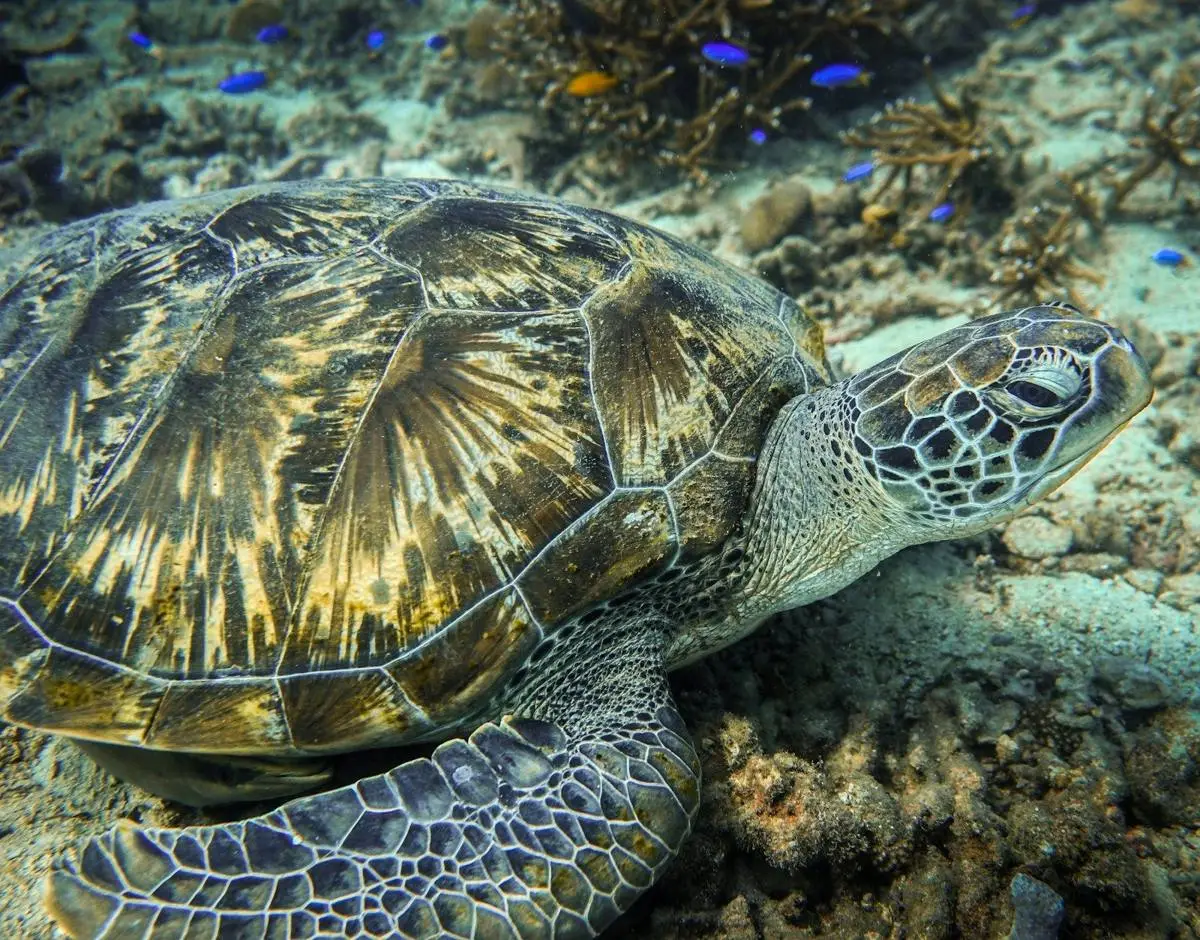
The green turtle has a different secret, and it is settled before the turtle hatches. The temperature of the sand sets the sex of the hatchlings. Warmer nests produce more females.
On the warm northern beaches of the Great Barrier Reef, researchers found that 99.1% of juvenile green turtles were female. It is a quiet sign of how a warming climate can shape a whole population.
Green turtles are often seen grazing slowly at the Gili Islands and along the reefs of Moalboal, two places our referral trips go.
The fish that makes beaches
The bumphead parrotfish is hard to miss: a big green fish with a bumpy forehead. It feeds by biting into the reef and grinding the coral with strong teeth in its throat.
According to Fishes of Australia, a large bumphead may eat as much as 5 tonnes of reef in one year, making tonnes of coral sand along the way. The Natural History Museum in London gives a similar picture, describing a single bumphead taking in over 4.5 tonnes of reef material each year.
So the next time you push your toes into soft white sand, some of it may have passed through a parrotfish. Bumpheads are recorded at Amed and Gili Trawangan in Indonesia, and at Apo Reef in the Philippines.
It is a lovely thing to keep in mind if you are ever lucky enough to see a dugong grazing a seagrass meadow. Our Atlas lists dugongs around Coron in the Philippines, where seagrass still grows in quiet bays. Knowing it might have decades of life behind it is one more reason to stay back and let it feed in peace.
Why do rays begin life so big, and so slowly?
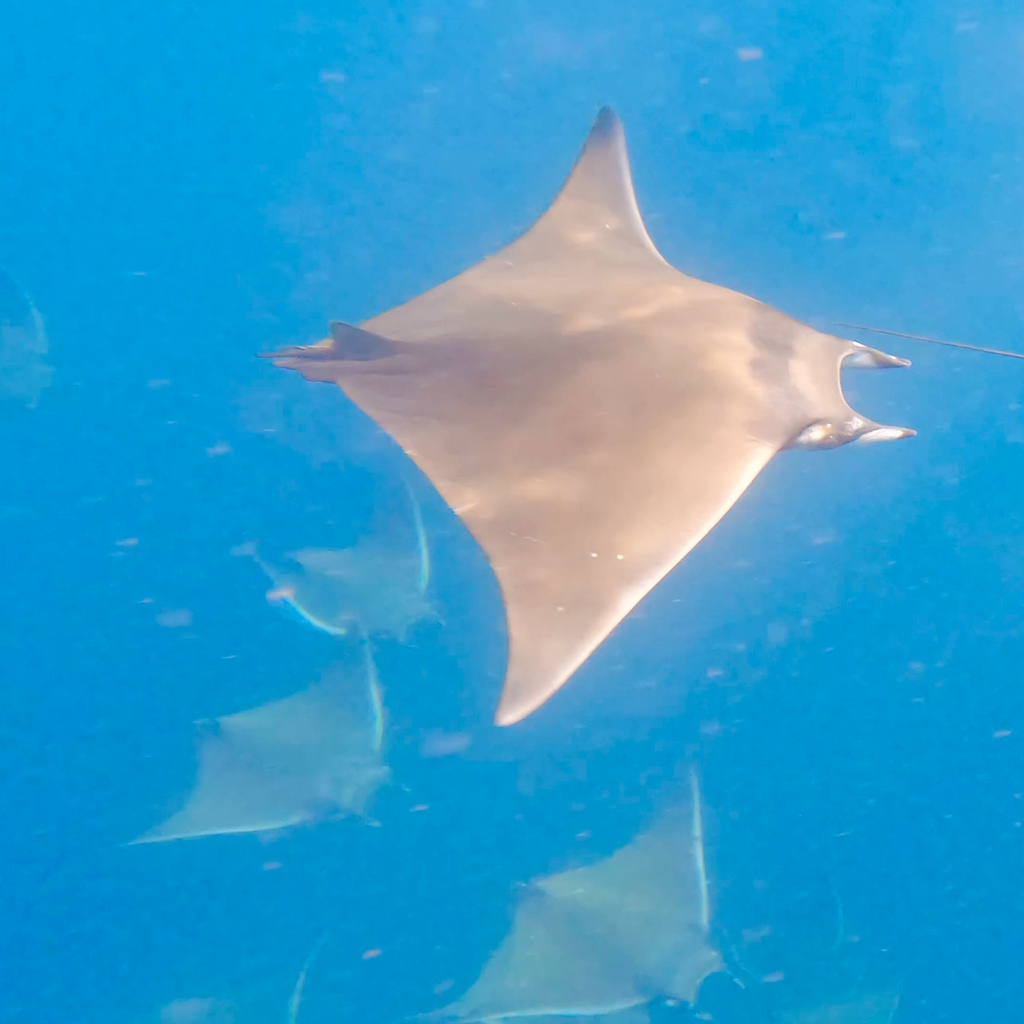
Manta rays live slow lives. The reef manta ray carries a single pup, for a pregnancy of about 12 to 13 months.
The pups are already large when they arrive. Some of the clearest measurements come from births at the Okinawa Churaumi Aquarium in Japan, where newborn pups measured 182 cm and 193 cm across. These were births in an aquarium, so wild pups may differ. But the lesson is the same: a manta starts life already wider than your open arms. Reef mantas are found in places such as Komodo in Indonesia, and they deserve the same care wherever you meet them.
Their small cousin, Munk’s devil ray, gave scientists another first. The first nursery ever described for this species is Ensenada Grande, a shallow bay in the Espíritu Santo archipelago near La Paz, in Mexico. There, 84% of the tagged rays were newborns or juveniles, and one young ray stayed inside the bay for up to 145 days in a row. A nursery is a place to leave alone.
Hunters with hidden details
Some surprises are written in a bite. The teeth of the Komodo dragon carry orange, iron-rich coatings along their serrated edges and tips, which help keep those cutting edges sharp. In Komodo National Park, the dragons are only visited on land, with park rangers.
In the Maldives, the island of Fuvahmulah is known for tiger sharks. Over seven years of photo identification, researchers recognised 239 individual tiger sharks there, and 84.5% of them were female. The authors describe it as the world’s largest known tiger shark aggregation in a small area.
Two honest notes. 239 is the total recognised over the whole study, not what anyone sees on one dive. And the sharks near the harbour are fed daily with fishers’ tuna scraps, as the same paper explains. Why so many are female is still an open question.
How to meet them gently
For sea turtles, NOAA’s advice is simple: never feed them or try to touch them, and when boating, slow down and steer around them. A resting or feeding turtle should be able to come up for air without a crowd above it. I like a low-volume mask that fits well, so I can float quietly at the surface and let the turtle choose.
With mantas, the Manta Trust code of conduct asks swimmers to enter the water quietly no closer than 10 m, never come closer than 3 m, keep fins below the surface, and never chase or touch. The same calm spirit works for parrotfish schools and for rays in general.
Dugongs are marine mammals, so we only watch them from the boat or from a respectful distance, and never follow, surround or touch them. We never enter nursery areas such as the Munk’s devil ray bay at Espíritu Santo. And with sharks, we try to explain honestly how each site works, including when food is involved, so you can choose with open eyes.
Wildlife encounters are unpredictable. Snorkelling and diving with turtles, mantas, dugongs and sharks should always follow local regulations and experienced professional guidance.
Questions people ask
Where can I see hawksbill and green turtles on an Ocean Calling trip?
Hawksbills are recorded around the Gili Islands and Amed in Indonesia and around Moalboal and Apo Island in the Philippines, and green turtles are often seen at the Gili Islands and Moalboal. Gili, Amed and Moalboal are referral trips with local teams. Turtles are wild and move freely, so each encounter is a gift, never a promise.
Is it true that turtle eggs become female in warm sand?
Yes. In sea turtles, the temperature of the sand during incubation decides the sex of the hatchlings, and warmer nests produce more females.
How do scientists know how old a dugong is?
They count growth layers in the tusk, with one layer added each year. In Thailand this method revealed a female aged 69.
Will I see 239 tiger sharks at Fuvahmulah?
No. That is the number of individuals recognised over seven years of research. On any one dive you will see far fewer, and sometimes none.
Wildlife encounters are never guaranteed and never forced. Ocean Calling works only with vetted, ethical local operators, and every animal is free to approach, or not, entirely on its own terms.
Sources & further reading
- Meylan, A., 1988. Spongivory in hawksbill turtles: a diet of glass. Science 239: 393-395.
- The State of the World’s Sea Turtles (SWOT). The hawksbill’s distinctive diet.
- NOAA Fisheries. Hawksbill turtle species profile.
- NOAA Fisheries, 2018. Rising temperatures turning major sea turtle population female.
- Cherdsukjai, P. et al., 2020. Age relationships with telomere length, body weight and body length in wild dugong (Dugong dugon). PeerJ.
- Bray, D.J., 2020. Bolbometopon muricatum in Fishes of Australia. Museums Victoria.
- Natural History Museum, London. The unusual link between parrotfish and sand.
- FishBase. Mobula alfredi, reef manta ray species summary.
- Okinawa Churaumi Aquarium research team, 2017. High-resolution monitoring from birth to sexual maturity of a male reef manta ray, Mobula alfredi, held in captivity for 7 years. BMC Zoology.
- Palacios, M.D. et al., 2021. Description of first nursery area for a pygmy devil ray species (Mobula munkiana) in the Gulf of California, Mexico. Scientific Reports 11.
- LeBlanc, A.R.H. et al., 2024. Iron-coated Komodo dragon teeth and the complex dental enamel of carnivorous reptiles. Nature Ecology & Evolution 8.
- Vossgaetter, L. et al., 2024. Non-invasive methods characterise the world’s largest tiger shark aggregation in Fuvahmulah, Maldives. Scientific Reports.
- Manta Trust. Manta ray tourism code of conduct.
Further reading on Ocean Calling: Green turtle in the Ocean Atlas · Bumphead parrotfish in the Ocean Atlas · Dugong in the Ocean Atlas · Reef manta ray in the Ocean Atlas · Munk’s devil ray in the Ocean Atlas · La Ventana’s mobula rays in May · Komodo dragon in the Ocean Atlas · Komodo dragon teeth have iron edges · Tiger shark in the Ocean Atlas · Fuvahmulah · Why so many of Fuvahmulah’s tiger sharks are female · Indonesia in the Ocean Atlas · Philippines in the Ocean Atlas · Maldives in the Ocean Atlas · Mexico in the Ocean Atlas · Moalboal trip
La Ventana: a mobula ray retreat in the Sea of Cortez
Ray retreat · La Ventana, Baja California Sur, Mexico
Six quiet days by the Sea of Cortez, in the month the devil rays gather. This story is about Mexico, where we run our ray retreat in the Sea of Cortez.
Explore in the Ocean Atlas
Places in this article
Animals in this article
 Hawksbill turtleEretmochelys imbricata
 Green turtleChelonia mydas
 DugongDugong dugon
 Bumphead parrotfishBolbometopon muricatum
 Reef manta rayMobula alfredi
 Munk's devil rayMobula munkiana
 Komodo dragonVaranus komodoensis
 Tiger sharkGaleocerdo cuvier