
Dugong
Dugong dugon
A quiet nose and a fluked tail over the seagrass. Dugongs graze on their own terms, and every sighting is a privilege, never a promise.
Vulnerable (IUCN, 2019) means it is at high risk of extinction in the wild. In East Africa, dugongs are Critically Endangered, and in New Caledonia they are Endangered (2022).


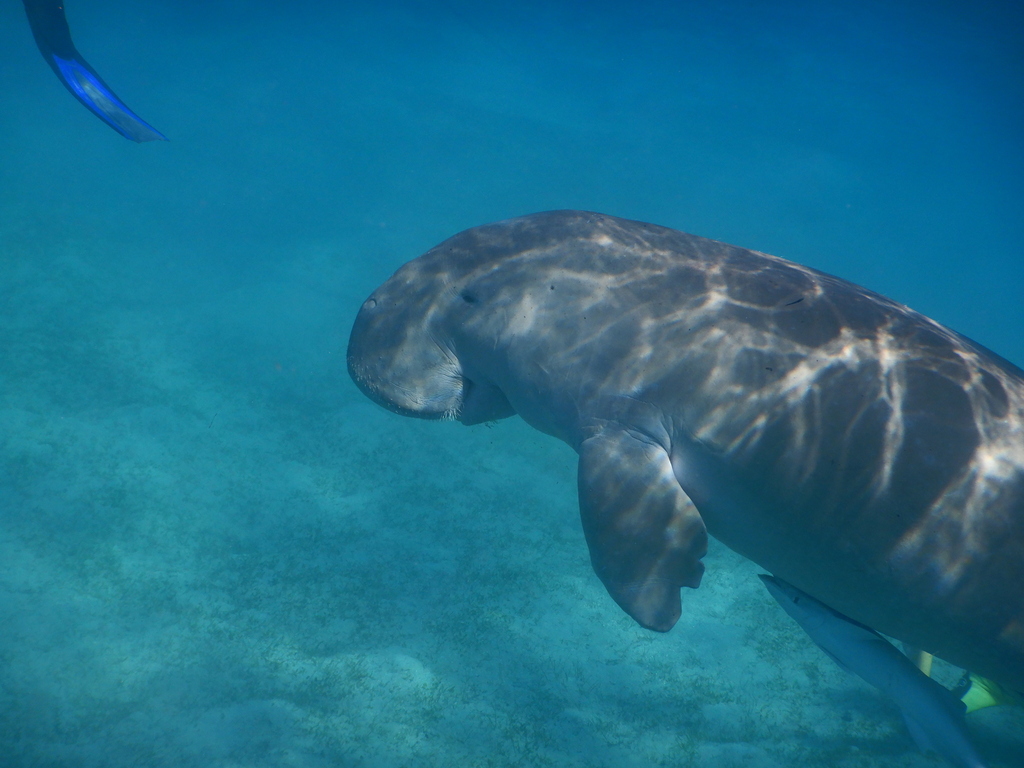
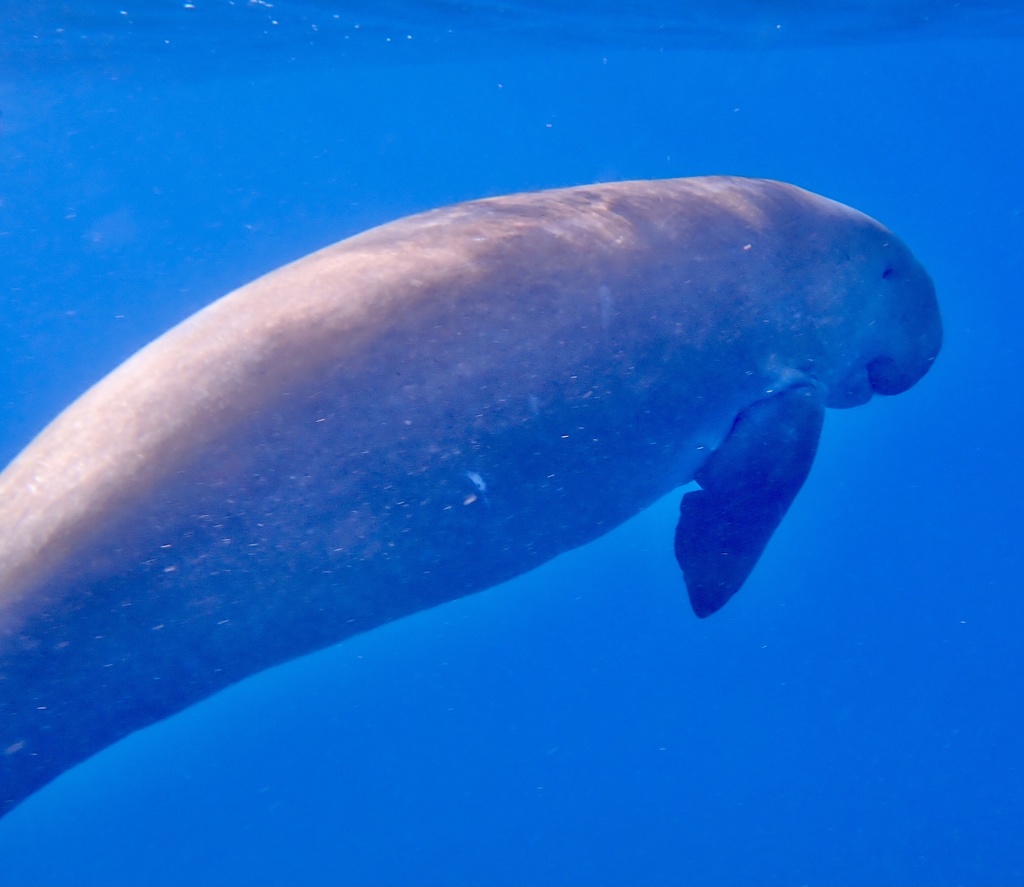
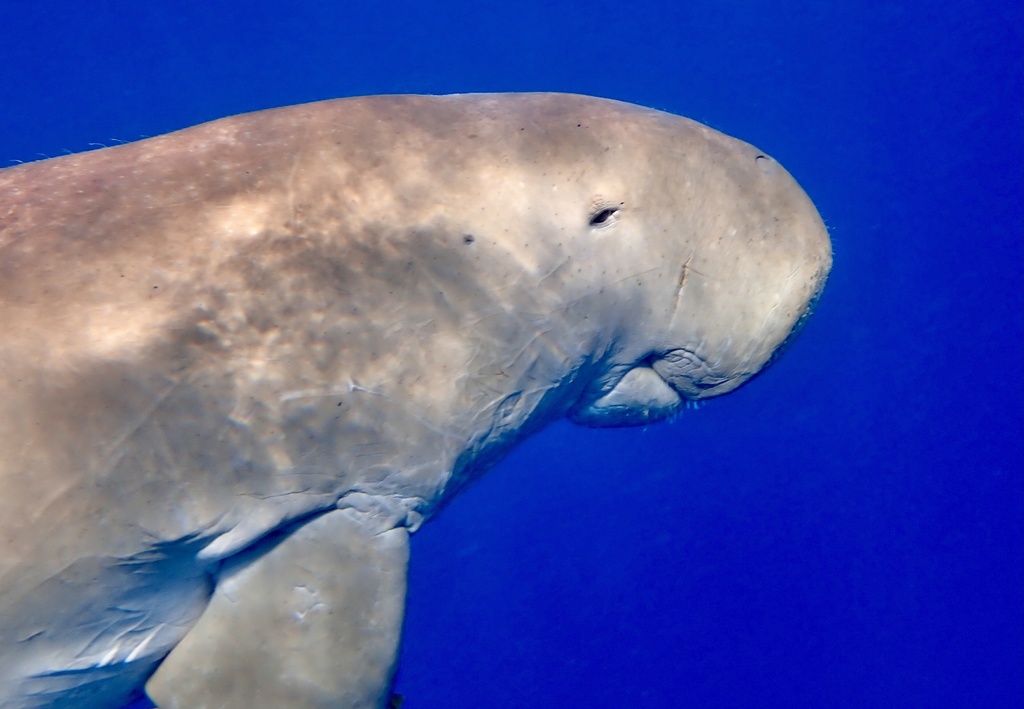
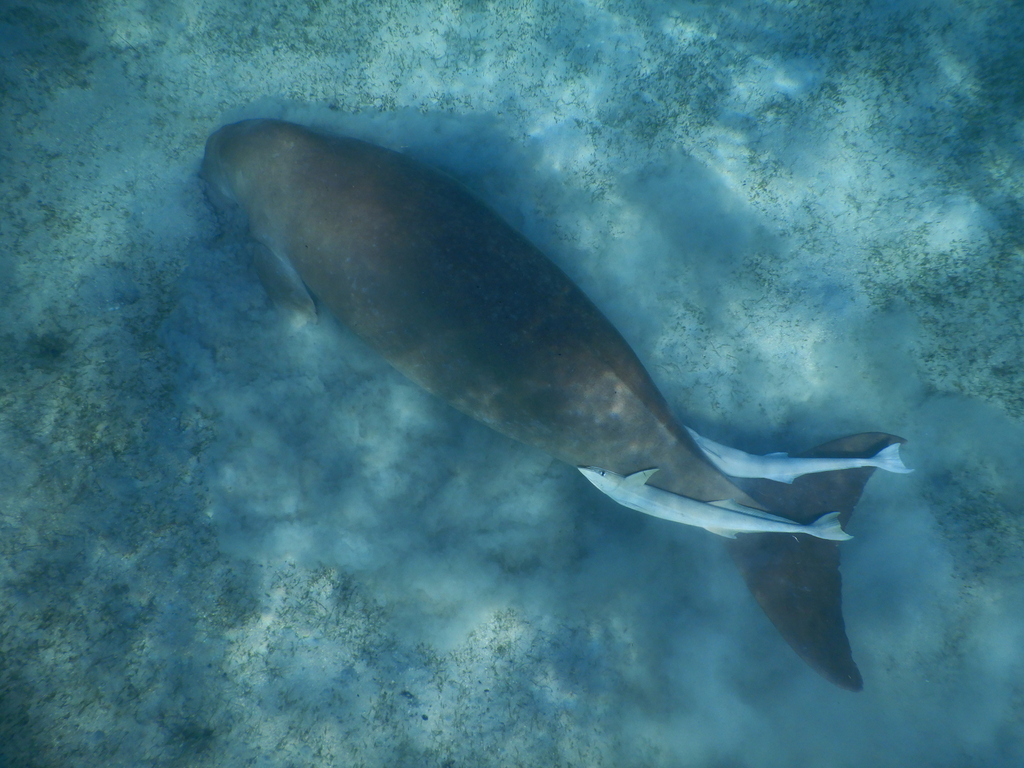
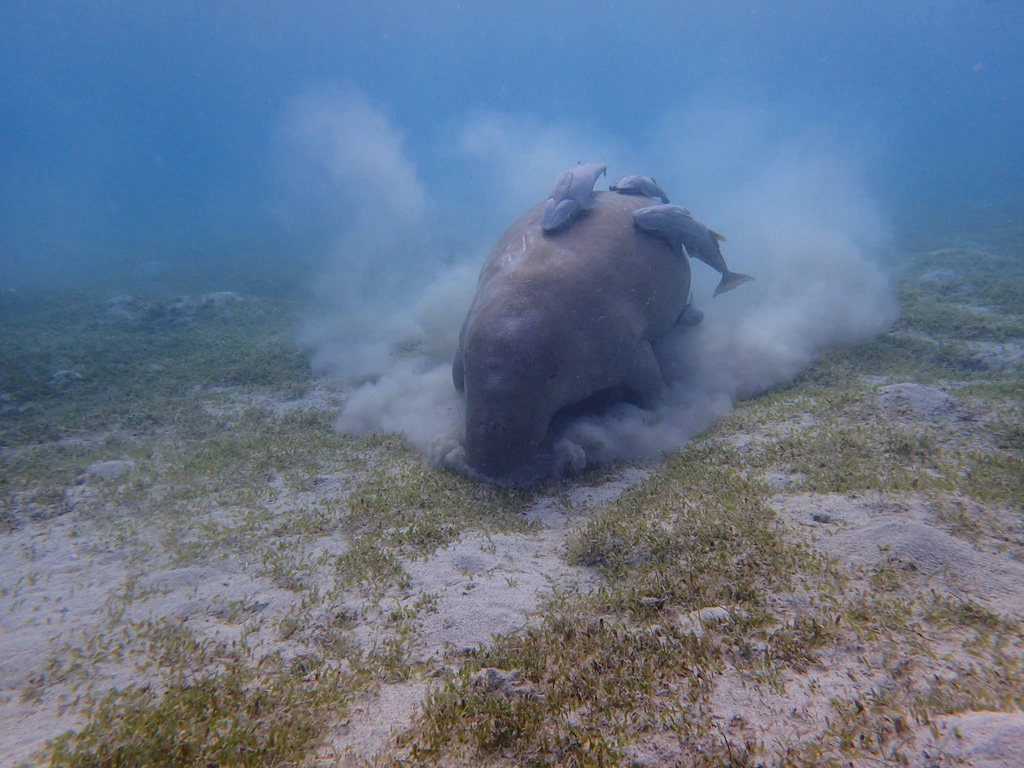
Photos show the species, not always the places on this page.
Length
Usually about 2.5 to 3 m (8.2 to 9.8 ft); adults rarely exceed about 3.3 m (10.8 ft)
Weight
Adults often about 350 to 450 kg (770 to 990 lb); up to about 570 kg (1,260 lb) reported
Next to a person
About 1.5 to 2 times as long as an adult is tall, and as heavy as several adults
What it eats
Seagrass, often pulling up whole plants and leaving winding feeding trails on the meadow. Estimates of how much they eat vary, roughly 20 to 40 kg of wet seagrass a day. When seagrass is scarce they may take some algae.
Around people
Calm, give space
How it lives
Dugongs graze on seagrass meadows in shallow coastal water. They usually live alone, as mother and calf pairs or in small groups, although rare large herds are seen, for example in the Persian Gulf. Females first give birth at about 6 to 17 years, after a pregnancy of about 12 to 15 months. A single calf suckles for about 14 to 18 months or longer, and there are 3 to 7 years between calves.
Where it goes
Many dugongs stay close to the seagrass meadows they feed on, so dugongs in neighbouring bays can form separate groups. Satellite tags show that some individuals travel hundreds of kilometres between meadows, while others stay local. There is no single migration route.
We only draw a journey on the map when scientists have tracked it or clearly documented it. For this animal we have not found one yet.
Populations
Australia holds most of the world's dugongs. Their status differs a lot by region: groups along the East African coast and in the Nansei islands of Japan are Critically Endangered, and New Caledonia's group is Endangered. The Persian Gulf and Red Sea hold important groups, while many in Southeast Asia are tiny and fragmented. There are no named subspecies.
Meet it respectfully
Watch quietly, move slowly and let the dugong choose the distance. Never chase, surround, touch, feed or block its path, and never dive down on it. Give extra space to mothers and calves. Boats should slow down over shallow seagrass, where resting dugongs can be hit. Rules differ by place: in the Philippines, national rules ask for at least 10 m in the water and 50 m for boats, with short encounters. Follow local rules and your guide.
Fun fact
Tap the bulb to light it up.
A dugong has a fluked tail like a dolphin. Manatees have a round, paddle-shaped tail and live in the Atlantic, so they belong to a different family.
Dugongs see poorly but hear well, and they find seagrass with their bristly snout.
When they pull up whole seagrass plants, they leave winding feeding trails on the seabed.
Like tree rings, a dugong's tusk adds one growth layer each year. Counting these layers in Thailand, scientists found one female that had lived to 69.
Dugongs usually travel alone or in pairs, but in February 2020 a herd of 600-700 was seen off the coast of Qatar, one of the largest ever recorded.
Source: Qatar Museums, Ten things you didn't know about dugongs
Dugong in the Ocean Atlas
Places we have researched where this animal is recorded. It is never guaranteed, and some places are for watching from the boat only.
Travel with usComing soonTrusted referralExploringOn pause, story onlyEthics pass
Country colour: pink where we travel, blue where we are exploring or refer, grey for story only.
 Australia
 Bahrain
 Cambodia
 China
China Cocos (Keeling) Islands
 Djibouti
 Egypt
Egypt India
India Indonesia
 Iran
Iran Japan
Japan Kenya
Kenya Madagascar
 Malaysia
 Mozambique
 Myanmar
 New Caledonia
 Palau
Palau Papua New Guinea
 Philippines
 Saudi Arabia
 Seychelles
 Singapore
 Solomon Islands
 Somalia
 Sudan
Sudan Tanzania
 Thailand
 Timor-Leste
 United Arab Emirates
 Vanuatu
 Vietnam
Read more about the dugong
Sources for this page
- Australian Government, 2026
- Great Barrier Reef Foundation, 2026
- Reef Authority (GBRMPA), Dugong
- IUCN Red List, 2019
- Dugong & Seagrass Hub, 2022
- CMS, Global Dugong Assessment, 2025
- Sheppard et al., 2006
- Queensland Government, 2026
Facts checked 26 September 2026. Photos: Unsplash licence, or Creative Commons as shown on each photo.
Work in ocean travel?
We are always happy to hear from exceptional local operators, accommodation, conservation organisations and destination experts. If your work fits responsible, small-group ocean travel, we would love to learn more.
Partner with Ocean CallingGili Trawangan in 5 days
from CHF 790