
Coron Freediving Lakes: Diving as a Guest on Tagbanwa Land
People send me photos of the Coron freediving lakes and ask one question: is it really like this? The honest answer is yes, and also no. Barracuda Lake and Kayangan Lake are two of the most unusual places I know to hold your breath and go down. But they are not empty wild places. They are someone’s home.
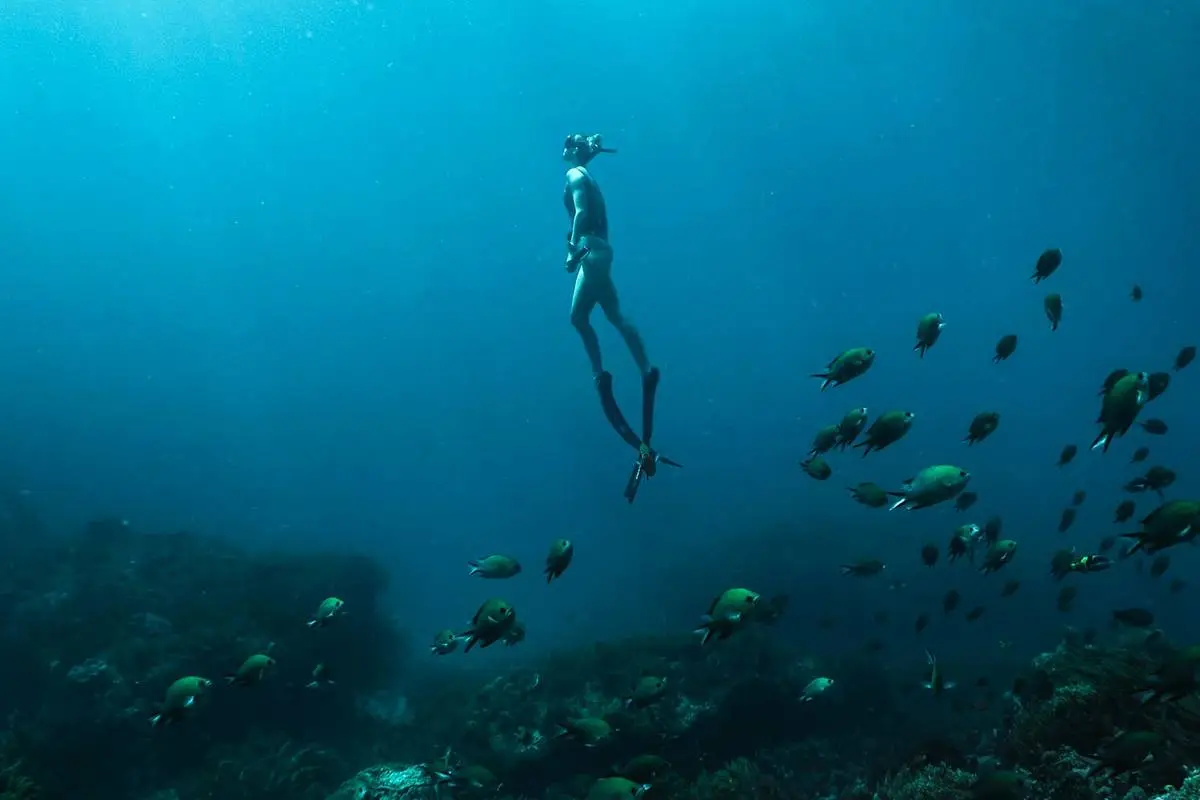
Barracuda Lake and Kayangan Lake sit on Coron Island, in northern Palawan. Before we talk about warm water layers and buoyancy, let me tell you whose lakes these are. It changes how you arrive.
Whose lakes these are
Coron Island is a block of limestone just south of Busuanga, in the Calamianes group of northern Palawan. Its steep rock hides a small world of lakes. The Philippine submission to the UNESCO World Heritage tentative list describes eight brackish lakes, a mix of salt and fresh water, and three smaller ones with underground connections to the sea.
The Calamian Tagbanwa have lived on and around Coron Island for generations. In 1998 they were recognised as the ancestral owners of the island, with the right to manage and protect more than 22,000 hectares. According to the Asian Development Bank, their later ancestral domain title covers the whole of Coron and Delian Islands and the waters around them, and it was the first in the Philippines to include traditional fishing grounds.
The community did not simply open the gates. They wrote their own management plan, based on their customary laws, with a visitor programme to control tourism and protect sacred sites from waste. Today the lakes are run by a Tagbanwa association as a community enterprise, and the ADB notes that entrance fees have improved health, education and livelihoods in the Tagbanwa communities.
I do not give a fee here on purpose. Fees are set locally, so pay what is asked, without negotiating.
Can you freedive in Barracuda Lake and Kayangan Lake?
Yes, both are open to visitors, on the community’s terms. They feel very different.
Barracuda Lake: layers you can feel with your skin
Barracuda Lake is the one freedivers talk about. It holds both salt and fresh water, and sometimes you can see the thin border between the two, a soft shimmer like oil in water.
Then comes the surprise. Atlas Obscura describes the surface at around 28 °C and then, at about 14 to 15 m, a sudden warm layer of just over 38 °C, before the water cools again near the bottom.
For a freediver, this is more than a curiosity. Fresh and salt water have different densities, so your buoyancy may not feel the same at every depth. The warmth can relax you more than you expect. That is lovely, but it can also make you less alert. A good instructor will check your weights in this water, not just use what worked for you in the sea.
And about the name: please do not come for the barracuda. The same source says the lake is largely empty of plants and animals, and barracuda are rarely seen now. It is a place for feeling, not for collecting sightings.
Kayangan Lake: the famous view, and a hard lesson
Kayangan is the lake of the famous viewpoint photo, reached by boat and a short climb on steps. The ADB counted 381,482 tourists visiting Coron in 2018, and it lists waste and crowding among the issues to improve. Early in the day is usually calmer.
Kayangan also asks for humility. In 2017, two young visitors on an island-hopping tour drowned while snorkelling in the lake, and rescuers found them at about 21.8 m. Rules for swimmers at Kayangan are set locally and can change, so ask on the day. If the staff ask you to wear a life jacket, you wear a life jacket. This is not a place to push a personal best.
A lake without current is still deep water
A lake has no waves and no current, so it feels easier. It is not. Divers Alert Network is very clear. Never freedive alone. Freedivers need eyes on each other on every dive and must be close enough to help. And 99 percent of blackouts, a sudden loss of consciousness from lack of oxygen, happen at the surface or within about 5 m of it.
Correct weighting matters too, so that you do not work too hard, and you do not sink if something goes wrong.
In the Coron freediving lakes I would add a few things. Dive with a certified instructor who knows these lakes. Use a line and a buoy only where the community allows it. If you are new, do not chase the warm layer. Our freediving safety basics go into more detail.
Two health notes before you travel. The US CDC lists malaria as present in Palawan and advises preventive medication for travellers there, so see a travel clinic and tell them you are going to Coron. And the Dive Philippines list of working hyperbaric chambers includes Puerto Princesa in Palawan, Cebu and Quezon City, but not Coron. Have insurance that covers evacuation, and ask your operator for their emergency plan.
How to be a good guest, in the lakes and the sea around them
You do not need to understand a sacred place to respect it. Follow the Tagbanwa staff, even when a rule seems small. The community’s own young people look after cleanliness and ask for respect around behaviour, noise and rubbish. Keep your voice low, because sound carries on still water, and take all your rubbish back to the boat. I keep a small wet pouch and dry bag for this, so nothing is left on the steps.
In the water, good buoyancy protects the fine sediment and the visibility for the next person. Do not touch or stand on the walls or the bottom, do not pick anything up, and do not feed fish. Never look for, ask about or try to reach the lakes that are closed.
A calm, simple kit helps you stay light and quiet. I dive with a low-volume mask I know well, and nothing extra hanging from me.
The sea around the lakes
The lakes are not a wildlife trip. If you hope for animals, the lagoons and reefs of the Calamianes give you more, and even there nothing is promised. Green turtles are a regular sight, and their name has a small secret: it comes from the colour of their fat, not their shells, which are dark brown, grey or olive.
Further north, off Calauit Island in Busuanga, an old field study from 1989 to 1990 measured dugongs eating an average of 30.5 kg of seagrass a day. That is not a count of dugongs today. They are rare and shy here, and on a calm day the most you should hope for is one slow breath seen from a distance.
Around turtles on the reefs, give them at least 3 m, never touch, and always leave them a clear path to the surface. Wildlife encounters are unpredictable. Snorkelling near turtles and dugongs should always follow local regulations and experienced professional guidance.
If you would like to feel water like this slowly, with people who know it, our Coron freediving trip with a local team is a gentle way in. It is a referral through Ocean Match, so you book the local team directly.
Questions people ask
Can you freedive in Barracuda Lake?
Visitors swim, snorkel and dive in Barracuda Lake, which the Tagbanwa opened to tourism together with Kayangan. Access and rules are set by the community, so go with an operator who follows them, and ask on the day whether lines and buoys are allowed.
Why can’t I visit the other lakes?
Because they are sacred to the Tagbanwa, and entry is for community members only.
Will I see animals in the lakes?
Very few. Barracuda Lake is largely empty of plants and animals, and barracuda are rarely seen. Turtles and reef life live in the sea around the island, and they are never guaranteed.
When is the best time to visit?
Early morning, when the lakes are quiet and the light is soft. Crowding is a known concern for the community, so arriving early is also a small kindness.
Wildlife encounters are never guaranteed and never forced. Ocean Calling works only with vetted, ethical local operators, and every animal is free to approach, or not, entirely on its own terms.
Sources & further reading
- ICCA Consortium, 2017. Coron Island, Philippines.
- Asian Development Bank, 2021. Philippines: Sustainable Tourism Development Project, Coron Indigenous Peoples Plan.
- UNESCO World Heritage Centre, 2006. Coron Island Natural Biotic Area, tentative list.
- Aguilar, R.C., 2005. Managing the sacred lakes of Coron Island, Palawan, Philippines. Proceedings of the First National Congress on Philippine Lakes, SEARCA.
- de Vera, D. (PAFID). Where the Water is Home. GRID Magazine.
- Atlas Obscura. Barracuda Lake.
- Philippine Daily Inquirer, 2017. 2 Czech tourists drown while snorkeling in Palawan.
- Bustad, C., 2019. Freediving Safety. DAN Southern Africa.
- US Centers for Disease Control and Prevention. Malaria information and prophylaxis, by country.
- Dive Philippines. Operational hyperbaric chambers.
- Aragones, L.V., 1994. Observations on dugongs at Calauit Island, Busuanga, Palawan, Philippines. Wildlife Research 21(6): 709.
- NOAA Fisheries. Green turtle species profile.
Further reading on Ocean Calling: Philippines in the Ocean Atlas · Green turtle in the Ocean Atlas · Dugong in the Ocean Atlas · Coron’s marine world · Coron after the wreck dives · Scuba days in Coron
Freediving certification in Coron: Barracuda Lake, WWII wrecks and dugongs
Freediving certification · Coron, Palawan, Philippines
A lake, a wreck and a quiet day in dugong waters. Coron is where we dive wrecks, a lake and dugong waters, always without promising a sighting.
Explore in the Ocean Atlas
Places in this article
Animals in this article

