
Coron Reef Conservation: A Visitor’s Guide Beyond the Wrecks
Everyone comes to Coron for the wrecks. But the living reef around them, and the people whose waters these are, ask something different from a visitor. Here is what.
Most people arrive in Coron for the wrecks. On the morning of 24 September 1944, US Navy carrier aircraft attacked Japanese ships anchored in Coron Bay, and those wrecks now sit a short boat ride from town. But Coron’s underwater story does not end where the metal does.
So what does Coron reef conservation actually ask of a visitor? In short: respect the Tagbanua community’s rules on their ancestral waters, respect the no-take marine park at Siete Pecados, choose boats that do not anchor on coral, and keep your hands, fins and sunscreen off the reef.
The same waters hold fringing reefs, seagrass and lakes walled by limestone. They belong to a different kind of story, one that has less to do with history and more to do with who has the right to decide how this place is used, and what a visitor owes it once they arrive.
Whose waters these actually are
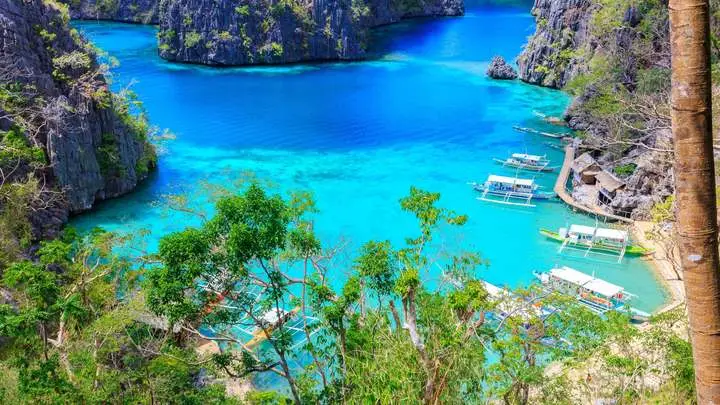
Coron Island, the limestone mass that holds Kayangan Lake and Barracuda Lake, is not just a pretty backdrop. It is the ancestral domain of the Tagbanua people. According to the ICCA Consortium, the community first received a Certificate of Ancestral Domain Claim in 1998, and then a Certificate of Ancestral Domain Title in 2001, covering about 22,284 hectares of land and surrounding sea. Other sources give different dates and areas (one says 1998, another 2004 and 24,520 hectares), so I use the ICCA figures here as the best supported, and flag the conflict.
This was a landmark case for indigenous rights over sea as well as land in the Philippines. It matters for a visitor for a very practical reason. The lakes and much of the water around them are not public infrastructure. Entrance fees, closed areas, daytime-only visits and local guiding rules exist because a specific community holds the right to manage this place. Following them without complaint is a small, direct way of respecting that.
Siete Pecados: the reef that is not in the wreck brochures
Siete Pecados, a small marine park a short hop from Coron town, is where reef conservation becomes visible. It covers about 1.8 square kilometres and protects coral reefs, mangrove forests and seagrass meadows. It is a locally managed marine protected area, set up and run by local communities together with their local government.
On 17 April 2024, the Marine Conservation Institute gave Siete Pecados a silver-level Blue Park Award at the Our Ocean Conference in Athens. The Philippine Department of Foreign Affairs noted it was the country’s third Blue Park, after Tubbataha Reefs and Apo Reef. The Institute’s profile describes high live coral cover and the highest fish species richness and biomass in the Calamianes Islands MPA network. I could not find an exact coral cover percentage, so I will not quote one.
Why protection takes time and good management
Recovery is not automatic, and it is not fast. A 2025 preprint by Ballesteros, Olalo and Atrigenio, not yet peer-reviewed, estimated how long fish biomass takes to double inside selected Philippine marine protected areas, using factors such as starting biomass, reserve size, years of strict protection and the quality of management. I could not read its full results, so I will not quote its numbers.
Earlier work points the same way. A 2019 study of Philippine MPAs, with its data published openly, found fish biomass below the level for maximum sustainable yield in 68% of the reserves surveyed, and its authors concluded that many locally managed MPAs were not yet effective enough for reef fisheries.
The takeaway for a busy place like Coron is that a marine park’s protection only works if visitors and operators respect it every single day, not just on paper. For the wider evidence, our piece on whether marine protected areas actually work goes deeper.
What does Coron reef conservation ask of you in the water?
Most of what damages a reef around Coron is ordinary, not dramatic. A fin kick against a coral head while photographing a wreck. A boat anchor dropped onto living coral instead of a sandy patch or mooring buoy. Sunscreen washed off skin in shallow water. A group lingering too long over a fragile coral garden because no one asked them not to. None of it looks like headline harm. All of it adds up where many boats pass every day in high season.
The fixes are just as simple. Choose operators who use mooring buoys or anchor only on sand. Keep a respectful distance from coral. Treat the ancestral-domain lakes and their rules as non-negotiable. And ask whether the plan includes quieter sites, so visitor pressure is spread out instead of piling onto the same few famous spots. If you want the mechanics of why an anchor in the wrong place does so much damage, our piece on what happens to a reef when anchors drop in the wrong spot explains it.
Two small things from the packing list help too. A long-sleeved rash guard protects your skin from the strong sun on long boat days with much less cream in the water, and when you do use cream, a mineral sunscreen put on well before you swim is the usual advice.
The ethical layer: wrecks, reefs and people as one responsibility
Coron’s wrecks are places of war, where lives were lost, as well as dive sites. The living reef around them is a recovering ecosystem. And the lakes belong to a community that fought for years for the right to manage them. Three different kinds of respect, asking for the same behaviour: slow down, follow the local rules, take nothing, and do not touch.
Our approach rests on curiosity, responsibility and always learning. We work with experienced local professionals and follow low-impact guidelines. In Coron, that means treating the wrecks and the living reef around them as two halves of the same responsibility, not as separate attractions. We wrote more about the wrecks in what reverence looks like on Coron’s WWII wrecks.
Wildlife around Coron, honestly
Turtles and other protected species can appear around Coron’s reefs, but sightings are never guaranteed, and nothing should be done to make them happen. Any encounter should follow marine park rules and Tagbanua community guidelines: never touching, feeding or crowding a wild animal. If an animal leaves, the encounter is over. Wildlife encounters are unpredictable. Snorkelling near turtles should always follow local regulations and experienced professional guidance.
Coron will probably keep being known first for its wrecks. But the reef quietly recovering around them, and the community whose ancestral waters they sit in, are the part of the story that decides whether this place is still worth visiting in twenty years. If this made you curious about experiencing it yourself, you can explore a Coron freediving trip with a local team, a referral through Ocean Match where you book the local team directly.
Questions people ask
Who manages Coron Island and its lakes?
Coron Island is the ancestral domain of the Tagbanua people. The ICCA Consortium reports a Certificate of Ancestral Domain Title in 2001 covering about 22,284 hectares of land and sea. Other sources give different dates and areas.
Can I visit all the lakes on Coron Island?
No. Only Kayangan and Barracuda (Luluyuwan) are open to visitors, by day and with guides. The other lakes are sacred and kept for the community.
What is Siete Pecados Marine Park?
A locally managed marine protected area of about 1.8 square kilometres near Coron town, protecting coral reefs, mangroves and seagrass. It won a silver-level Blue Park Award from the Marine Conservation Institute in April 2024.
How can I protect Coron’s reefs as a visitor?
Choose boats that use moorings or anchor on sand, keep your hands and fins off coral, use less sunscreen in the water, follow park and community rules, and never touch, feed or chase wildlife.
When were the Coron wrecks sunk?
On 24 September 1944, when US Navy carrier aircraft attacked Japanese ships in Coron Bay and around Busuanga Island.
Wildlife encounters are never guaranteed and never forced. Ocean Calling works only with vetted, ethical local operators, and every animal is free to approach, or not, entirely on its own terms.
Sources & further reading
- ICCA Consortium. Tagbanwa of Coron Island: ancestral domain and community conservation.
- ICCA Consortium. Stories tagged Coron (lakes open to visitors and community rules).
- Marine Conservation Institute via ICRI. Siete Pecados, Philippines: Blue Park profile.
- Department of Foreign Affairs, Philippines, 2024. Philippines receives Blue Park Award for Siete Pecados Marine Park.
- Ballesteros, M.B., Olalo, D.C. and Atrigenio, M.P., 2025. Doubling time of fish biomass in selected marine protected areas in the Philippines. Preprints.org (not peer-reviewed).
- Data on the biomass of commercially important coral reef fishes inside and outside marine protected areas in the Philippines. Data in Brief (PMC).
- Pacific Wrecks. Coron Bay, Palawan, Philippines.
- Manila Times, 2024. Coron MPA joins oceanic Blue Parks.
Further reading on Ocean Calling: Coron WWII wrecks · Coron freediving lakes guest guide · Do marine protected areas work? · Philippines · Coron freediving trip via Ocean Match · More from the journal · Ocean Atlas
Freediving certification in Coron: Barracuda Lake, WWII wrecks and dugongs
Freediving certification · Coron, Palawan, Philippines
A lake, a wreck and a quiet day in dugong waters. Coron is where we dive wrecks, a lake and dugong waters, always without promising a sighting.
Explore in the Ocean Atlas
Places in this article