
Coron Marine Ecosystem: Wrecks, Reefs and Barracuda Lake
A lake that turns salty a few metres down, then warm like a bath. Ships from 1944 slowly turning into reef. Why Coron’s marine world feels like several ecosystems stacked on top of each other.
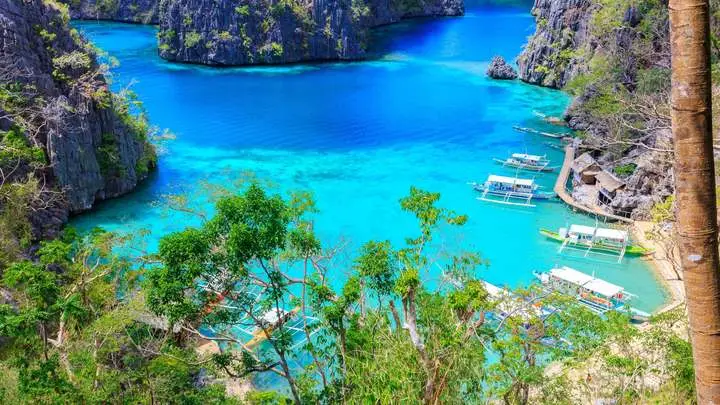
Imagine swimming down into a lake inside a limestone crater. A few metres below the surface you cross a blurry line where the water suddenly turns salty. Deeper still, it turns warm, like a bath. That is Barracuda Lake, and it is only one of the reasons Coron is special.
Coron’s marine ecosystem is unusual because three very different worlds sit side by side: Second World War shipwrecks that have become reefs, coral gardens in sheltered bays, and enclosed lakes with layered fresh and salt water, all partly protected by the indigenous Calamian Tagbanwa.
What makes Coron’s marine ecosystem unique?
Coron sits in northern Palawan, in the Philippines, inside the Coral Triangle. That is the stretch of tropical seas shared with Indonesia, Malaysia, Papua New Guinea, the Solomon Islands and Timor-Leste, known for some of the richest coral and reef-fish diversity on the planet.
What always strikes me about Coron, beyond that regional richness, is how much variety it packs into such a small area. Limestone cliffs, a bay full of sunken ships, sheltered lagoons, and a handful of enclosed lakes that behave almost nothing like the ocean around them.
None of these exist on their own. The limestone shapes the coastline and the lakes, the sheltered bays calm the water, and the lakes connect to the sea in ways that make them partly salty. Geology shapes biology, and biology depends on very specific conditions staying steady. That is why Coron feels less like one dive destination and more like several ecosystems stacked on top of each other.
The WWII wrecks of Coron Bay that became a reef
Coron Bay holds one of the best-known groups of Second World War wrecks in Asia. On 24 September 1944, aircraft from US Navy Task Force 38 attacked a Japanese supply fleet anchored around Coron and Busuanga. Dive magazine X-Ray Mag describes 96 Hellcat fighters and 24 Helldiver dive bombers taking part, in what was then one of the longest-range carrier air strikes.
How many ships went down depends on the source. Wikipedia names nine vessels sunk that day, including the seaplane tender Akitsushima, the Irako and the Olympia Maru, while a report in The National says about 24 ships are believed to lie off Busuanga but only 11 wrecks have been found. We would rather tell you the numbers disagree than pick one.
Most of the wrecks lie at roughly 14 to 46 metres, about an hour by boat from Coron town. A few are shallow. The Lusong gunboat almost breaks the surface and can be seen by snorkellers, and the Terukaze Maru lies at around 5 to 20 metres.
Over eight decades underwater, the hulls have become something close to an artificial reef. Coral, sponges and algae grow over the steel, and fish use holds and passageways as shelter, the way they would use a natural reef. The wrecks give the seabed something a flat sandy bottom cannot: vertical surfaces, shade and enclosed spaces.
It is a strange thing to sit with, honestly, that a violent day in 1944 slowly built habitat. These were also places where people lost their lives, which is why we approach them with reverence. What you see changes by day and season, and nothing is ever guaranteed. Go in with curiosity, not a checklist.
Barracuda Lake: two kinds of water in one dive
If the wrecks are Coron’s best-known feature, Barracuda Lake is its strangest. The lake sits among limestone cliffs and holds fresh and salt water in separate layers, not one uniform body.
Dive-site guides describe the change from fresh to salt water at only about 4 metres, visible as a grey, blurry horizontal line. That is the halocline. Further down there is a strong thermocline: from about 28°C near the surface to around 38°C at roughly 14 metres, with cooler water again near the bottom. The lake’s maximum depth is given as about 35 metres, where silt and tannins from fallen leaves make the water murky.
Why the deep layer is so warm is something we could not confirm. Some explanations point to heat trapped in the dense salt layer, which does not mix with the fresh water above. Others suggest geothermal warming. We would treat both as possibilities, not facts.
Because the lake is enclosed and has no waves, it is also a calm place for freedivers to practise relaxation with an instructor. Life in the lake is sparser than in the bay, and despite the name, barracuda are not something you can count on seeing. It is less about lots of species and more about the strangeness of the water itself.
Between the wrecks and the lakes you are often climbing on and off small boats, so a roll-top dry bag is useful for keeping a phone and a towel dry. If you like to photograph the wrecks, a small underwater or action camera on a wrist strap is easier to manage than anything you need to hold with both hands near fragile coral.
Tagbanwa waters, and how to visit without wearing them down
Coron Island’s lakes and reefs sit within the ancestral domain of the Calamian Tagbanwa (also spelled Tagbanua). According to the Sacred Natural Sites initiative, a Certificate of Ancestral Domain Claim was awarded in 1993, and in 1998 the Philippine environment department granted Coron Island’s ancestral domain claim. The Coron community’s claim is described as the first formal legal claim in the Philippines that included ancestral waters, and the first such claim recognised by a government. Lakes in the ancestral domain are considered sacred by the Calamian Tagbanwa, and the community decides which places visitors may enter.
I do not have a confirmed, current figure for the conservation fees at Barracuda Lake or Kayangan Lake. The numbers change, so instead of quoting something that may already be out of date, I would point you to the local guides on our experts page, or to the community managers when you arrive. What matters more to me than the exact peso amount is that the fee exists at all, and that it supports the people whose home this actually is.
The conservation layer, kept simple
On the wrecks: do not touch, do not enter spaces you are not trained for, and never take anything, not a bottle, not a piece of metal. Good buoyancy matters more than any camera. On the reefs: stay off the coral, keep fins high, and wear covering clothes so you need less sunscreen. If you use any, a mineral sunscreen put on well before you swim is gentler than spraying on at the boat. In the lakes: follow the Tagbanwa rules on where you can and cannot swim, without arguing about it.
Group size matters too. Coron’s famous spots can get busy, and a small group of six or fewer, arriving at quieter times, simply leaves less mark on a fragile place. Our Coron reef conservation guide and our piece on diving Coron’s wrecks with reverence go deeper into both.
Why Coron stays with you
What I take from Coron is not really one fact. It is the sense of layers. War history sitting quietly under a crust of coral. A lake that behaves like two different bodies of water depending on how deep you go. A community that protected this place long before tourism discovered it, and keeps doing so as tourism discovers it again. A few days between the wrecks and the lakes does not just fill a dive log. It shows you how specific the conditions are that let all of this keep existing.
If this made you curious about experiencing it yourself, you can explore a Coron freediving trip with a local team, a referral through Ocean Match where you book the local team directly.
Questions people ask
What makes Coron’s marine ecosystem unique?
The combination: WWII wrecks that now work like artificial reefs, coral reefs in sheltered bays, and enclosed lakes like Barracuda Lake with separate fresh and salt water layers, all in a small area.
How many WWII wrecks are there in Coron Bay?
Sources disagree. Wikipedia names nine ships sunk in the 24 September 1944 air attack, while other reports say about 24 ships may lie off Busuanga and around 11 wrecks have been found. Most lie at about 14 to 46 metres.
Can snorkellers see any of the wrecks?
Yes, a few are shallow. The Lusong gunboat almost breaks the surface, and the Terukaze Maru lies at around 5 to 20 metres. Ask your local guide which wrecks suit your level and the conditions that day.
Why is Barracuda Lake warm at depth?
Dive guides report water around 28°C at the surface and about 38°C near 14 metres. The cause is not clearly confirmed. Heat trapped in the salty layer and geothermal warming are both suggested.
Who looks after Coron Island’s lakes and reefs?
The Calamian Tagbanwa. Their ancestral domain claim over Coron Island was granted in 1998 and is described as the first in the Philippines to include ancestral waters. Lakes in the domain are considered sacred, and the community sets the rules for visitors.
How much are the Barracuda Lake and Kayangan Lake fees?
We could not confirm current amounts, and they change. Ask your local guide or the community managers on arrival, and see the fee as support for the Tagbanwa’s care of the place.
Wildlife encounters are never guaranteed and never forced. Ocean Calling works only with vetted, ethical local operators, and every animal is free to approach, or not, entirely on its own terms.
Sources & further reading
- Management and enhanced protection of sacred marine areas in Coron Island, Philippines. Sacred Natural Sites Initiative.
- Tagbanwa people and the Coron Island ancestral waters claim. Wikipedia, accessed 2026.
- Coron Bay: ships sunk on 24 September 1944 and wreck depths. Wikipedia, accessed 2026.
- Philippines: Wrecks of Coron. X-Ray Mag.
- Japanese ships, casualties of war, make for fascinating dives. The National.
- Attack on Coron Bay. Divernet.
- Barracuda Lake. Atlas Obscura.
- Barracuda Lake dive site profile. dive.site.
Further reading on Ocean Calling: More from the journal · Wildlife & the law · See the retreats · Ocean Atlas
Freediving certification in Coron: Barracuda Lake, WWII wrecks and dugongs
Freediving certification · Coron, Palawan, Philippines
A lake, a wreck and a quiet day in dugong waters. Coron is where we dive wrecks, a lake and dugong waters, always without promising a sighting.
Explore in the Ocean Atlas
Places in this article