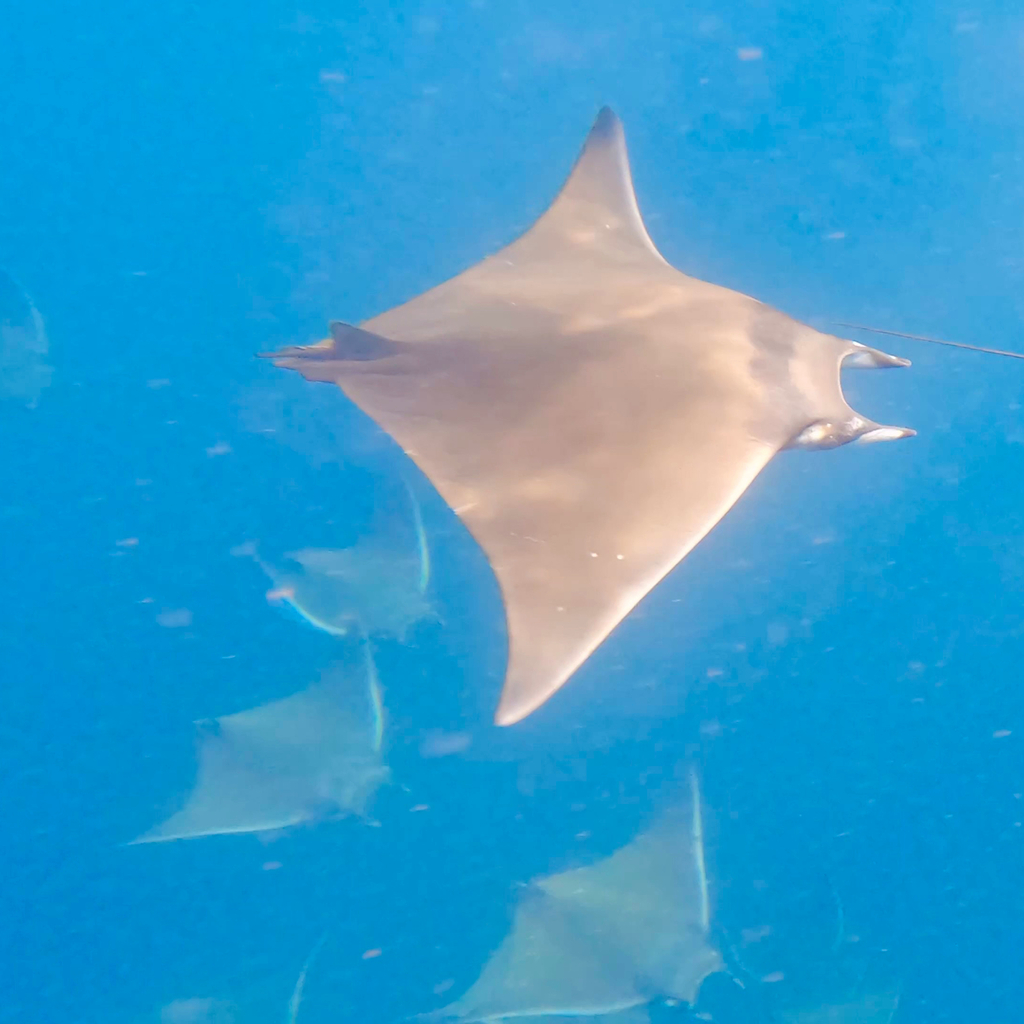
La Ventana Mobula Snorkelling: An Honest Day on the Water
The photos show hundreds of wings under a perfect blue sea. A real day of La Ventana mobula snorkelling, in Baja California Sur, is slower and more honest than that. It is mostly searching, a little waiting, some wind, and then a few seconds you will remember for years.
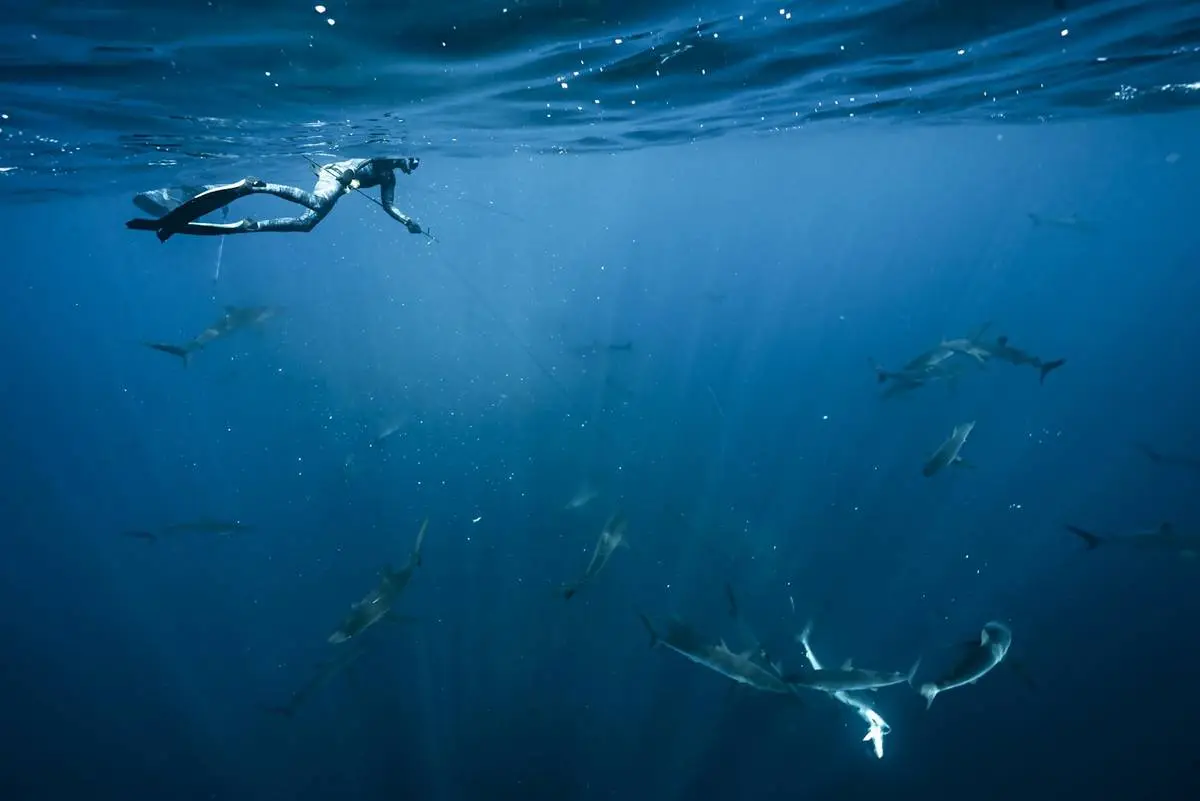
So what is a mobula snorkelling day really like? You spend hours on a small boat looking for splashes, you slide in quietly when a school is near, and you float at the surface on your own breath while the rays decide how close they come. Some days give you a long pass of wings. Some give you a few far splashes. This story is for confident swimmers who want to know what really happens on the boat, including the parts that never make it to Instagram.
Why La Ventana mobula snorkelling is special
The small "flying" rays of La Ventana are mostly Munk's devil rays, Mobula munkiana, the smallest of the devil rays. On average they are about 89 to 100 cm across, with a maximum of 130 cm. You can read more about them on our Munk's devil ray page in the Ocean Atlas.
Researchers used 69 days of boat surveys, 428 spotter-plane flights and 31 records from citizen scientists, along 312 km of the eastern Baja California peninsula. They documented 221 courtship and mating events of three devil ray species. 209 of them happened around La Ventana and Ensenada de Muertos.
These are study numbers, not a promise of what one visitor will see. But they explain why this channel matters. When you slip into the water here, you are entering a courtship ground.
What the day actually looks like
A mobula day is snorkelling from a small boat. Everyone watches the surface for a splash, or a ray turning in the air. When the captain finds a group, the boat stops at a distance and you slide in with mask, snorkel and fins. Expedition reports describe the same simple habits: enter without a splash, keep your fins under the surface, and move calmly.
Scuba is usually not part of it. The same report explains that scuba bubbles can scare off mobula groups, possibly because orcas are thought to use bubbles when they hunt the rays. So the whole day happens at the surface, on your own breath.
And then there is the searching, the part photos never show. Some mornings the boat finds rays quickly. Other mornings pass with only a few splashes far away. You may get in several times, see a school pass below you for a few seconds, climb back on board, and look again. Days often start early and continue until early afternoon, when conditions allow.
Reports from May and June trips describe water of about 70 to 80 °F, roughly 21 to 27 °C, with air temperatures in the 90s °F. They recommend a 3 mm wetsuit or a dive skin, partly for protection from jellyfish. I bring a thin long-sleeve layer for exactly this reason.
Wind, chop and the days you stay on the beach
La Ventana is famous among kitesurfers. Its main wind season generally runs from November to April, with December to February at the heart of it. Strong northerly "El Norte" winds can bring some of the roughest conditions of the year.
The mobula months come later in spring, but the sea is still the sea. When the wind rises, the surface breaks into chop and spotting rays becomes much harder. Sometimes the right decision is not to go out at all.
We do not see these days as failures. The rays are still out there, doing what they came to do.
Why they leap, and why nobody can tell you for sure
On the boat, everyone asks the same question: why do they jump? The honest answer is that science is still learning.
A 2024 review of shark and ray breaching lists possible reasons, like removing parasites, hunting or stunning prey, males following females during courtship, and escaping predators. Manta and devil rays showed the highest share of breaches among the groups studied. The authors say there is still much to learn about why these animals spend so much energy jumping out of the water.
For Munk's devil ray, the Manta Trust says the purpose is still unclear, and may relate to social life in their big groups. Off La Ventana, some leaps are clearly part of courtship. When a ray jumps near you, it is part of their private life, not a performance for the boat.
Who this day suits, and who might wait
This day fits people who are confident in open water, comfortable climbing in and out of a boat many times, relaxed in some chop, and happy with the idea that a long day may bring only a short encounter. The desert sun is strong, so shade, a hat and covering up matter as much as sunscreen.
If you get seasick easily, or you are still building confidence in deep water, it may be kinder to yourself to wait. There is no shame in that. Watching rays leap from a quiet boat is also a real La Ventana day.
Rays yes, whales stay on the boat
These waters are shared with other animals, and sometimes a whale appears on a mobula day. In Mexico, the whale-watching standard NOM-131-SEMARNAT-2010 covers all baleen whales and the sperm whale. It does not permit fishing, diving or swimming during whale-watching activities.
So if a whale comes near, everyone stays on board and watches. A mobula trip is never a loophole.
How we swim near the rays
Mobula rays are fish, not marine mammals, so snorkelling near them can be done well. The Manta Trust code of conduct, written for manta rays, is a sensible guide: enter the water quietly and no closer than 10 m, do not approach closer than 3 m, let the animal come to you, never chase and never touch. We could not find an official minimum distance for mobula snorkelling in La Ventana, so we follow this code, stay back, float quietly and let the rays decide.
With courtship groups we are even more careful. We never drop swimmers in front of a moving line of rays, never dive down into a courtship group, and leave a school alone when it turns away.
There are good reasons for this care. Munk's devil rays are listed as Vulnerable, and because they swim in schools they are easily caught in gill nets, trawls and purse seines. Their newborns grow up nearby, in a shallow bay called Ensenada Grande in the Espíritu Santo archipelago near La Paz. Young tagged rays stayed there for up to 145 days in a row, and the researchers recommend managing tourism there to protect them. Around nursery bays, we simply let the young rays be.
Wildlife encounters are unpredictable. Snorkelling near mobula rays should always follow local regulations and experienced professional guidance.
If this slower way of meeting the Sea of Cortez speaks to you, you can read about our La Ventana retreat in May 2027, built around quiet days on the water.
Questions people ask
Do I need to be a strong swimmer to snorkel with mobulas in La Ventana?
You should be a confident swimmer in open water. The rays move, entries are from a boat, and you may get in and out several times in a day, sometimes in light chop.
Can I scuba dive with the mobula schools?
Mobula trips here are usually snorkel only. Expedition reports explain that scuba bubbles can scare off the groups.
What happens if it is too windy?
Sometimes the boat does not go out, or the day is shorter. Chop makes it hard to spot rays and uncomfortable to swim. A good guide makes that call calmly, and the day becomes time on land instead.
Is it the same as swimming with manta rays?
Munk's devil rays are close relatives of mantas, but much smaller, with a maximum width of about 130 cm. They move fast and in groups, so encounters are often short.
Wildlife encounters are never guaranteed and never forced. Ocean Calling works only with vetted, ethical local operators, and every animal is free to approach, or not, entirely on its own terms.
Sources & further reading
- Palacios, M.D. et al., 2023. Reproductive behavior, seasonality, and distribution of three devil ray species (Mobula mobular, M. thurstoni, and M. munkiana) in the Southern Gulf of California, Mexico. Marine Biology.
- Palacios, M.D. et al., 2021. Description of first nursery area for a pygmy devil ray species (Mobula munkiana) in the Gulf of California, Mexico. Scientific Reports 11.
- Hobson, M., 2023. 122 devil rays joined in a wild mating ritual that lasted for hours. National Geographic.
- UC Davis, 2024. Sharks and rays leap out of the water for many reasons (on Klimley et al., 2024, Environmental Biology of Fishes).
- Manta Trust. Munk’s pygmy devil ray (Mobula munkiana) species guide.
- Manta Trust. Manta ray tourism code of conduct.
- SEMARNAT, 2011. NOM-131-SEMARNAT-2010, Diario Oficial de la Federación (via FAOLEX).
- Morlock, S., 2021. Snorkeling with Baja’s Mobula Rays. Scuba Diving.
- Baja Wing. La Ventana Wind Guide: When, Where and Why the Wind Blows.
Further reading on Ocean Calling: La Ventana’s mobula rays and the May season · What Mexican law actually allows with whales · Why mobula rays are protected in Mexico, yet still sold · Mexico in the Ocean Atlas
La Ventana: a mobula ray retreat in the Sea of Cortez
Ray retreat · La Ventana, Baja California Sur, Mexico
Six quiet days by the Sea of Cortez, in the month the devil rays gather. This story is about Mexico, where we run our ray retreat in the Sea of Cortez.
Explore in the Ocean Atlas
Places in this article
Animals in this article