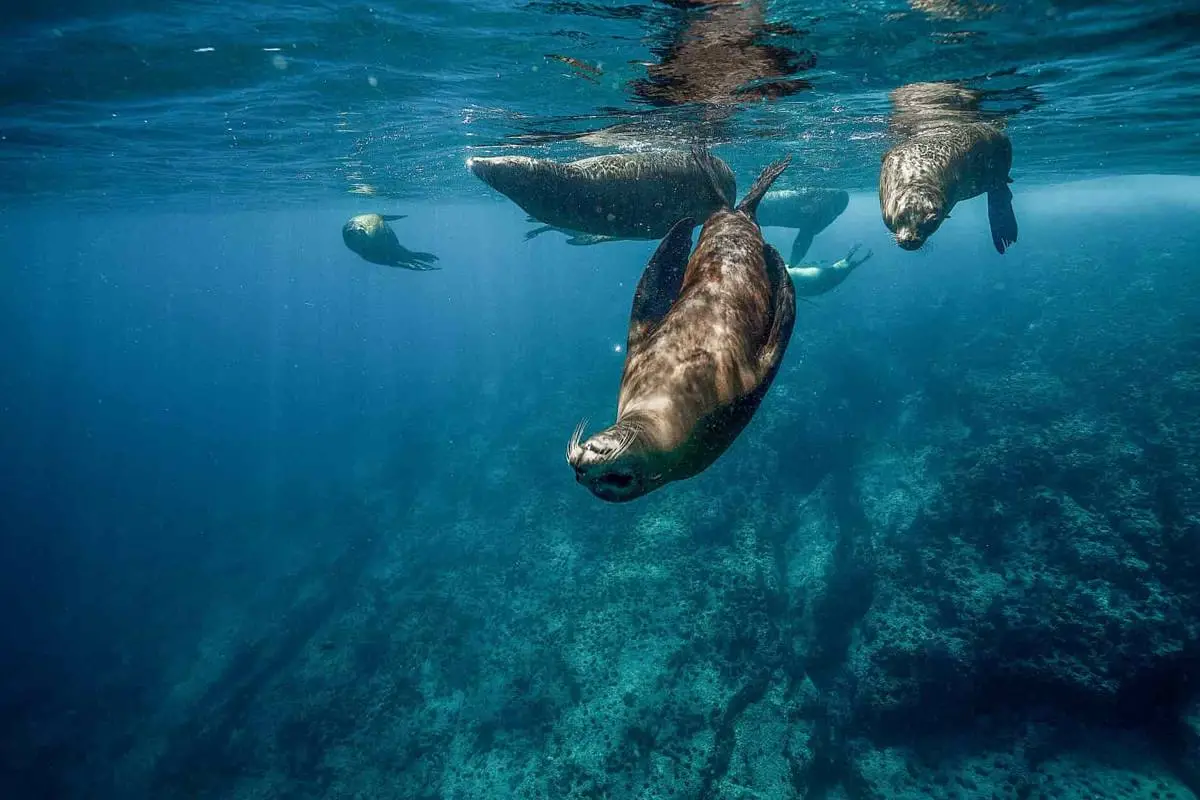
Snorkeling With Sea Lions: What to Do When They Approach
A young sea lion swims straight at your mask, twists away at the last second, then comes back to turn circles around you. Few moments in the sea feel so playful. But snorkelling with sea lions asks something of us, and it is not to play back.

So what do you do when a sea lion comes close? Very little. Stay calm and flat at the surface, keep your hands near your body, never touch or follow it, and let it come and go. In places like Baja California or the Galápagos, sea lions may approach on their own. That closeness is a gift, and it is the heart of snorkelling with them. It is also the moment where many kind people make small mistakes without noticing.
If the animal comes closer
A curious sea lion is still a wild animal. Its curiosity does not make it a pet, and it does not give us permission to follow it when it leaves.
The best thing you can do is very little. Stay calm and horizontal at the surface, keep your hands close to your body, and leave the animal room to pass. Try not to block its way back to the group or to the rocks. Do not reach for its flippers, and do not try to turn one pass into a second one by swimming after it.
If a guide asks everyone to move back, do it, even if the animal looked curious a moment ago. A scene that feels playful to us may include behaviour we cannot read with confidence.
What one small colony taught researchers
Los Islotes is a small breeding colony of California sea lions in the Gulf of California, near La Paz in Baja California Sur. It is also a popular place for tourism. You can meet this population on our California sea lion Atlas page.
Researchers watched the colony for a full year, from May 2000 to April 2001, and recorded 112 disturbances. Most had natural causes, but about a quarter came from people. Those visitors were there for sea lion watching (30%), snorkelling (27%) and scuba diving (26%), with smaller numbers kayaking, fishing and swimming.
The pattern was clear. In about a third of the disturbances caused by people, animals reacted by going into the water. Disturbances piled up when tourism was at its peak, and when high tides and strong winds already made resting difficult.
The authors found that the distance of the boats seemed to be the only variable that significantly affected the animals' behaviour. Because larger groups of boats caused disturbance, they suggested limiting the number of boats in one place at one time to five.
The ones you do not see
This is an older study of one colony, but its message travels well. The sea lions in the water are not the whole story.
On the rocks, other animals are resting, nursing or recovering from a night of feeding. Every boat that edges too close has a cost for them, even when the animals in the water seem happy to see us.
How close can you get to sea lions?
Every place has its own rules, and the rules of one country should not be borrowed for another.
In the Galápagos, visitors follow the national park rules, including a minimum distance from wildlife. In Mexico, the rules for a site depend on its protected area and permits, so the local operator should be able to tell you exactly what applies.
Where no local rule exists, a careful reference helps. In the United States, NOAA Fisheries asks people to stay at least 50 yards from seals and sea lions, in the water or on shore. It asks people never to feed them, and never to put a boat between a mother and her young. It also lists the signs that you are too close: an animal that starts to stare, fidget, or flee into the water.
A curious animal can still be a vulnerable one
The Galápagos sea lion is listed as Endangered. A study in the southeast of the archipelago estimated around 2,300 to 4,100 animals in that region between 2011 and 2015, and noted that the species has declined by around 50% over the last 30 years.
The same study describes the main breeding colony on San Cristóbal, next to the town, as exposed to human disturbance and contact with domestic animals. So the friendliness we see in the water should not hide the pressure these animals live under.
Wildlife encounters are unpredictable. Snorkelling with sea lions should always follow local regulations and experienced professional guidance.
How to be the easy presence
Before you book, ask the local, permit-holding team how they handle a sea lion that approaches guests, how close the boat goes to the colony, and how they protect the animals resting on land. A responsible answer tells you when to leave the water as well as when to get in.
In the water, get in quietly, stay together as a small group, and let the animals decide the distance. Avoid swimming towards pups or into narrow channels between rocks, and never try to attract an animal with food or objects. Keep flash and lights off. If an animal shows signs of stress, such as staring, fidgeting or fleeing, follow the guide back to the boat without discussion.
On days like these I pack a long-sleeve rash guard for the boat and the water.
Ocean Calling has not approved every sea lion location as a hosted experience, and a sighting can never be promised. The encounter belongs to the animal. If you are dreaming of a trip like this, our Ocean Match is a gentle place to start.
If this made you curious to meet the ocean this way, you can explore our upcoming retreats.
Questions people ask
Is it safe to snorkel with sea lions?
Sea lions are wild animals, and a bite is always possible. Follow your guide, keep your distance from pups and resting animals, and never touch or feed them. Where its guidelines apply, NOAA Fisheries advises staying at least 50 yards away.
Why do sea lions come so close to snorkellers?
Some animals seem curious about swimmers, but we cannot always read their behaviour. The kindest response is to stay calm and let them come and go freely.
Can I touch a sea lion if it touches me first?
No. Let it pass and give it space. A touch can stress the animal and risks a bite, and it turns a wild encounter into something the animal did not choose.
How close can boats go to a sea lion colony?
It depends on the local rules. At Los Islotes, researchers found that the distance of the boats was the key variable affecting behaviour, and most disturbances caused by people came from less than 20 m.
Wildlife encounters are never guaranteed and never forced. Ocean Calling works only with vetted, ethical local operators, and every animal is free to approach, or not, entirely on its own terms.
Sources & further reading
- Labrada-Martagón, V., Aurioles-Gamboa, D. and Martínez-Díaz, S.F., 2005. Natural and human disturbance in a rookery of the California sea lion (Zalophus californianus californianus) in the Gulf of California, Mexico. Latin American Journal of Aquatic Mammals 4(2).
- NOAA Fisheries. Marine life viewing guidelines.
- Riofrío-Lazo, M., Arreguín-Sánchez, F. and Páez-Rosas, D., 2017. Population abundance of the endangered Galapagos sea lion Zalophus wollebaeki in the southeastern Galapagos Archipelago. PLOS ONE.
Further reading on Ocean Calling: Why touching marine animals harms them · The Galápagos 2-metre rule · Galápagos sea lion in the Ocean Atlas · Observation versus interaction in marine tourism · Mexico in the Ocean Atlas
La Ventana: a mobula ray retreat in the Sea of Cortez
Ray retreat · La Ventana, Baja California Sur, Mexico
Six quiet days by the Sea of Cortez, in the month the devil rays gather. This story is about Mexico, where we run our ray retreat in the Sea of Cortez.
Explore in the Ocean Atlas
Places in this article
Animals in this article