
California sea lion
Zalophus californianus
Curious, noisy sea lions of the California and Baja coasts. Young animals may approach in the water, but never chase, touch or feed them. Sightings are not guaranteed.
Least Concern (IUCN, 2014) means it is not at high risk of extinction worldwide today.
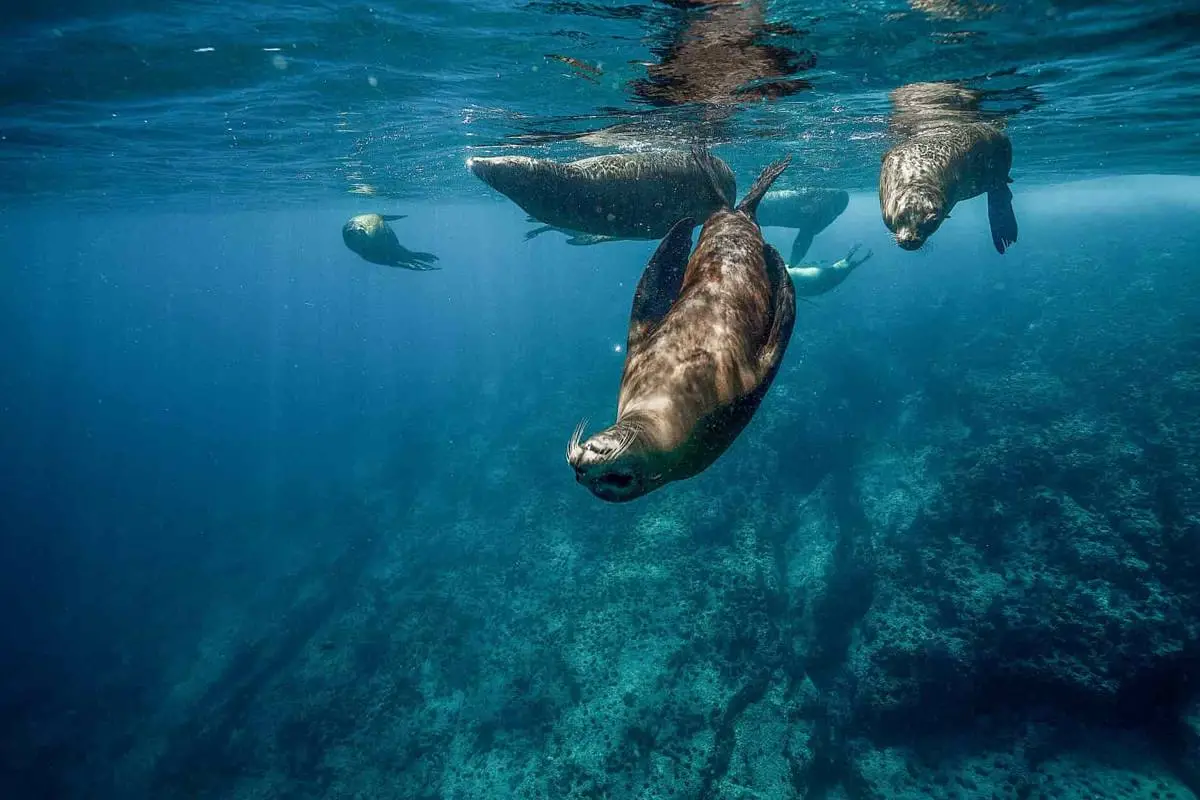


Photos show the species, not always the places on this page.
Length
Males usually about 2.3 m (7.5 ft); females about 1.8 m (6 ft)
Weight
Males up to about 318 kg (700 lb); females about 110 kg (240 lb); newborn pups about 7 kg (16 lb)
Next to a person
A bull is longer than a tall adult and can weigh as much as several adults; a female is about as long as a person is tall and weighs about one to one and a half adults
What it eats
Fish and squid, including anchovies, sardines, mackerel and rockfish, and many other local fish in the Gulf of California.
Around people
Potentially dangerous, respect
How it lives
California sea lions feed in rich upwelling waters. They are very social, barking loudly and resting together in rafts at the surface with their flippers in the air, which is resting, not entanglement. Males hold breeding territories with up to about 14 females; pups are born mostly in May and June, and mating follows from late June to early August. Mothers alternate 2 to 5 day feeding trips with 1 to 2 days of nursing, and feed their pups for nearly a year.
Where it goes
In most years, adult males leave the breeding islands after summer and travel north to feed off California, Oregon, Washington, British Columbia and southeast Alaska in winter. Females and pups stay near the colonies until the pups are weaned, and Gulf of California females are loyal to their home colonies.
Populations
Sea lions on the Pacific side of Baja and southern California and those in the Gulf of California are separate populations. Gulf animals stay loyal to their home colonies, have broader, lower skulls, often eat a wider range of sea-floor prey, and have declined more. The sea lions seen on the Pacific side of Baja are California sea lions, not Galápagos sea lions.
Meet it respectfully
Rules differ by place. In the US, NOAA guidance asks you to stay at least 50 yards (45 m) from sea lions and watch for 30 minutes or less, and its West Coast Share the Shore guidance asks for 100 yards (91 m); feeding and harassing them is illegal. At Los Islotes, La Paz, the park closes swimming and diving from 1 June to 31 August for pupping and mating; outside that time, go only with accredited guides, in groups of up to 10 plus a guide. Never touch, feed or chase them, never crowd mothers and pups, and give territorial bulls room. Stay away from stranded or shaking animals, which may be sick.
Fun fact
Tap the bulb to light it up.
Sea lions have small ear flaps and can turn their back flippers forward to walk on land. True seals cannot do either.
Toxic algae blooms can poison sea lions with domoic acid and cause seizures, so never approach a stranded or shaking animal.
The sea lions of Baja's Pacific coast are California sea lions, not the separate Galápagos sea lion.
In a California study, a sea lion learned to bob its head in time with music, even at new tempos. Before this, only sound mimics like cockatoos and humans had shown it.
Source: Cook et al., 2013, Journal of Comparative Psychology, a California sea lion can keep the beat
Males are almost three times heavier than females. A big male weighs about 700 pounds (320 kg), a female about 240 pounds (110 kg).
At Los Islotes, near La Paz, the park has closed swimming and diving from 1 June to 31 August in recent years, when pups are born and bulls defend their territory. The dates are set each year by the park, so they are checked before any visit.
Source: Escapada H, 2023, park director on the Los Islotes sea lion swim closure
Follow its journey
Watch it travel. Every line comes from satellite tracking or documented research, and the source is named.
StartEndJourney (the line joins documented areas; real paths vary)
California sea lion in the Ocean Atlas
Places we have researched where this animal is recorded. It is never guaranteed, and some places are for watching from the boat only.
Travel with usComing soonTrusted referralExploringOn pause, story onlyEthics pass
Country colour: pink where we travel, blue where we are exploring or refer, grey for story only.
 Canada
 Ecuador
 Germany
 Japan
Japan Mexico
 United States
Read more about the california sea lion
Sources for this page
- NOAA Fisheries, 2026
- NOAA Fisheries, Share the Shore
- IUCN Red List, 2025
- Wolf et al., 2007
- Goldstein et al., 2008
- Revista de Biología Tropical
- Espíritu Santo National Park visitor guidelines, 2022 (Costa Salvaje)
- Escapada H, 2023, park director on the Los Islotes sea lion swim closure
Facts checked 29 September 2026. Photos: Unsplash licence, or Creative Commons as shown on each photo.
Work in ocean travel?
We are always happy to hear from exceptional local operators, accommodation, conservation organisations and destination experts. If your work fits responsible, small-group ocean travel, we would love to learn more.
Partner with Ocean CallingNot sure where to go? Get your Ocean Match
from CHF 19