
Walvis Bay Wildlife Watching: Seals, Dolphins and Whales
Morning mist over a desert lagoon. Flamingos standing in pink lines, a seal's head popping up beside the boat, and somewhere out there, a small dolphin that lives nowhere else on Earth. Walvis Bay is wonderful. It also asks for a few new rules.

Can you watch wildlife ethically at Walvis Bay and Swakopmund? Yes, from a boat or from the shore, with distance. You can see Cape fur seals, dolphins, flamingos and, in season, humpback whales. What has changed is that you must keep your distance from seals, because rabies has reached them. The dolphin rules are unclear, and whales are only seasonal.
The seals are not the problem, and you do not need to stay away from the coast. This is a cold desert shore, very different from the warm reefs we usually write about. It is also a place where I found fewer written rules than I expected, so this article says clearly where my evidence stops.
A desert on one side, the Benguela on the other
Walvis Bay sits where the Namib Desert meets the cold Benguela Current. The cold water is rich in fish, which is why seals, dolphins and seabirds gather here. Mornings are often misty, and nobody goes in without a thick wetsuit. That alone makes this a trip for watching, not swimming.
The lagoon is also a wetland of international importance. The Ramsar listing, designated in 1995, covers 12,600 hectares of tidal lagoon, mudflats and sandbars, and reports between 37,000 and 79,000 wetland birds. BirdLife puts summer numbers higher, at over 100,000, and says that most of the region's wintering flamingos use this area and the nearby saltworks. I did not find counts of great white pelicans, so I will only say that pelicans are part of the picture, without a number.
Cape fur seals: the headline animal
Namibia is home to a very large share of the species. One researcher quoted in the press said there are about 1.7 million Cape fur seals in total, and about a million of them in Namibia. Colony sizes at single sites are less certain. Tour operators give figures from 50,000 to more than 100,000 at Pelican Point, which are informal estimates, not census counts. A brochure for Cape Cross says up to 210,000 seals can be present in the breeding season in November and December.
The colonies are not always safe places for the seals themselves. In 2020, more than 5,000 pups died at Pelican Point, and researchers linked it to a wave of pregnancy losses. The cause was never fully established in the sources I found. A seal colony is a nursery, not a stage.
The rabies warning, in plain words
Our separate article on Namibia's seal rabies warning has the detail, so here is only the summary. The World Organisation for Animal Health reports more than 100 confirmed cases in Cape fur seals in South Africa and Namibia since 2024. In Namibia, the first case was a seal at Walvis Bay Lagoon, announced by the veterinary authorities in June 2025. They asked the public not to feed, touch or help seals, even ones that look calm, weak or injured.
Counts differ by source and date. A Namibian press report gave smaller Namibia-only numbers, six positive cases and 13 human exposures since June 2025, and quoted a Ministry of Health official saying no human rabies from this outbreak had been detected by July 2026. I could not check these against the WOAH totals, which cover two countries, so please treat all numbers as moving.
What does not move is the advice. Never touch, feed or approach a seal. If you are bitten or scratched, wash the wound with soap and water for 10 to 15 minutes and see a doctor straight away.
I did not find an official distance rule for seals in Namibia. At Cape Cross, travel guides say visitors must keep to the paths, may not cross the low barrier and may not bring pets, but I could not confirm these in a current official document. Where nothing is written, we use the NOAA reference of staying at least 50 yards, about 46 m, from seals and sea lions. It is a cautious borrowed number from the United States, not a Namibian law. I searched Namibian marine resources legislation twice for a distance rule for seals, dolphins or whales and found none I could read, so please check the current rule with the Namibian authorities or the reserve staff before you go.
Which dolphins live at Walvis Bay?
Heaviside's dolphin is a small, local animal. It lives only in the Benguela region, from southern Angola to the Cape of Good Hope, in coastal waters mostly shallower than 100 m. A 2020 paper says the IUCN has revised its status from Data Deficient to Near Threatened, partly because of uncertainty over population structure and threats. Bycatch in fishing gear is probably the largest threat. What we know about them in Namibia is still thin.
For Walvis Bay, one South African assessment gives about 508 Heaviside's dolphins, with a range from 461 to 833. Earlier pilot work found fewer than 100 bottlenose dolphins there, described as preliminary. Dusky dolphins share the same Benguela waters. I found an estimate of about 3,493 for the Namibian Islands Marine Protected Area in 2012 to 2014, but nothing specific for Walvis Bay, so I will not say how likely you are to see them.
The real question is how a boat behaves around such small groups. I could not find an official Namibian code for dolphin boats, and one operator page credits its rules to WWF and the Namibia Tourism Board without a document to check. Advice from a travel blog, that a boat should never be driven straight at animals and should cut the engine near them, is sensible, but it is not law. Our guide to how ethical dolphin tours turn into chases lists what to watch for, and we would not sell swimming with any of these dolphins.
Wildlife encounters are unpredictable. Dolphin and seal watching should always follow local regulations and experienced professional guidance.
Whales: a recovery still in progress
Southern right whales once calved off Namibia. A study of sightings from 1971 to 1999 found regular presence between June and December and at least ten calves between 1996 and 1999. A December 2025 article, however, says right whales, once common at Walvis Bay, have still not returned there.
Humpback whales are the better news. After many decades without them, single whales were seen again from around 2012, 40 to 50 km offshore. From 2021, whales began to enter Walvis Bay itself, and a 2025 report says sightings are becoming more frequent. One operator gives July to November as the season. I would treat that as a guide, not a guarantee, and I found no recent survey counts.
What ethical travel looks like here
The conservation side is simple: low-impact watching, distance, and honesty about what is not known. Choose a boat tour, or a Pelican Point 4x4 visit, over anything that puts you close to animals in the water. Ask how the operator keeps distance from seals on shore and at sea, what the guide does if a seal approaches, and whether anyone has told them the current veterinary advice. A good answer is calm and specific.
The coast is cold and windy, so a roll-top dry bag keeps your phone and a dry layer safe on a boat. If you want to film, a small action camera on a strap keeps your hands free, but please film from where you are and never move closer for a better shot. Remember the environmental cost of getting here too: Namibia is a long flight for most of us, so a longer stay is kinder than a quick one.
Ocean Calling does not run trips in Namibia, and while our operator and safety checks are open, we will not. If this made you curious about ocean travel done slowly, you can explore our retreats, and read more about the country on our Namibia page.
Questions people ask
Is it safe to watch seals in Walvis Bay?
Yes, if you keep your distance and never touch or feed them. Rabies has been confirmed in Cape fur seals, so follow your guide and the current veterinary advice.
Can I swim with dolphins or seals in Namibia?
I found no official Namibian rule that makes it safe or clear, the water is cold, and seals now carry a rabies warning. We would not sell it.
What dolphins live at Walvis Bay?
Heaviside's dolphins are resident and found only in the Benguela region, and bottlenose dolphins are also present in small numbers. Dusky dolphins share the same waters, but I found no estimate for Walvis Bay itself.
When can I see whales in Namibia?
Humpback whales have been reported again from about 2012, and in Walvis Bay since 2021. One operator gives July to November. Sightings are never certain, and southern right whales have not returned to Walvis Bay according to a recent article.
Are there official rules for boats near dolphins and seals?
I could not find a current official Namibian code or distance rule. Where nothing is written, we use NOAA’s United States guideline of about 50 yards from seals as a borrowed reference. Ask your operator which rules they follow and who checks them, and check the current rule with the Namibian authorities before you travel.
What if a seal bites or scratches me?
Wash the wound with soap and water for 10 to 15 minutes, get medical care straight away and say you may have been exposed to rabies.
Wildlife encounters are never guaranteed and never forced. Ocean Calling works only with vetted, ethical local operators, and every animal is free to approach, or not, entirely on its own terms. This story is not medical advice: after any bite or scratch, see a health professional.
Sources & further reading
- World Organisation for Animal Health (WOAH), 2026. Rabies detected in Cape fur seals highlights an unprecedented shift in rabies ecology.
- New Era, 2025. Public urged to steer clear of seals amid rabies discovery.
- The Namibian, 2025. Rabies confirmed in Cape fur seal at Walvis Bay.
- The Namibian. Seal rabies bites deep into coast (Namibia-only case and exposure counts).
- Ocean Conservation Namibia. Rabies in Cape fur seals in Namibia.
- National Institute for Communicable Diseases (South Africa). Rabies and seals in South Africa: what you need to know.
- NOAA Fisheries. Marine life viewing guidelines.
- Martin, Gridley, Roux and Elwen, 2020. Frontiers in Marine Science. Heaviside's and dusky dolphins in Namibia.
- SANBI. Red List of South African Species: Heaviside's dolphin.
- Sea Search, Namibian Dolphin Project. Population ecology of bottlenose and Heaviside's dolphins.
- Travel News Namibia. Namibian Dolphin Project: baseline data urgently needed.
- Sightings of southern right whales in Namibian waters, 1971 to 1999. Journal of Cetacean Research and Management.
- The Namibian, 2025. Return of the Giants: a coast healing through protection.
- Namibian.org. Humpback whales visit Walvis Bay again.
- Ramsar Sites Information Service. Walvis Bay.
- BirdLife International DataZone. Walvis Bay Important Bird Area.
- Bloomberg, 2020. Mass seal pup die-off probed by Namibia's government.
- Ministry of Environment and Tourism (older brochure). Cape Cross Seal Reserve.
- SA Hikes. Cape Cross Seal Reserve (visitor guidance, unofficial).
Further reading on Ocean Calling: Namibia seal rabies warning · Namibia in the Ocean Atlas · Cape fur seal · Heaviside's dolphin · Dusky dolphin
Swim with humpback whales in Moʻorea: an ethical whale retreat
Whale encounter retreat · Moʻorea, French Polynesia
Time in the blue, on the whales’ terms. If you love whales, this is our whale trip: small group, slow pace, on the animals’ terms.
Explore in the Ocean Atlas
Places in this article
Animals in this article
 Cape fur sealArctocephalus pusillus pusillus
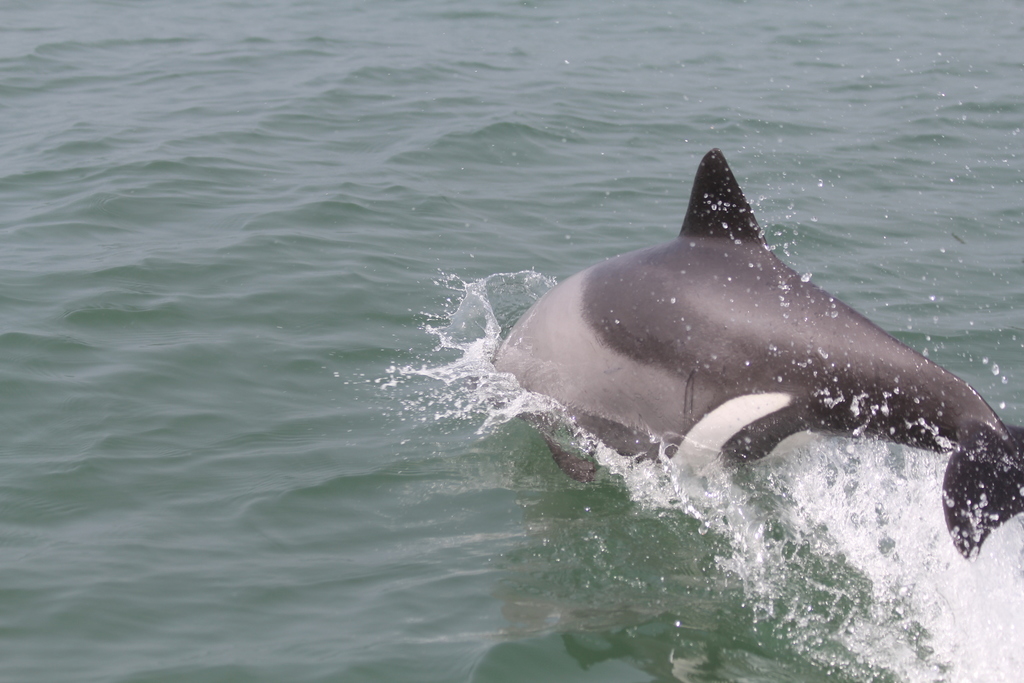 Heaviside's dolphinCephalorhynchus heavisidii
 Dusky dolphinLagenorhynchus obscurus
 Humpback whaleMegaptera novaeangliae
 Southern right whaleEubalaena australis
 Common bottlenose dolphinTursiops truncatus