
Blue-lipped sea krait
Laticauda laticaudata
A quiet blue and black banded sea krait of reefs and shore rocks. Its dark lip sets it apart from its yellow lipped cousins. Look, but never handle.
Least Concern (IUCN, 2010) means it is not at high risk of extinction worldwide today.
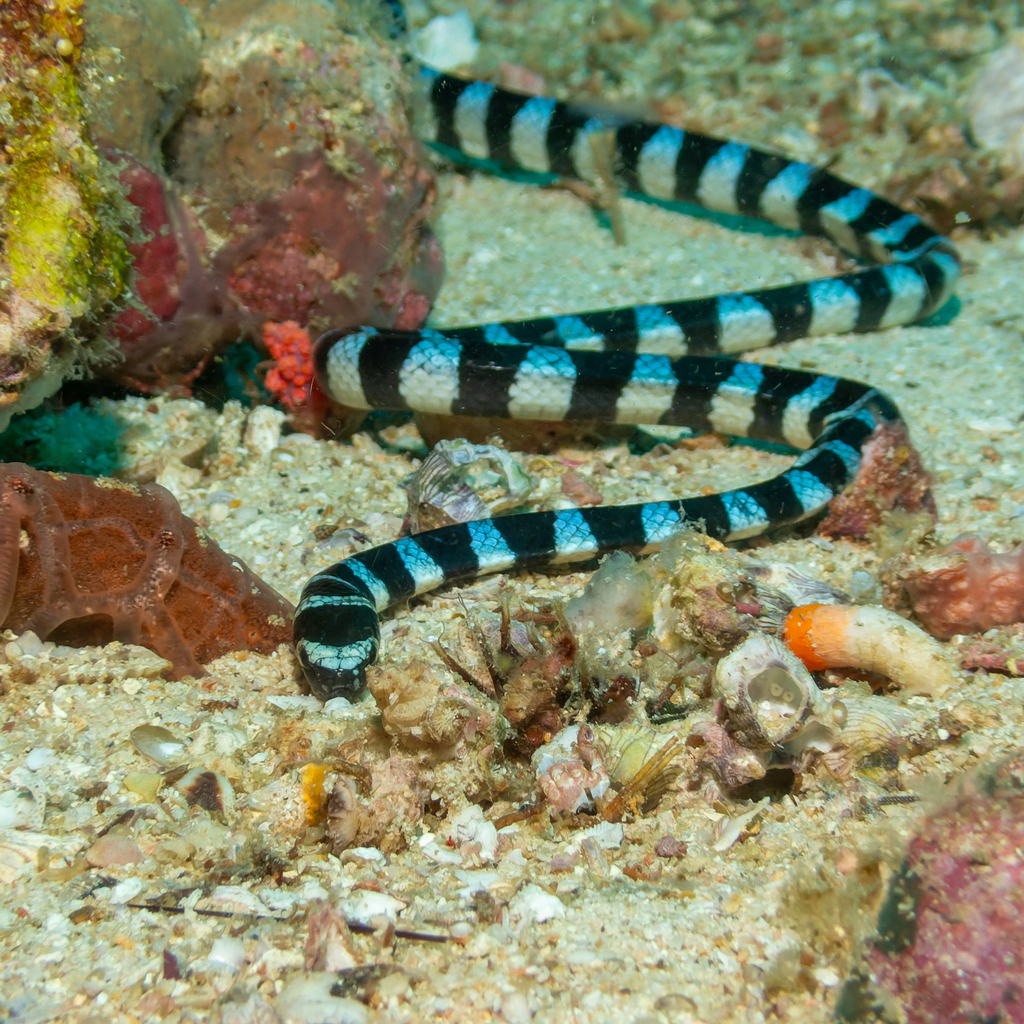
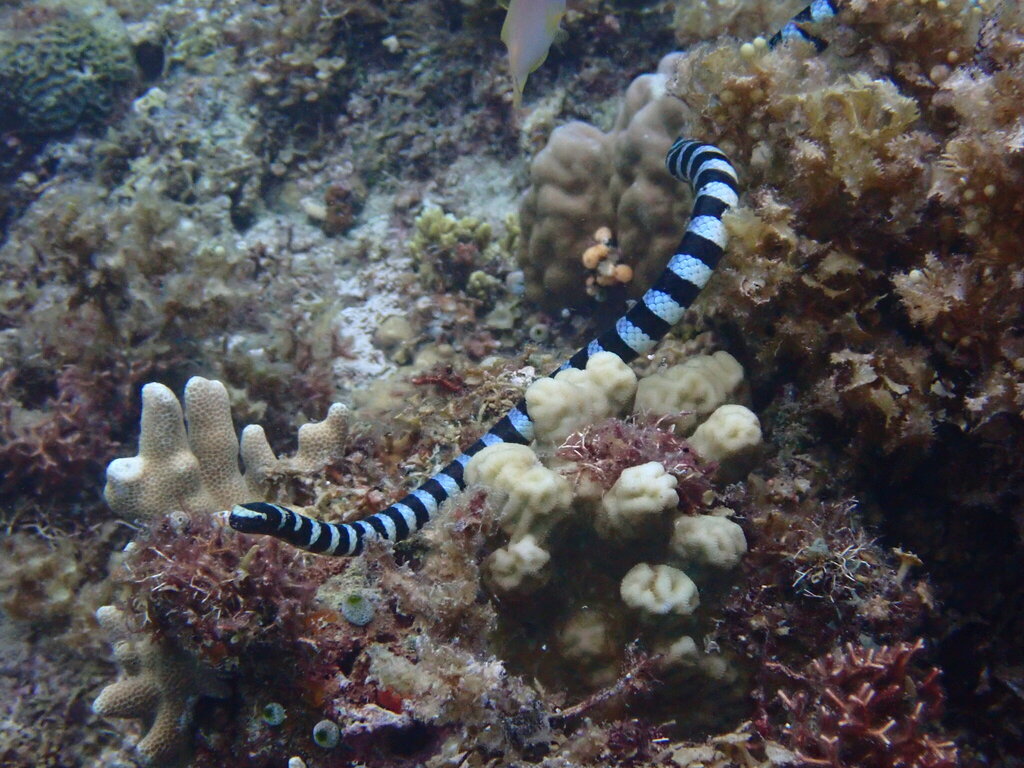
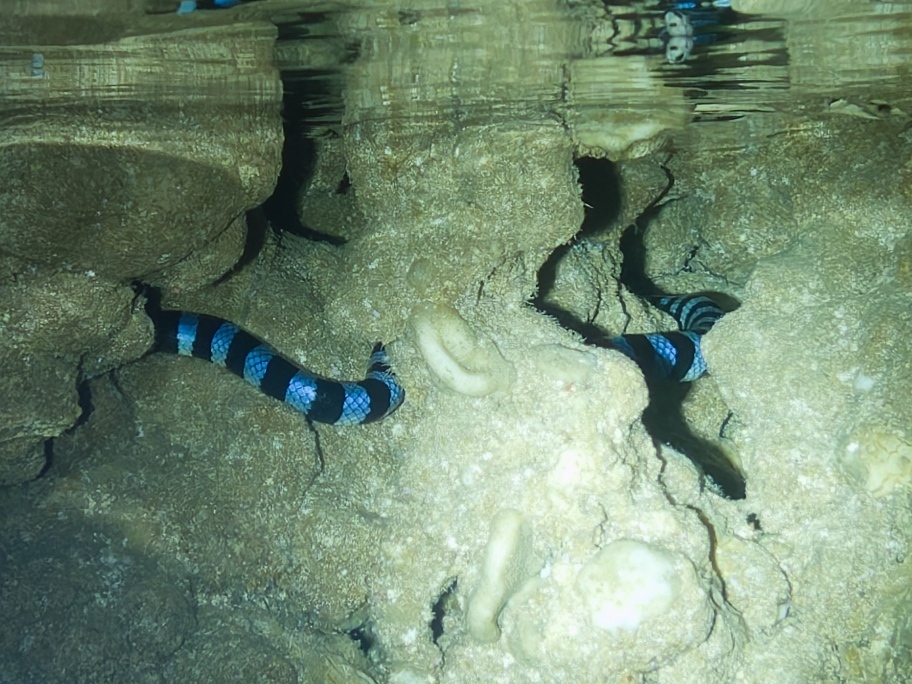
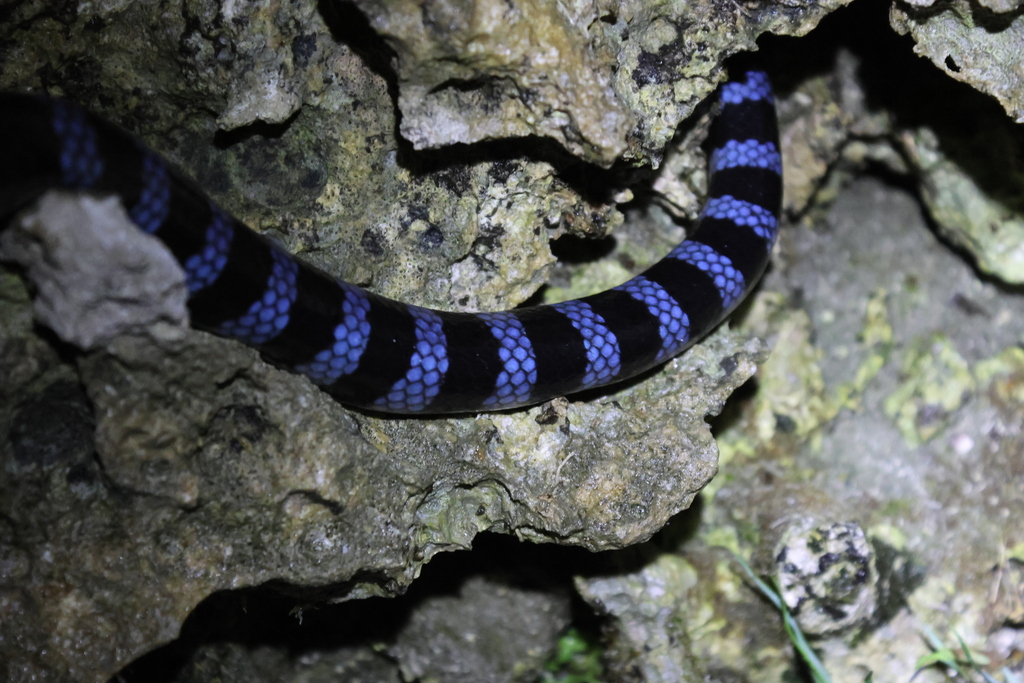
Photos show the species, not always the places on this page.
Length
Usually about 0.5 to 1.1 m (1.6 to 3.6 ft); males average about 0.9 m (3 ft) and females about 1.1 m (3.6 ft). Largest reported about 1.5 m (4.9 ft), not well verified
Weight
About 0.2 to 0.5 kg (0.4 to 1.1 lb), males lighter; one typical weight is not reliably measured
Next to a person
Usually well under a person's height; a big female reaches about waist to chest height on a standing adult. Slender, not bulky
What it eats
Mostly eels and other eel shaped fish, hunted in holes and burrows in soft bottoms and reefs. It often digests its meal on land, which can take days.
Around people
Potentially dangerous, respect
How it lives
Like other sea kraits, it hunts in the sea and then returns to land to digest, mate, shed its skin and lay eggs, often in rock cracks and caves close to the water. It is more tied to the sea than the banded sea krait and rarely goes far from the water's edge. It is highly venomous but usually calm, and bites mostly happen when people handle it.
Where it goes
Resident. Sea kraits in New Caledonia show strong, fine-scale fidelity to their own stretch of shore, and moved snakes come back to it. No long migrations are known.
We only draw a journey on the map when scientists have tracked it or clearly documented it. For this animal we have not found one yet.
Populations
In New Caledonia it shares islets with the New Caledonian sea krait, and both return to the same shore segments year after year. Researchers there suggest protecting these shore spots like turtle nesting beaches.
Meet it respectfully
Never touch, chase or handle a krait, even if it is caught in fishing gear. Never block its way to the surface, and do not follow it into caves or cracks. On beaches and islets, walk carefully, do not lift rocks where kraits rest, and do not crowd resting snakes. In Australia and New Zealand, first aid guidance says to treat a sea snake bite like a land snake bite and call emergency help.
Fun fact
Tap the bulb to light it up.
Its dark upper lip is the easiest way to tell it from the yellow lipped banded sea krait.
In New Caledonia it often hunts eels in soft bottoms, while its yellow banded neighbour hunts on the reef.
Niue's own sea krait, the katuali, is a different species.
In New Caledonia, sea kraits are so faithful to their own bit of shore that scientists asked for these spots to be protected, like the beaches where turtles nest.
Source: Brischoux, Bonnet & Pinaud, 2009, Biodiversity and Conservation
Blue-lipped sea krait in the Ocean Atlas
Places we have researched where this animal is recorded. It is never guaranteed, and some places are for watching from the boat only.
Travel with usComing soonTrusted referralExploringOn pause, story onlyEthics pass
Country colour: pink where we travel, blue where we are exploring or refer, grey for story only.
 Australia
 Fiji
Fiji India
India Indonesia
 Japan
Japan New Caledonia
 Niue
Niue Papua New Guinea
 Philippines
 Taiwan
 Thailand
 Vanuatu
Sources for this page
- Brischoux, Bonnet & Pinaud, 2009, Biodiversity and Conservation
- Gherghel et al., 2016, ZooKeys
- ANZCOR Guideline 9.4.5, First aid management of marine envenomation
- GBIF occurrence records
- NZ Herpetological Society, Laticauda laticaudata
- SeaLifeBase, Laticauda laticaudata
- Australian Government SPRAT, Laticauda laticaudata
Facts checked 26 September 2026. Photos: Unsplash licence, or Creative Commons as shown on each photo.
Work in ocean travel?
We are always happy to hear from exceptional local operators, accommodation, conservation organisations and destination experts. If your work fits responsible, small-group ocean travel, we would love to learn more.
Partner with Ocean Calling5-day freediving course in Bali
CHF 1,180