
Common stingray
Dasyatis pastinaca
A flat shape on the sand, easy to miss, and no sighting is ever a promise.
Vulnerable (IUCN) means it is at high risk of extinction in the wild, mainly because of fishing.
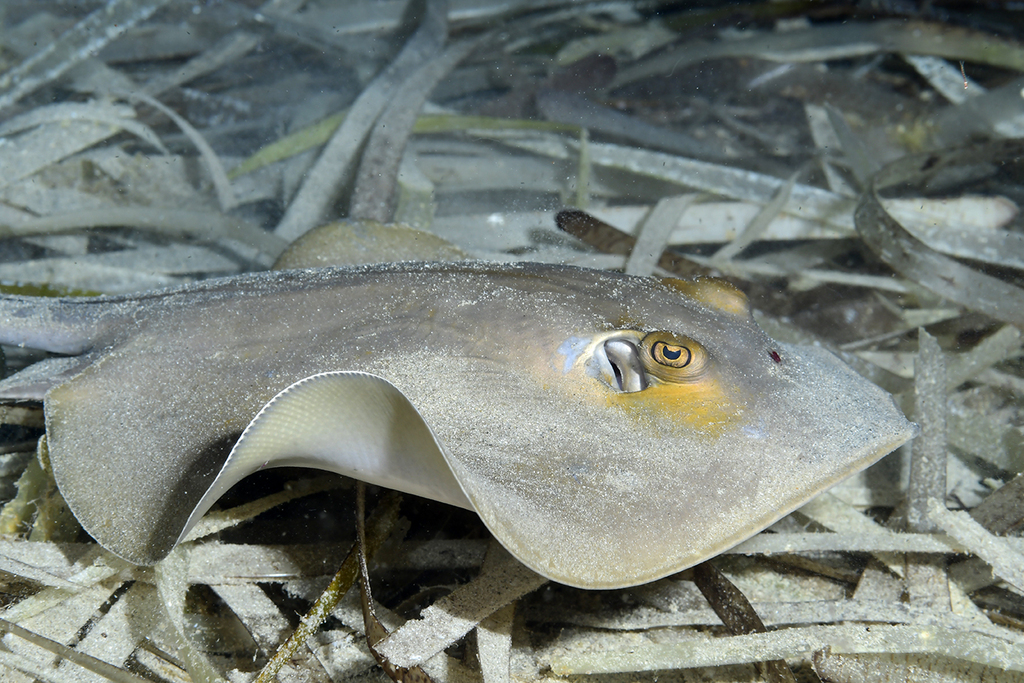
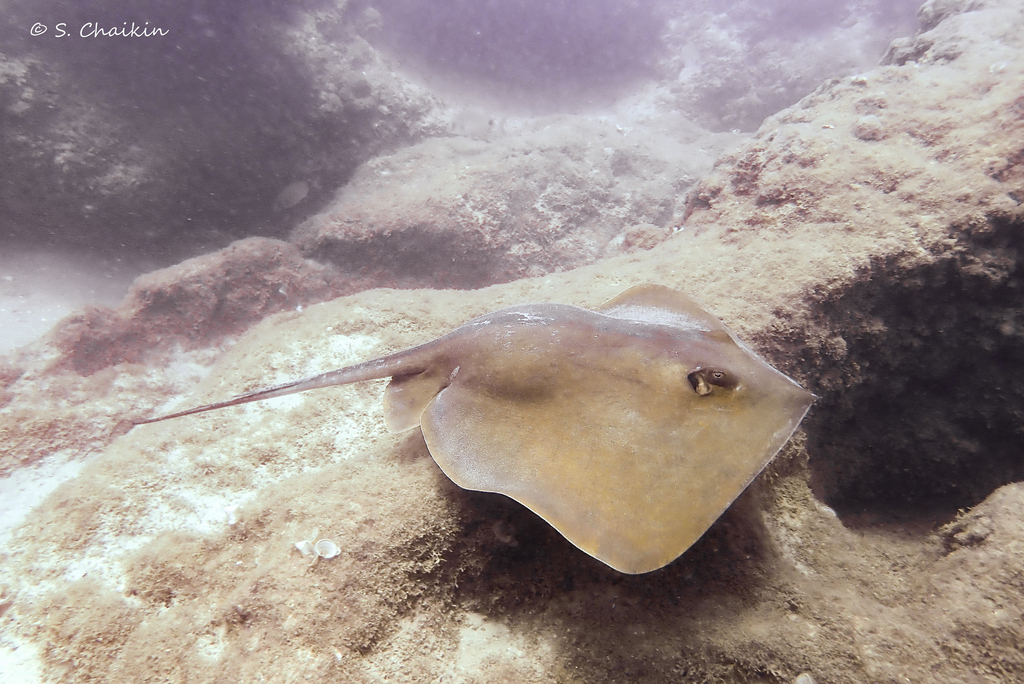
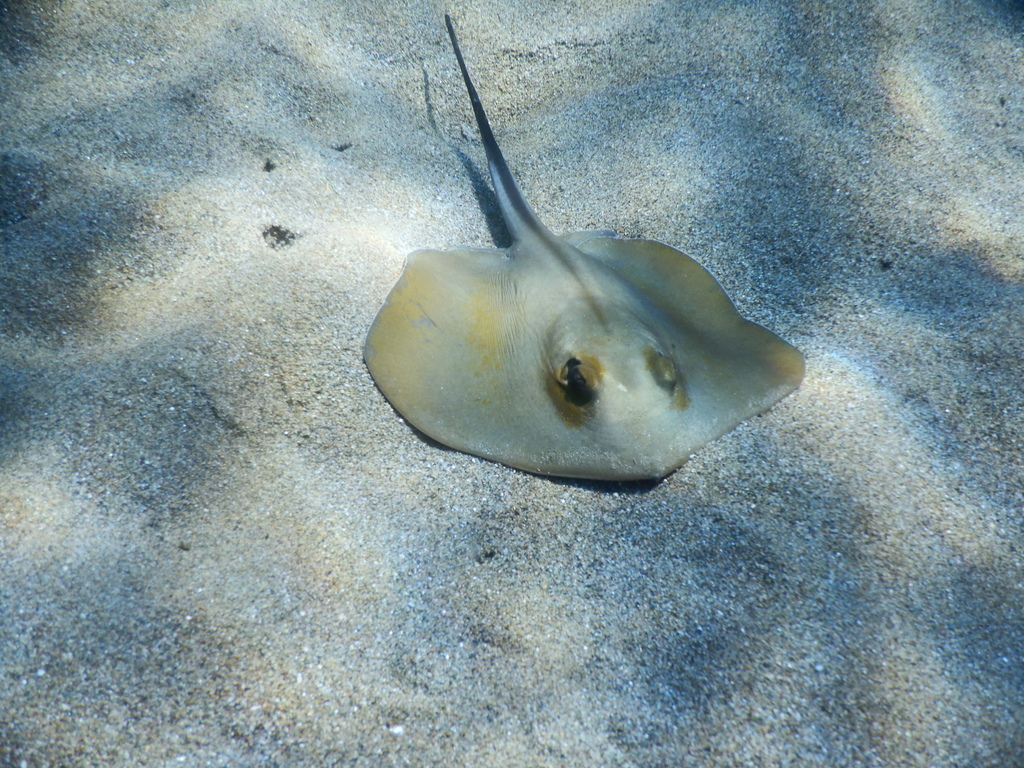
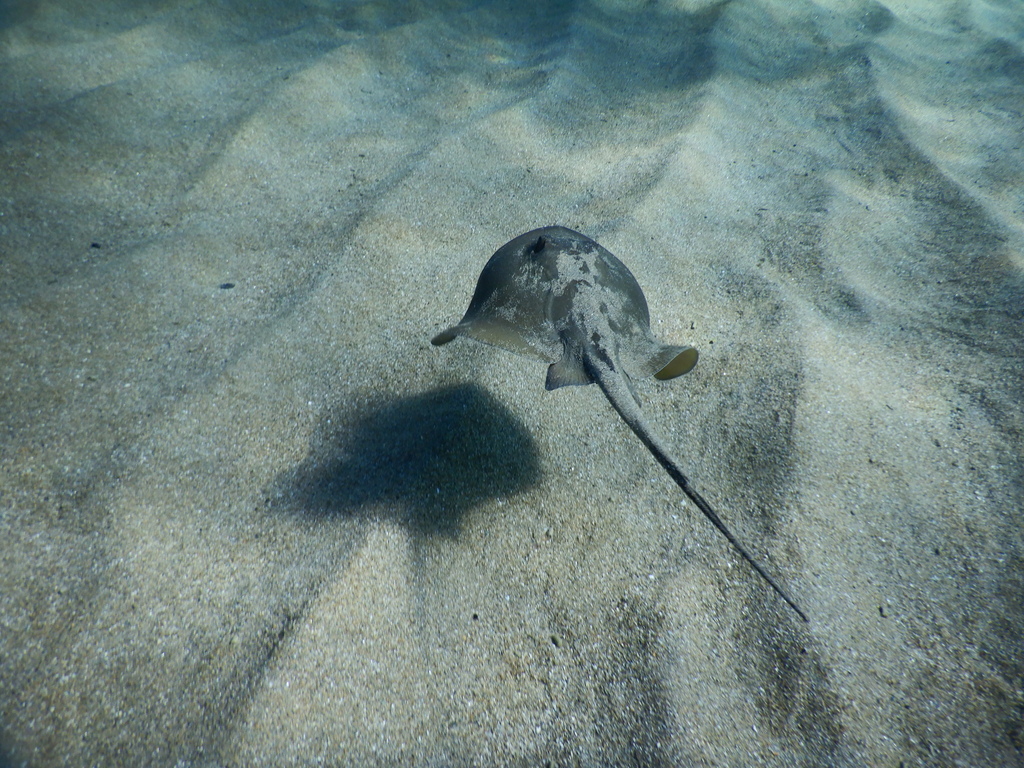
Photos show the species, not always the places on this page.
Length
Disc usually about 45 cm (18 in) across. Sources give a maximum disc width of about 68 to 75 cm (27 to 30 in), and the whole animal with its tail can reach about 2 m (6.6 ft). Sources disagree on the record size
Weight
Up to about 14.6 kg (32 lb) according to FishBase. Typical weights were not given
Next to a person
A typical disc is about as wide as an adult's shoulders. With its tail, the largest ones are about as long as an adult is tall
What it eats
Mostly animals that live on the seabed: crustaceans such as shrimps and crabs, plus molluscs, worms and small bony fishes.
Around people
Calm, give space
How it lives
The common stingray lives on sandy and muddy seabeds, from 5 to 200 m but usually at 20 to 35 m. It also enters lagoons, shallow bays and estuaries. It rests by day, often partly buried in sand, and is more active at night. Females give birth to live young after a gestation of about four months, with 4 to 7 young reported in a litter. Newborns are about 8 to 12 cm wide. The longest recorded lifespan is 10 years, from a Mediterranean population. The tail carries a venomous spine that can reach 35 cm (14 in). The spine is shed and regrown from time to time.
Where it goes
I found no tracking studies for the common stingray. It is often seen alone or in groups, and some groups are mostly one sex.
We only draw a journey on the map when scientists have tracked it or clearly documented it. For this animal we have not found one yet.
Populations
Worldwide: Vulnerable (IUCN; FishBase dates the assessment to August 2020). It lives in the northeast Atlantic, from the North Sea to Angola, and in the Mediterranean and Black Seas. It is caught as bycatch in bottom trawls, gillnets and trammel nets, and its numbers are described as dwindling across its range. Survey data in the Adriatic and Black Sea suggest a decline between 1948 and 1998, while Sardinian surveys suggest stable numbers. It is protected in five marine protected areas in the Balearic Islands. An older review (MarLIN, 2018) listed it as Near Threatened in the northeast Atlantic. I did not read a current regional assessment.
Meet it respectfully
The common stingray often lies hidden in sand, and its tail spine is venomous, so look where you step in shallow sandy water. Watch from a distance. It tends to bolt if approached too closely in daylight. Never chase, touch, feed or bait it. Rules differ by place, so follow local rules and your guide.
Fun fact
Tap the bulb to light it up.
The venomous tail spine can be up to 35 cm long, and the animal sheds and regrows it from time to time.
It rests on the seabed by day and is more active at night.
Newborns are only about 8 to 12 cm wide.
Common stingray in the Ocean Atlas
Places we have researched where this animal is recorded. It is never guaranteed, and some places are for watching from the boat only.
Travel with usComing soonTrusted referralExploringOn pause, story onlyEthics pass
Country colour: pink where we travel, blue where we are exploring or refer, grey for story only.
 Belgium
 Croatia
 France
 Greece
 Ireland
 Israel
 Italy
Italy Netherlands
 Portugal
 Spain
Spain Türkiye
 Ukraine
 United Kingdom
Sources for this page
- GBIF (IUCN Red List category), 2026
- FishBase, 2026
- Wikipedia, 2026
- MarLIN, 2018
- Sharks and Rays (website), 2026
- Shark-References, 2026
Facts checked 5 October 2026. Photos: Unsplash licence, or Creative Commons as shown on each photo.
Work in ocean travel?
We are always happy to hear from exceptional local operators, accommodation, conservation organisations and destination experts. If your work fits responsible, small-group ocean travel, we would love to learn more.
Partner with Ocean CallingGili Trawangan in 5 days
from CHF 790